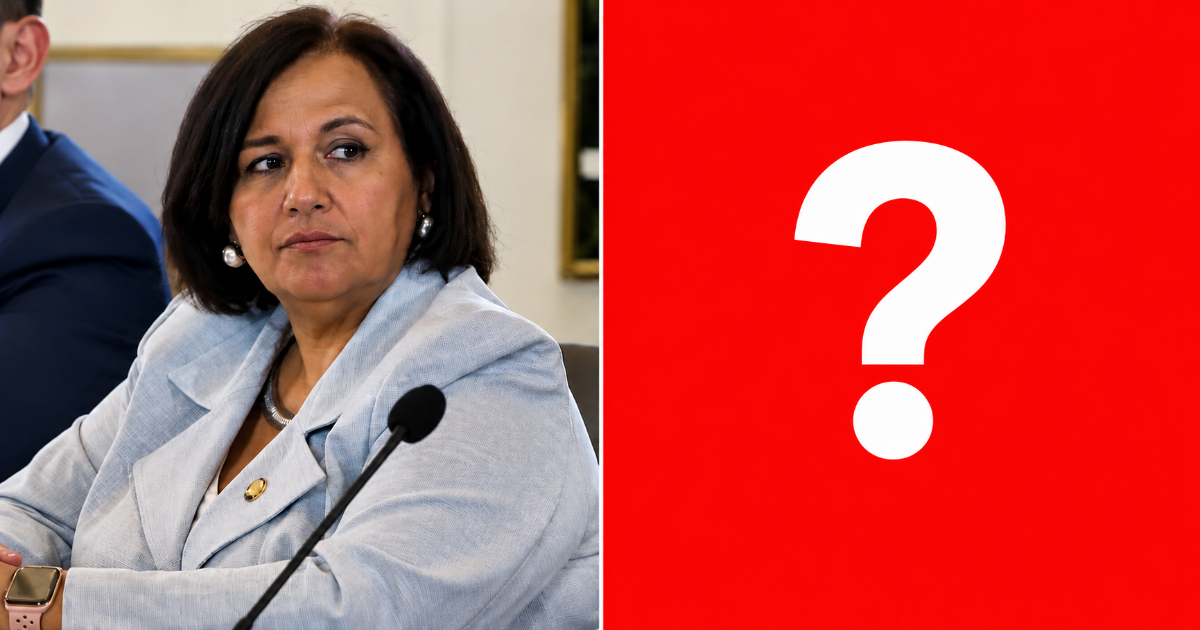
When the United States decided to promote negotiations between the government of Delcy Rodríguez and the Venezuelan opposition, it did not turn to María Corina Machado, the leader with the most popular support, but to Dinorah Figuera, a politician exiled in Spain who was working as a home caregiver.
According to NBC News, Washington contacted Figuera in April and proposed that she return to Venezuela to lead the reconciliation talks and the conditions for future democratic elections.
Figuera, president of the National Assembly elected in 2015, agreed to negotiate directly with Jorge Rodríguez, brother of the acting president and one of the principal leaders of chavismo.
Her story raises a new question in the debate about the Cuban transition.
CiberCuba has previously examined the possible emergence of a “Cuban Delcy”, a leader from within the regime capable of negotiating from the inside, and the eventual need for a “bolichico”, an economic operator who can facilitate the transformation of the business framework controlled by GAESA.
Both are hypotheses inspired by the Venezuelan precedent, not identified figures or inevitable components of a Cuban transition.
But that model raises another question: who would represent the Cuban opposition and civil society in negotiations with the regime and the United States?
Who could play that role?
A figure that deserves attention is Laritza Diversent, a lawyer and executive director of Cubalex, an organization specialized in human rights, documentation of repression, and legal assistance to its victims.
Her experience in judicial independence, political prisoners, and institutional guarantees could prove valuable in establishing the conditions for a democratic transition.
In an interview with CiberCuba in July, Diversent warned that the fall of the regime would not automatically guarantee democracy and that civil society must prepare to prevent an improvised transition or one that reproduces the mistakes of the past.
It is significant that, like Figuera, Diversent has publicly stated that she does not aspire to hold government positions, as reported by el TOQUE in February 2025. The Venezuelan leader has specifically defended the separation between those negotiating the conditions for a transition and those who aspire to govern afterwards.
Diversent, for its part, has emphasized the need to prepare civil society for that process and to ensure that reconciliation does not result in impunity.
Although their paths are different—Figuera comes from institutional politics and Diversent from human rights advocacy—they both share a view of public commitment that does not require turning participation in a transition into a personal aspiration for power.
There are also other figures with diverse trajectories and political proposals, such as Rosa María Payá, José Daniel Ferrer, or Manuel Cuesta Morúa, as well as organizations both inside and outside of Cuba that have developed initiatives for a democratic transition.
The problem is that none of them has an electoral mandate equivalent to that of the Venezuelan National Assembly of 2015, nor do they individually represent the entire Cuban opposition.
Negotiating is not the same as governing
The Venezuelan case presents a particularly interesting distinction.
Figuera has publicly acknowledged Machado's leadership and has emphasized that his mission is to pave the way toward democracy, not to compete for the presidency.
“It is not logical to be both a presidential candidate and a negotiator at the same time, because these are two different tasks,” she explained to NBC.
The leader also acknowledged the difficulties of sitting down with those responsible for a regime accused of torture and crimes against humanity. For her, reconciliation cannot mean impunity.
Her role has been made possible by support from Washington and her institutional background, but Machado's return to Venezuela, welcomed by crowds, introduces new tensions and demands regarding the negotiations.
Experience shows that the ability to negotiate, the legitimacy to represent the opposition, and political leadership do not necessarily have to rest with the same person.
In Cuba, that separation would be even more complex. Unlike Venezuela, where the opposition won national elections and maintained politically recognized structures internationally, the Cuban regime has prevented the consolidation of democratically elected opposition institutions.
There is also no figure with support comparable to that of María Corina Machado.
A "Cuban Dinorah" or a plural representation?
For now, there are no public indications that Washington is specifically looking for a figure like Figuera for Cuba. The United States maintains contacts with Havana, but the regime continues to reject any negotiations that challenge its political system.
However, if U.S. pressure policy were to succeed in opening negotiations for a transition, the issue of representation would inevitably arise.
Should Washington choose an interlocutor, as it did in Venezuela, or should it be up to the Cuban opposition to agree beforehand on who can negotiate on their behalf?
One possible formula would be a plural representation that brings together political leaders, representatives from civic organizations, specialists in transitional justice, and voices from the opposition within the island.
Figures like Diversent could help establish guarantees for the release of political prisoners, the restoration of rights, judicial independence, and the necessary justice mechanisms to prevent a negotiated reconciliation from turning into impunity.
The Venezuelan precedent offers possibilities, but also warnings. That the United States recognizes certain interlocutors does not mean that they automatically possess the legitimacy to represent an entire society.
And a negotiation capable of facilitating the end of a dictatorship does not, by itself, guarantee that those who wielded power will accept building a democracy.
The question of a potential "Cuban Dinorah" is not, therefore, solely about who could sit down to negotiate with the regime, but rather on whose behalf they would do so, with what mandate, and under what guarantees.
Related videos:
Filed under: