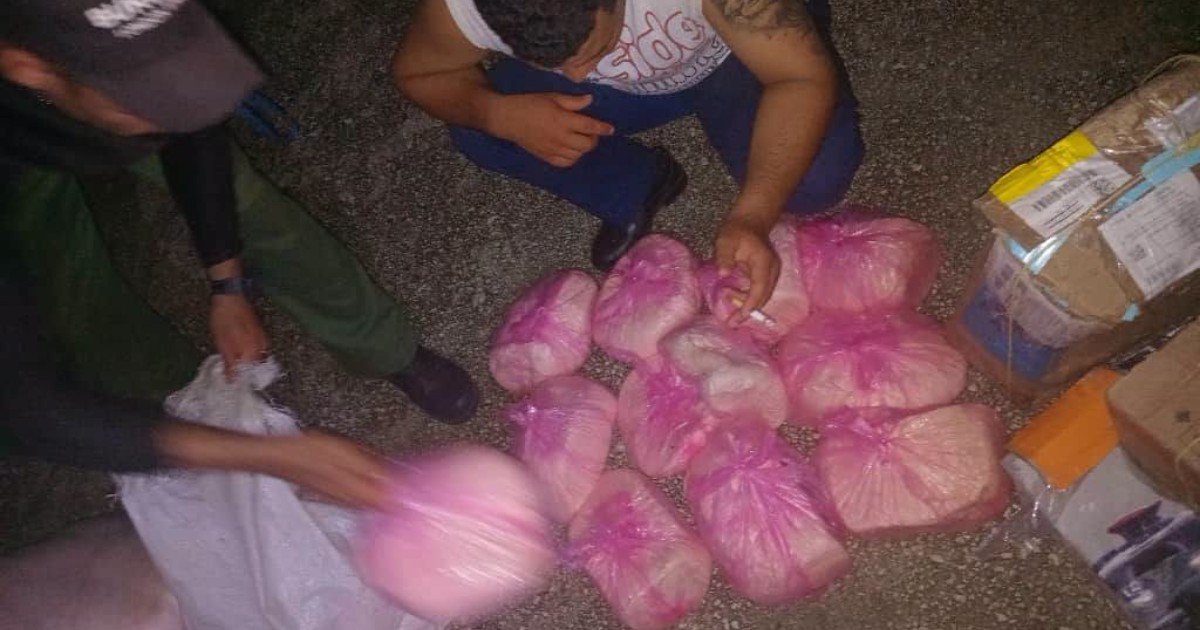
Indignation erupted on social media this Wednesday after it was revealed that agents of the National Revolutionary Police (PNR) intercepted a bus in the municipality of Chambas, in the province of Ciego de Ávila, and seized a considerable amount of homemade cheese that was en route to Havana.
"As part of the fight against illegal activities and the control of resources, law enforcement in Ciego de Ávila conducted a search of a rented bus, where a considerable amount of locally made cheese was found, intended for final distribution in the capital of the country," reported on Facebook Luis Alberto Medina Vega, a profile aligned with the regime of Havana.
"The merchandise was taken to the National Revolutionary Police (PNR) Station along with the citizens who were carrying it, until the situation is clarified and its legality is determined," added Medina, who describes himself as "a faithful defender of the principles, values, and achievements of the Cuban Revolution."
The reaction of Cubans in the comments was immediate and predominantly critical.
"What is the name of the crime?" asked one of the first commentators, a question that became the recurring theme throughout the conversation.
Another user was more explicit in defending those transporting the food: “A Cuban who spends his money on buying a product to resell it for a little profit, when we all know that salaries don't cover anything. They are not stealing from anyone; they are just creatively resisting.”
Several Cubans joked about the final destination of the seized goods: "The police: we already have cheese, we just need someone to pass by with coffee and we'll have a night," wrote one. Others directly asked: "So where is the cheese going to end up?"
"Damaging are the murderous assailants roaming freely in this province; one can't even go out on motorcycles, tricycles, or scooters, because you have to live in fear since they could easily kill you just to take them away," wrote a resident of Avileño, questioning why the PNR acts quickly against food transport while insecurity in Ciego de Ávila remains unaddressed.
Another user raised the same contradiction more calmly: "I'm not saying it's not illegal, as everything is in Cuba, but my question is why the same action and willingness for this is not applied to real serious crimes, like the robberies that are daily occurrences in Ciego de Ávila."
In that province, there have been frequent robberies at the Quesada intersection and home invasions reported throughout 2026.
Some comments also defended the rural producers. "Let the farmers earn a few pesos, as the State goes up to five months without paying them for the milk," wrote one user. According to a Cuban, a relative has been delivering milk to two state-owned stores for nine months and is barely paid 38 pesos per liter, with constant delays.
In March 2024, the police seized over 1,600 pounds of cheese being transported on a bus from Villa Clara to Havana, with 13 individuals detained. The pattern — local cheese, bus, route to the capital — repeats with striking regularity.
The backdrop is a food crisis that the regime itself cannot hide: Cuba imports approximately 80% of the food it consumes, and between 2018 and 2023, national milk production fell by 58%, according to official statistics compiled by the World Food Program.
"With another seizure like that, we would have solved all the problems in Cuba," one of the commentators ironically concluded, summarizing the sentiment of those who see these operations not as a solution, but as a persecution of those trying to survive.
Related videos:
Filed under: