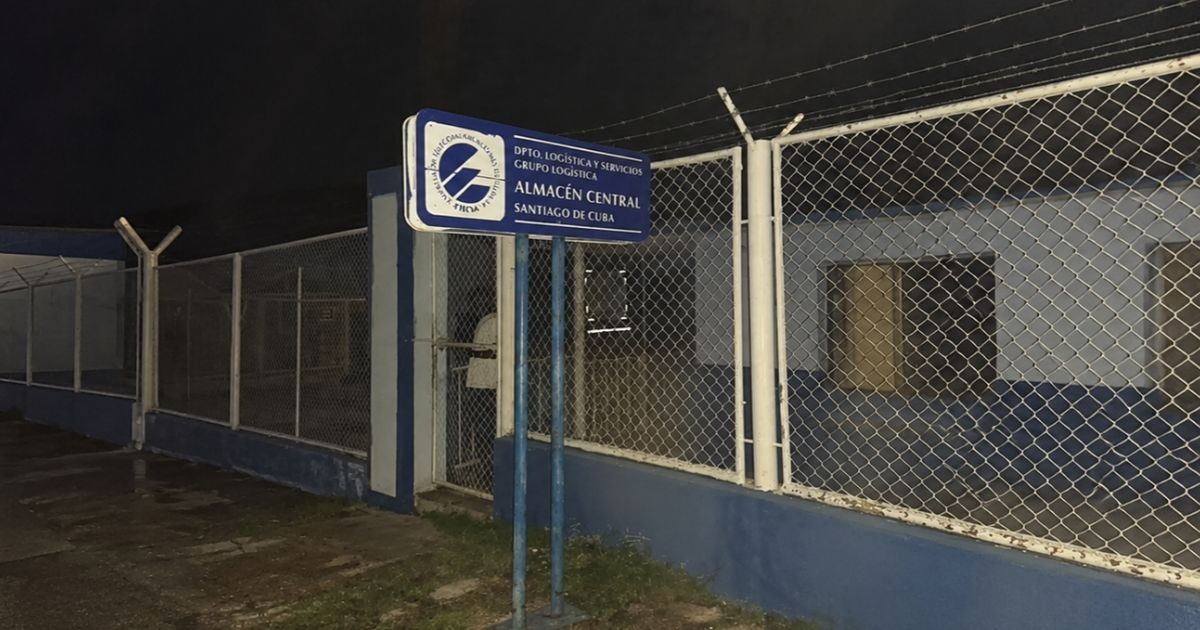
The authorities in Santiago de Cuba are resorting to nighttime surveillance with community participation to try to curb thefts against public facilities that impact essential services for the population, in a context where the Committees for the Defense of the Revolution (CDR), traditionally responsible for organizing such activities in neighborhoods, have lost prominence in these functions.
The measure reflects the concern over crimes against infrastructure in a city where, in recent months, there have been numerous reports of thefts of electrical and telecommunications equipment.
The information was disclosed this Tuesday by Yaneydis Batista Hechavarría, President of the Municipal Assembly of the People's Power of Santiago de Cuba, who announced in a Facebook post the continuation of community monitoring actions.
"As part of the participatory movement #MyNeighborhoodForTheHomeland in the municipality of #SantiagoDeCuba, nighttime surveillance actions continue to be carried out to prevent and contain the occurrence of criminal acts against infrastructures that have affected services to the people," wrote the official.
The message concluded with a phrase that summarizes the approach of the authorities to address these crimes: “Confrontation is everyone’s task”, a rhetoric that the regime traditionally uses to “motivate” people.
The publication confirms that surveillance activities are being carried out during the night, but it leaves a lot of room for doubt: what are the protected facilities or which organizations directly coordinate the patrols. It also does not clarify whether participation is voluntary, what schedules the individuals involved adhere to, or whether there are specific mechanisms in place to ensure their safety.
The initiative raises another important question: to what extent is the protection of public facilities relying on the mobilization of the residents themselves due to the inadequacy of the usual security mechanisms?
The maintenance of electrical infrastructure, telecommunications, and other essential services falls to the institutions responsible for managing them and to the authorities in charge of public safety.
Citizen collaboration can facilitate crime prevention and the identification of suspects, but it does not replace the surveillance, investigation, and response functions that must be carried out by the competent state agencies.
The call comes after a series of criminal acts against public facilities in Santiago de Cuba, particularly those related to the electrical supply and telecommunications.
One of the most striking cases occurred in August when several solar lights installed on major avenues in Santiago de Cuba were stolen just a few days after their installation.
The equipment was part of a public lighting project initiated by the authorities to keep certain streets illuminated during prolonged blackouts.
Among the areas that benefited were avenues such as Las Américas, Céspedes, Garzón, and Ferreiro, as well as the surroundings of Plaza de Marte.
However, the removal of the streetlights once again left several stretches of those roads in the dark, provoking criticism from residents who questioned the lack of surveillance.
A neighbor then reported that workers from the University of Oriente had called the police while witnessing one of the thefts, but the officers did not arrive at the scene, according to the testimony shared on social media.
Another citizen questioned how equipment placed in front of state institutions that had security could go missing.
The thefts have also directly impacted ETECSA's infrastructure, affecting hundreds of telephone and internet users.
In May, four solar panels were stolen from a telecommunications cabinet in the Flores neighborhood, which provided electrical backup to the service during blackouts.
The complaint was made by engineer Luis Enrique Torres Almarales, an employee of the state-owned company, who requested citizen assistance to recover the equipment.
In September, other solar panels of ETECSA were damaged by stones in the same neighborhood, at a facility located in the courtyard of the School of Arts and Trades.
The incident revealed that the impacts were not limited to the theft of equipment for potential resale but also included acts of vandalism that could disable facilities providing services to the community.
On September 20, another incident was reported when two solar panels were stolen from a telephone cabinet in the Santa Bárbara neighborhood, leaving nearly 900 users without energy backup.
The affected system was located on 5th Street, between Enramadas and Escario, next to the Miguel Ángel Cano primary school.
The installation allowed for the maintenance of telephony and data services during power outages, so the removal of the panels worsened the communication difficulties for the affected customers.
Electric substations have also been targets of attempted theft.
On September 2, two individuals were arrested and another two managed to escape following an attempt to steal dielectric oil at the Sevilla substation, known as "La Redonda."
According to the report from the Electric Company of Santiago de Cuba, neighbors in the area and members of the operational police guard caught the suspects trying to extract oil from one of the transformers.
On that occasion, the entity expressed gratitude for the collaboration of the residents and requested to maintain constant vigilance to prevent similar incidents.
Related videos:
Filed under: