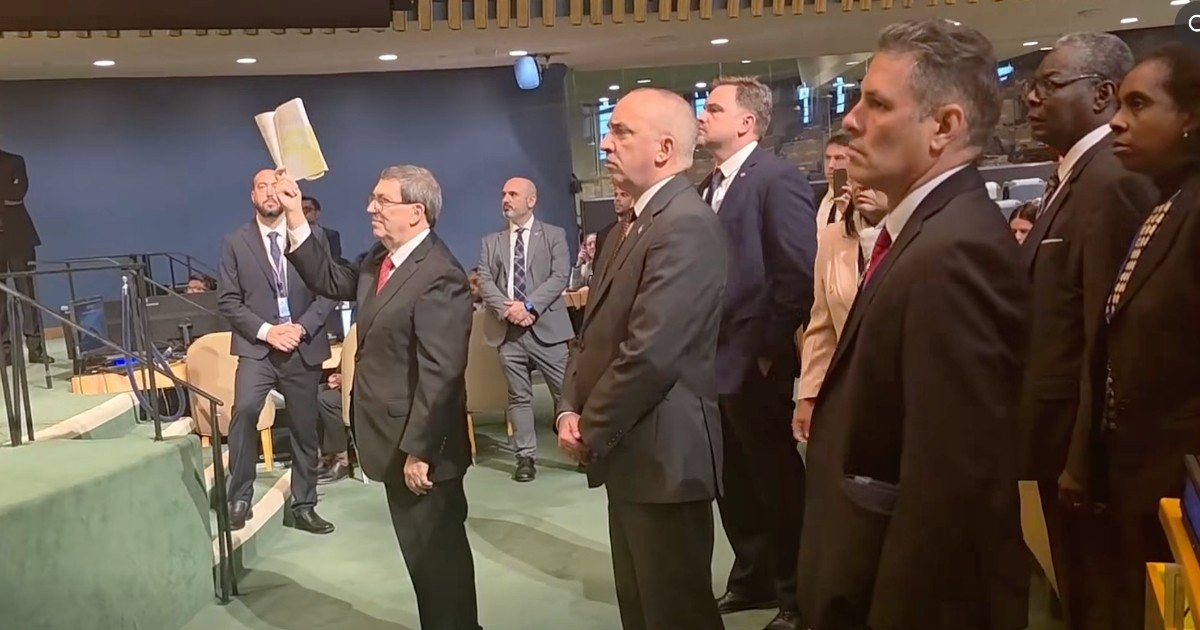
The Cuban writer Wendy Guerra published a reflection on Facebook this Wednesday regarding the altercation involving the Cuban delegation at the UN on Tuesday, in which she outlines seven decades of diplomatic confrontation by the regime to conclude that the aggression of its officials is not a sign of strength but rather an indication of weakness.
The trigger was the scene on Tuesday, October 27, at the General Assembly: Chancellor Bruno Rodríguez Parrilla rose from his seat and approached the podium while U.S. Ambassador Mike Waltz was speaking, attempting to interrupt his speech. The Cuban delegation pounded their desks and presented at least three rejected motions for order. The President of the General Assembly, Khalilur Rahman, had to briefly suspend the session. Simultaneously, Richard Tur de la Concepción, the first secretary of the Cuban mission to the UN, attempted to snatch the phone from U.S. spokesperson J. P. Freire while he was recording the confrontation.
Guerra places the episode within a long tradition of aggressive Cuban rhetoric in international forums. He recalls that Raúl Roa declared before the UN in November 1960: "If any great power is unworthy of belonging to the United Nations, it is the United States." He remembers that Ernesto Guevara, in December 1964, proclaimed from the very same podium: "Executions, yes, we have executed; we execute and will continue to execute as long as it is necessary." He also notes that Rodríguez himself described the embargo in 2022 as "a deliberate act of economic war aimed at preventing financial revenues to the country and destroying the government’s capacity."
But the writer distinguishes between that rhetoric and what happened on Tuesday: "Each of them embodied, through voice, gestures, and attire, the language of their era: previously, career diplomats who adapted to the rebellious tone of the Revolution; today, the 'masters of diplomacy,' with the mannerisms, the violence, and the dictatorial breath, vulgar, unrestrained of their time."
Guerra also draws a parallel with a domestic episode: the outburst of Culture Minister Alpidio Alonso against independent journalist Mauricio Mendoza during a peaceful protest outside the Ministry of Culture in Havana, in January 2021. For the writer, both gestures reveal the same pattern: officials who, faced with the inability to counter arguments, resort to physical violence to silence the record of their actions.
"This type of repudiation act, so undiplomatic, only highlights, here or there, the desperation of the unprepared Cuban officials, indicating that everything has gone out of control. There are no standards; there is no dignity or moderation in any sphere of the Cuban political strata," wrote Guerra.
"Why did Bruno Rodríguez have to walk to the forefront to try to interrupt the speech of the U.S. ambassador? What truth was there to stop if, supposedly, all of it was 'lies of Yankee imperialism'? Does he feel that his arguments are so fragile today?" Guerra questioned.
The response from Washington to what happened at the UN was immediate: Secretary of State Marco Rubio signed the expulsion order for Tur, who must leave the United States within 24 hours. Waltz warned that there would be consequences if anyone laid hands on an American diplomat again.
Despite the spectacle put on by Cuban diplomats at the UN, it became clear that Havana is losing support each year. The General Assembly approved this Wednesday the Cuban resolution against the embargo with only 130 votes in favor, compared to 165 in 2025 and 187 in 2024, marking the worst outcome since Cuba began advocating for this resolution in 1992.
Related videos:
Filed under: