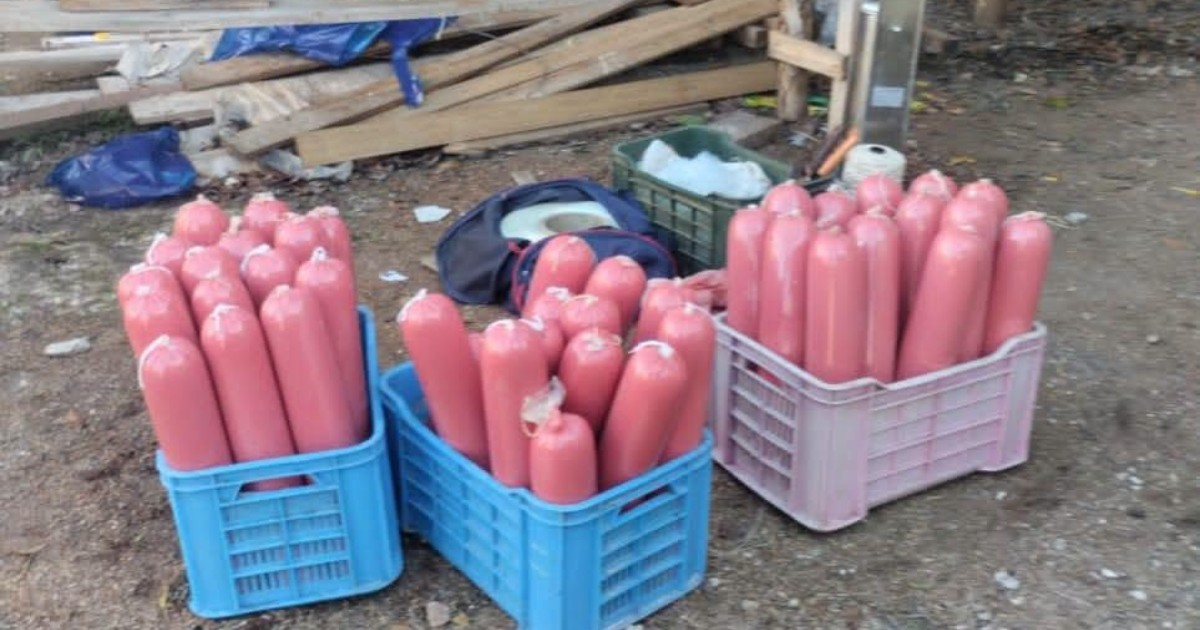
Cuban authorities dismantled a suspected illegal sausage factory on Wednesday located in the center of Ciego de Ávila, according to a Facebook post by Luis Alberto Medina Vega, a regime-affiliated profile that uses the hashtags #MinitCiegodeÁvila and #CreoEnTi. The announcement sparked a public debate that blends health concerns with frustration over food shortages and obstacles to entrepreneurship.
The operation took place just a day after the same profile reported on the seizure of artisanal cheese on a bus intercepted in Chambas, also in Ciego de Ávila, en route to Havana. The coincidence did not go unnoticed: a Cuban woman commented sarcastically on the coincidence: “They already have the ham and the cheese... yesterday the cheese and today the ham, what an incredibly casual coincidence."
Medina Vega justified the operation due to alleged Public Health issues: "Health is not a game, and the irresponsibility of a few can affect many." He also acknowledged that "we support the entrepreneurship of our citizens, but everything must be done in accordance with the established legal framework." The publication did not specify the address of the property, the number of confiscated products, the authorities involved, whether there were any arrests, or if any sanctions were imposed. It also did not provide health analyses confirming contamination in the sausages.
The circulated photographs show plastic boxes—two blue and one pink—containing pink cylindrical pieces resembling sausages, artisanal machinery with rusted pulleys, and a person next to large metal containers emitting steam, all set in a rustic environment.
A significant portion of the reactions questioned the closure of an activity that, amidst the food crisis, supplies the population. "Those who make sausages know the proportions of all the ingredients, including curing salts and seasonings, and they don’t work with spoiled meats because they realize it’s for their family and the community. What they do is help us a little more," wrote a user.
Others pointed to the structural barriers that push producers into informality: "If they didn't impose so many obstacles and instead of dismantling things, they provided the necessary permits, of course with all the required hygiene and supervised by MINSAP, things would be different, and food wouldn't be so expensive and difficult to find."
There were also criticisms regarding police priorities. "Why are there so many armed robberies unresolved? Where are the famous law enforcement forces?" asked an internet user, referring to the insecurity recorded in the province during 2026.
Voices supporting health controls were not absent, although with some nuances. "We are not against people prospering, but from that to it becoming a health problem: NO," pointed out one user. Another commenter suggested that "the production of food must be verified for the sake of health, but illegality is sometimes accompanied by high taxes on self-employed workers, the harassment of opportunistic inspectors, and an endless number of obstacles created by institutions and the government."
Cuba depends on imports for between 70% and 80% of its food consumption, and national production plummeted between 2018 and 2023: pork decreased by 95%, rice by 87%, and beans by 70%, according to official statistics gathered by the World Food Program. Year-on-year food inflation reached 42.66% in September 2026.
So far, the authorities have not independently confirmed the details of the operation in Ciego de Ávila, nor the final destination of the seized products.
Related videos:
Filed under: