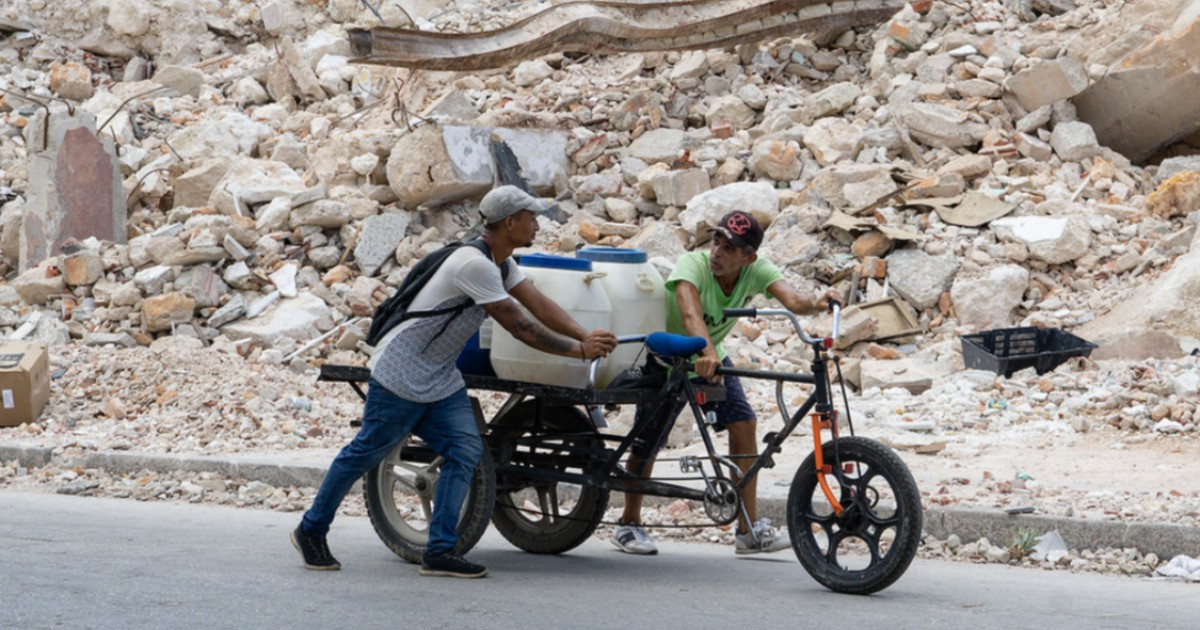
Cuba imports around 80% of the food it consumes and allocates approximately 2.4 billion dollars a year to purchase it from abroad, while basic productions such as pork, rice, beans, and milk have collapsed.
The question is why a country with arable land, favorable climate, and access to the sea fails to produce enough food for its population.
A comprehensive report published on August 25 by BBC News Mundo, authored by Atahualpa Amerise, examines the historical and current causes of this paradox.
The report does not attribute the crisis to a single factor: it acknowledges the economic impact of U.S. sanctions, but it also includes strong criticisms from experts regarding the internal functioning of the Cuban agricultural model.
The figures illustrate the extent of the deterioration. Between 2018 and 2023, the production of pork decreased by 95%, rice by 87%, beans by 70%, and milk by 58%, according to official statistics collected by the World Food Programme (WFP) and cited by BBC.
The data on foreign dependency also appears in the Strategic Plan for Cuba 2026-2030 from the World Food Programme.
The United Nations agency estimates that the island imports approximately four-fifths of its food supply, at an annual cost of about 2.4 billion dollars, and warns that the average household diet is inadequate in energy, diversity, and nutritional quality.
The situation is reflected in depleted markets and a ration book that has not sufficiently met food needs for years.
Cuba's high dependence on food imports has also been highlighted in the debate surrounding the U.S. embargo and the internal production crisis.
To explain how this situation came about, BBC refers to Cuba's historical dependence on sugar.
For decades, the island focused a significant part of its economy on producing and exporting that product to finance the purchase of other goods abroad, including food.
This does not mean that before 1959 Cuba did not produce food. According to data from the United States Department of Agriculture cited in the report, between 1955 and 1959 an average of 183,000 tons of beef, 39,000 tons of pork, and 775,000 tons of milk were produced annually.
At that time, national rice production accounted for nearly half of the availability for domestic consumption.
The commercial dependency also existed: In 1958, the United States provided 86% of Cuba's agricultural imports.
After the triumph of the Revolution, the Soviet Union became the main economic partner, purchasing sugar under preferential conditions and supplying oil, fertilizers, machinery, and other resources.
Fidel Castro's government initially tried to diversify agriculture but later refocused significant resources on sugar.
The 1970 sugar harvest reached about 8.5 million tons, falling short of the political target of ten million, and during the following decades, the agricultural sector operated with a high dependence on fuels, fertilizers, machinery, and other inputs from the socialist bloc.
The collapse of the Soviet Union exposed the fragility of that system. Cuba lost both privileged trade conditions for sugar and a decisive source of agricultural inputs.
The sugar industry never returned to the levels seen in the late 1980s. From about eight million tons in 1989, production plummeted to less than 150,000 tons in the 2024-2025 harvest, marking the worst outcome in over a century. The last harvest was lower than the production recorded in 1899.
However, one of the central questions in the analysis by BBC is why, more than three decades after the disappearance of the USSR, Cuba still has not managed to reorganize its agriculture to sustainably increase food production.
The Cuban economist Pável Vidal points to the functioning of the system itself. Among the problems he identifies are the economic controls, the lack of market mechanisms, and the role of Acopio, which is responsible for purchasing part of the production intended for the State.
According to what was explained to BBC, producers may be forced to sell at very low prices, sometimes below their costs, while the promised supplies do not always arrive and state-owned enterprises accumulate significant debts with farmers.
Unpaid debts are not a theoretical problem: Cuban producers have reported delays of months in receiving payment for goods that have already been delivered.
The Havana Acopio agency accumulated debts of nearly 200 million pesos to producers, while Río Zaza accumulated over 150 million in debts with suppliers in Sancti Spíritus.
Another fact is particularly revealing. According to official figures cited by BBC, 79% of agricultural land is state-owned, compared to 13% owned by private farmers and 8% by cooperatives.
However, more than 80% of food production comes precisely from the peasant and cooperative sector, which also works on state-owned lands provided in usufruct.
The report also recalls that during the Special Period, farmers were allowed to market certain surpluses after fulfilling their state obligations.
Non-sugar production subsequently increased, an experience that agricultural economist William A. Messina from the University of Florida uses to highlight the importance of incentives for producers.
The paradox also extends to fishing. Despite being surrounded by the sea, Cuba currently obtains few fishing resources for daily sustenance.
BBC attributes the decline of the former state fleet to a lack of investment, fuel, and maintenance, and also points out the existing restrictions on the private use of vessels.
In response to the drop in productivity, the Government has announced successive reforms. In June, it presented a package of 176 economic and social transformations.
For agriculture, among other measures, the expansion of usufruct, greater access for private actors and cooperatives, opportunities for foreign trade, and changes in marketing mechanisms are being considered.
Amid these announcements, Miguel Díaz-Canel acknowledged that there are internal obstacles that cannot be attributed to the embargo, mentioning bureaucracy, sluggishness, regulations that hinder production, and postponed decisions.
In that same context, the drops of 95% in pork, 87% in rice, 70% in beans, and 58% in milk were made public again.
The decapitalization of the countryside represents another obstacle. BBC highlights shortages of machinery, fuel, fertilizers, seeds, irrigation systems, transportation, and refrigeration.
In 2024, the Ministry of Agriculture acknowledged that the sector received barely 10% of the fuel it needed and that only 7% of the agricultural land was irrigated.
This is supplemented by investment priorities. In 2024, 37.4% of state investment was concentrated in activities related to tourism and hospitality, compared to approximately 2.7% allocated to agriculture, according to official data collected by BBC.
The difference has also been questioned by Cuban economists. In 2024, tourist investment exceeded agricultural investment by about 14 times, according to data from the National Office of Statistics and Information.
BBC highlights the productive potential through a Vietnamese rice project in Pinar del Río that achieved seven tons per hectare in 2025, compared to a local average yield of 1.6 tons.
The contrast suggests that even under the current Cuban conditions, there are considerable margins to raise productivity through investment, technology, and different management methods.
The experience of the Vietnamese company Agri-VMA in Los Palacios had already demonstrated yields far superior to the national average.
A previous report indicated an average of 5.21 tons per hectare over several campaigns, with yields of up to nine tons per hectare in more recent harvests, compared to a national average of 1.7 tons recorded in 2024.
The United States embargo is also part of the explanation. BBC notes that the sanctions hinder Cuba's access to financing, supplies, machinery, and technology, and that banking restrictions increase the cost of international operations.
Although the island can purchase food from the United States, it must do so under restrictive conditions and with limited access to credit.
The impact of external restrictions, therefore, is not dismissed by the consulted experts. Messina argues that the embargo and sanctions have economic consequences, but believes that “the fundamental problem is the structure of the system”.
The demographic crisis adds another difficulty. BBC points out that more than two million Cubans have emigrated in recent years, many of them young, reducing the availability of labor in a sector that also lacks sufficient mechanization.
Hurricanes, droughts, and power outages create a scenario where irrigation, cooling, and food transportation may come to a halt.
The problem is already affecting the entire food supply chain. A recent analysis from Food Monitor Program warned that Cuba is losing its ability to produce, import, preserve, transport, and distribute food, a situation summarized in the phrase: "The chain is broken."
BBC stated that it contacted the Cuban government to obtain its position on the issues addressed in the report, but did not receive a response.
Related videos:
Filed under: