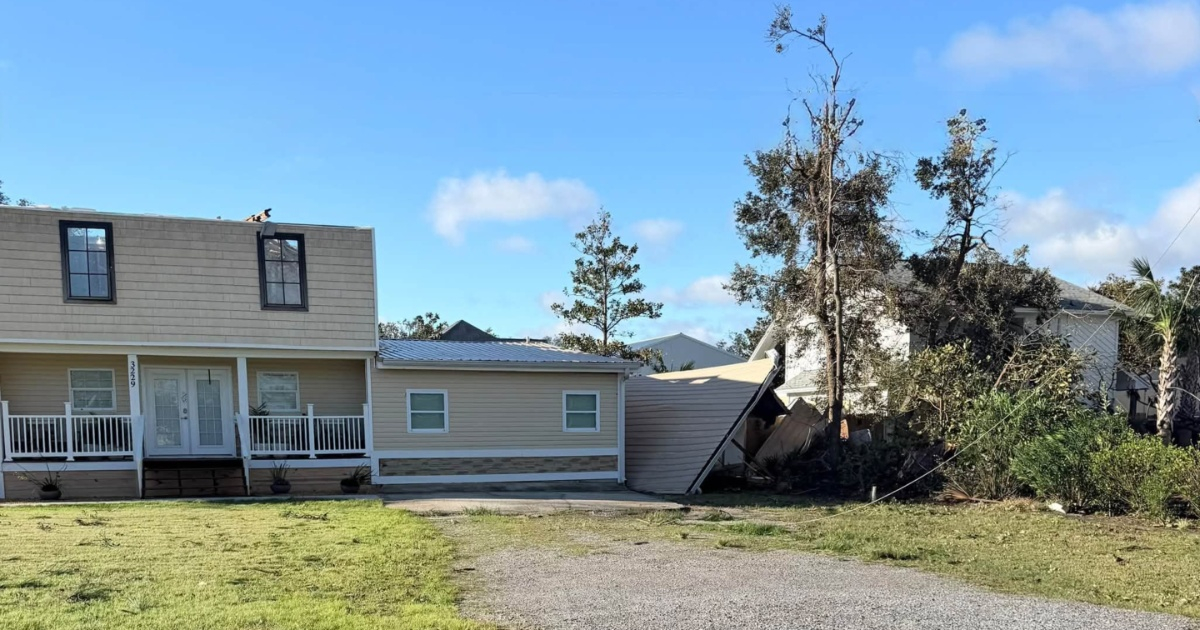
President Donald Trump signed the major disaster declaration DR-4955-FL for Florida on Tuesday following Hurricane Isaias, activating federal recovery funds for 15 counties in the northwestern part of the state, as confirmed by the official records of the Federal Emergency Management Agency (FEMA), updated this Wednesday.
The statement exclusively covers Public Assistance (PA, for its acronym in English), a mechanism that reimburses local and state governments as well as certain nonprofit organizations for debris removal costs, emergency protective measures, and repair of damaged infrastructure — it does not involve direct payments to families or residents.
The counties included in the designation are Bay, Calhoun, Escambia, Franklin, Gadsden, Gulf, Holmes, Jackson, Jefferson, Liberty, Okaloosa, Santa Rosa, Wakulla, Walton, and Washington, all located in northwest Florida.
What has not yet been approved is equally relevant for thousands of affected individuals: the Individual Assistance (IA), which would directly benefit households with damage not covered by insurance, is still under review.
Walton County confirmed on Wednesday in an official statement: "Individual Assistance for residents and households is still under review. Risk Mitigation assistance is also under review," stated the Walton Office of Emergency Management.
Florida requested Individual Assistance for eight of the 15 designated counties: Bay, Escambia, Gulf, Holmes, Okaloosa, Santa Rosa, Walton, and Washington, where approximately 1,000 homes were preliminarily identified as damaged.
While that review continues, affected residents still cannot apply for FEMA Individual Assistance for damages from Isaias. If the program is approved and registration opens, they will be able to submit their applications through DisasterAssistance.gov or by calling FEMA's hotline
Isaiah made landfall near Destin on the night of October 9 as a Category 2 hurricane, with sustained winds of 105 mph (169 km/h).
The impact was devastating in the Panhandle: about 448,000 homes and businesses were left without electricity in Florida, with Santa Rosa reporting 90% of its customers without service and Escambia 75%. The hurricane resulted in six fatalities in Florida, including direct victims and other deaths related to its subsequent consequences, as confirmed by Governor Ron DeSantis on October 13.
The insured losses in the state reached approximately 582 million dollars, with about 55,000 claims filed with insurers, according to the Florida Office of Insurance Regulation. The state requested nearly 237 million dollars from FEMA to cover public infrastructure, debris removal, and emergency measures.
The governor Ron DeSantis had formally submitted the request for a major disaster declaration on October 15—twelve days before its approval—after declaring a state of emergency on October 6 through Executive Order 26-202.
It is worth noting that Miami-Dade and Broward, where a significant portion of the Cuban community in Florida resides, are not included in any of the designations of the DR-4955-FL declaration.
The Walton Emergency Management Office warned that "additional assistance programs and county designations may be approved as damage assessments continue," so affected residents should stay alert to official communication channels for potential updates.
Related videos:
Filed under: