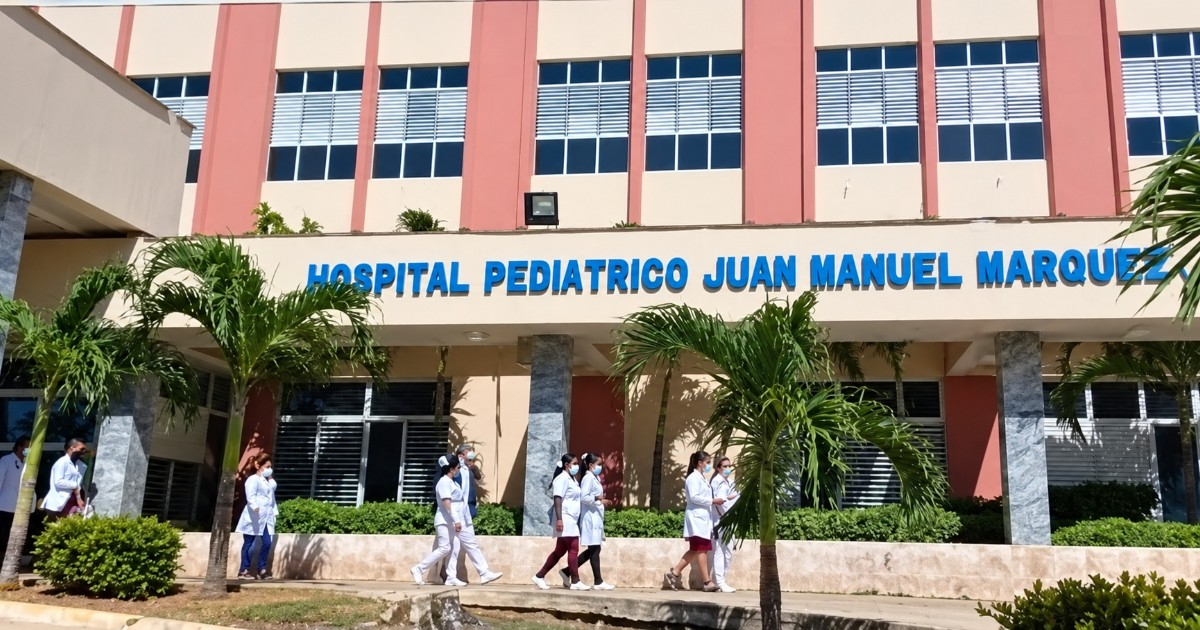
The Juan Manuel Márquez Teaching Pediatric Hospital in Havana removed the oxygen saturation and heart rate monitors from Luisi, an 11-year-old boy with cerebral palsy who has been hospitalized in the center's therapy room for almost a year, relying on mechanical ventilation. The justification given to his family was that the equipment was needed to care for new admissions, as reported by El Toque.
The same equipment was removed from another child admitted to a nearby bed in the same room. Luisi's mother, Rachel Rodríguez González, described the episode in words that reflect the desperation of many Cuban families trapped in a collapsing healthcare system.
"My son, a child with a disability, has been hospitalized for almost a year, fighting every day, and yesterday we experienced a moment of absolute terror," she wrote on her Facebook profile.
Rachel also questioned the lack of basic resources: "Where are the resources, the equipment, and the humanity? What is happening in our country that the essentials needed to save the life of a child in dire need are glaringly absent? A monitor is not a luxury; it is the artificial heartbeat that allows us to know our children are still alive."
Luisi was born with cerebral palsy and never developed motor skills such as walking, sitting, or speaking. Doctors performed a tracheotomy to aid his breathing through a cannula connected to a mechanical ventilator. During his hospitalization, he suffered from recurrent pneumonias, and at one point, one of his lungs collapsed.
The case of this child was documented for the first time in July 2026, when his family attempted to secure a solar kit from the East Havana government so that Luisi could return home and use a mechanical ventilator donated by another family. Government assistance never arrived. The hospital also did not have the gastric valve necessary for his care, and the family had to purchase it on the informal market for about 150 dollars.
Miguel Ángel Ruano Sánchez, a Cuban doctor exiled in Colombia and president of the Cuban Free Medical Guild, has repeatedly pointed out the deterioration of the healthcare system on the Island. A specialist in Physical Medicine and Neurorehabilitation with a doctorate in Neurosciences, Ruano Sánchez demanded an urgent response from Cuban authorities in November 2025 regarding the clinical, hygienic, and epidemiological decline in the country.
The case of Luisi is not an isolated incident. Just two days before this report, nurses from the Holguín Regional Center for Neonatal Surgery had to use manual resuscitators to keep newborns alive after power outages stopped the mechanical ventilators.
The crisis is spreading throughout the Cuban pediatric system: in April 2026, only 29% of the medications on the national essential drugs list were available, and in August, authorities acknowledged 98,500 patients on the surgical waiting list, including about 12,000 children.
In June, a Cuban mother reported that in order to discharge her baby she needed to have a photovoltaic system, air conditioning, a suction machine for secretions, and an emergency oxygen cylinder, conditions that are impossible to meet for most Cuban families.
The Juan Manuel Márquez Hospital is officially presented by the regime as a national referral center for neurological diseases and complex pediatric conditions in Havana, a distinction that contrasts starkly with the reality faced by the families of its most vulnerable patients.
Related videos:
Filed under: