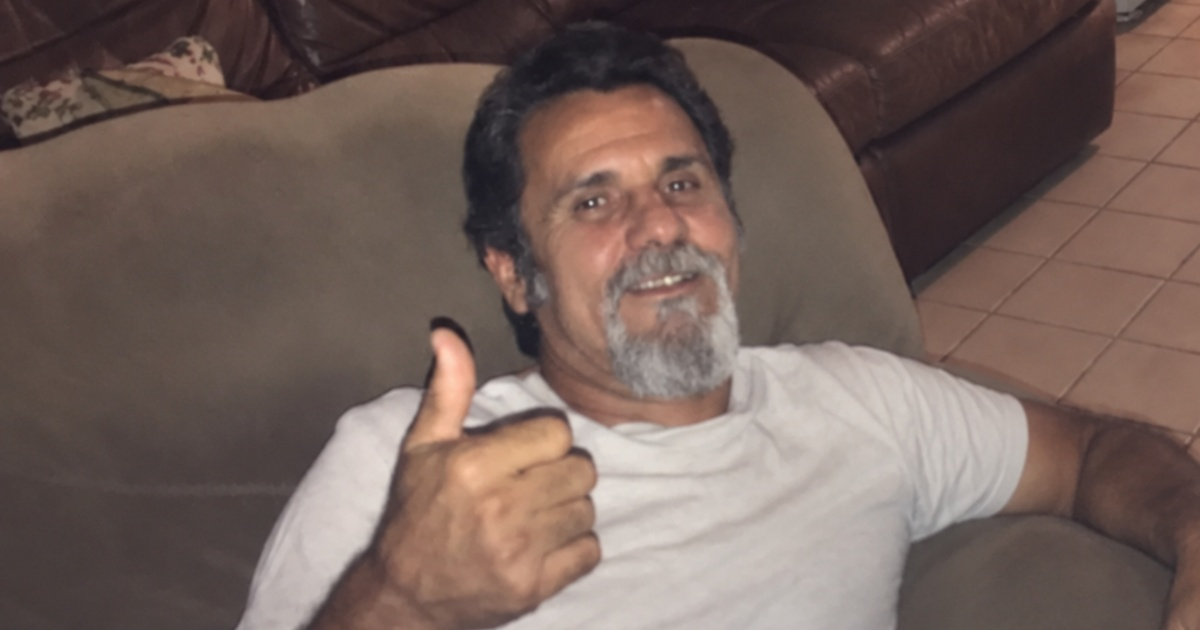
Gustavo Rivero Napoles, a 65-year-old Cuban who spent almost his entire life in Hialeah, passed away on Sunday, October 25, in the intensive care unit of a hospital in California after approximately five months in immigration custody, according to an investigation by the Miami Herald based on interviews with the victim's family.
The government has not officially registered his death because Immigration and Customs Enforcement (ICE) formally released him on October 23—the same day he was transferred to the ICU—when his family asserts that he was already unconscious, about 48 hours before he passed away.
"She died being treated like a dog," stated her niece, Angelina Rivero, 33, to the Miami Herald.
Rivero Napoles had been diagnosed with stage 4 liver cancer before being detained and was using a wheelchair because the illness caused him severe inflammation in his legs.
He emigrated from Cuba to the United States around 1970, when he was eight years old, and obtained permanent residency along with other Cubans who arrived during that time.
His family had been demanding his release for months, convinced that he was not receiving proper medication or treatment.
"This is the story of Gustavo."
According to a Facebook message from one of the deceased's sisters, Carolina Rivero, during the last year of his life, Gustavo violated his probation and was sent to prison, but a judge granted him release for humanitarian reasons in June, so he could spend his final months at home with his family.
The day before he was released, ICE intercepted and detained him.
"No had any deportation order. There was absolutely no legal or logical reason for his detention. He spent three months in a facility in Florida before being moved to the California City Immigration Detention Center. He called every day, crying in agony from the pain and pleading for medical attention," wrote Carolina Rivero.
Rivero Napoles himself told them over the phone that sometimes he would lie on the floor of his cell screaming, and that a doctor at the detention center had told him, "All of you illegal immigrants just want drugs" when he asked for his medication.
The family informed the Miami Herald that Gustavo was admitted to the hospital on October 20. Two days later, his sister contacted ICE officials, who confirmed that he was still in custody but refused to provide information about his condition.
On October 23, he was transferred to the ICU, and on that same day, the agency formally released him: where his signature was required, an agent noted "refuses to sign." His family claims that by then he could no longer understand or respond.
The next day, an agent called her sister Catalina Rivero, 72 years old, and told her that Gustavo was in a local health center, without specifying which one.
When the family called the provided number, the center informed them that she was not there. Hours later, a doctor from the hospital in California contacted her and asked her to come immediately.
Carolina Rivero and her husband drove for four and a half hours; Catalina took a flight from Miami. The nurses told them that they had pleaded with the ICE agents to notify the family, but they refused.
Upon arriving, they found the release form among Rivero Napoles' belongings, kept in a dirty donut box inside the hospital cabinet. He only responded once: he shed tears upon seeing his sister enter and hearing, "I'm here."
He was physically unable to move, let alone sign documents. "Only after the ICE resolved his custody situation did the hospital allow us to obtain information," Carolina said. "They simply discarded him. They just waited for him to die."
"This is the story of Gustavo. He died of cancer, but he was killed by medical mistreatment and the profound negligence of ICE and the California City Immigration Detention Center," he concluded in the Facebook message, where he demands justice.
Another life in the hands of ICE
Almost a week after the death of Rivero Napoles, an ICE agent called Catalina Rivero to confirm that her brother would attend an appointment in Miramar on November 23. When she informed them that he had passed away, they asked where he had died. "The ICE killed my brother," she replied.
The case falls within a policy change that ICE implemented in June 2026: the agency is no longer required to report and investigate deaths that occur within 30 days after a detainee's release, a rule established in 2021 specifically to prevent this type of situation.
Deborah Fleischaker, who drafted that original policy as deputy director of policies at ICE, stated to the Miami Herald: "In cases like this, where the person was very ill in custody, ICE still detained them and then released them when they were near death. It is very difficult to conclude that they are not doing this to avoid claims of death in custody."
Deaths in immigration custody have reached unprecedented levels: the fiscal year 2026 closed with 37 fatalities, the highest figure since the establishment of ICE in 2003.
Related videos:
Filed under: