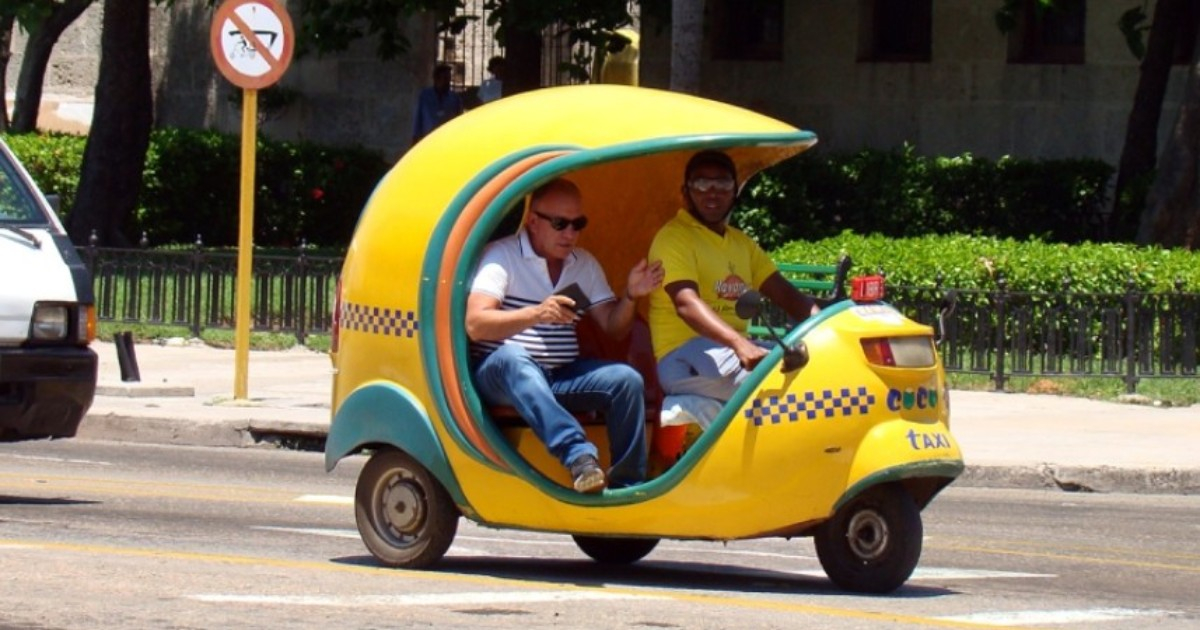
Two words from everyday Cuban speech have just earned their place in the most referenced dictionary in the Spanish-speaking world. The Royal Spanish Academy (RAE) and the Association of Academies of the Spanish Language (ASALE) presented this Friday the 24th edition of the Dictionary of the Spanish Language (DLE), and among the new entries are "asere" and "cocotaxi," two terms with a geographical mark of Cuba.
The event, held on October 30 in Madrid, was led by Santiago Muñoz Machado, director of the RAE and president of ASALE, along with the academic Paz Battaner, director of this edition.
During the ceremony, the presidents and directors of the national academies that make up ASALE each read a representative word from their country, chosen from among the new additions.
The Cuban Academy of Language chose "asere" to represent Cuba, the popular colloquial Cubanism that designates a close friend or inseparable companion.
«Cocotaxi» is defined in the DLE as "a motorized tricycle used as an urban transportation means, featuring rear seats and a semicircular body mimicking the shape of a coconut," and it is also recognized as a geographical brand of Cuba.
The inclusion of "asere" marks the conclusion of a long process of institutional recognition. The term was already listed in the Dictionary of Americanisms by ASALE—along with its variant "acere"—but its addition to the general DLE represents a qualitative leap: the reference dictionary for Spanish worldwide now officially acknowledges it.
The inclusion had been anticipated in September by journalist and linguistic disseminator Cristian Martínez González, director of the Buen Idioma project, who pointed out that "it is a word that has become widespread in Cuban Spanish and there is no reason to censor it."
The spelling with "s" — "asere" — is recommended by specialists because it is the most commonly used, although the variant with "c" is also valid.
In 2021, the RAE had published "acere" on its social media as the Cubanism of the day, which sparked a controversy among Cubans who pointed out that the usual form is with an "s".
The term gained international recognition in March 2023, when "Team Asere" became the nickname for the Cuban national team during the V World Baseball Classic.
This 24th edition arrives 12 years after the previous one, published in 2014, and is the first originally conceived in digital format: the printed version was created from the online edition, not the other way around.
The work contains 99,990 entries and nearly 209,000 definitions, as well as 54,829 etymologies and 85,201 examples.
The printed version, published by Espasa in two hardcover volumes with 3,606 pages, has been available in bookstores since October 21; the digital version was updated on Friday at dle.rae.es.
Among the other additions in this edition are terms such as "AI," "app," "influencer," "podcast," "fatphobia," "eco-anxiety," "metaverse," and "narco-boat."
The edition also commemorates the 300th anniversary of the publication of the first volume of the Diccionario de autoridades (1726), a foundational work of Spanish academic lexicography.
Muñoz Machado recalled that the online dictionary receives 100 million visits per month and that the Cuban Academy of Language has been working since 2025 on a project to document Cubanisms for this edition.
Paz Battaner summarized the spirit of the work with these words: "Dictionary authors can only aspire to explain the meaning and use of words at a given moment or up to a certain point, but they cannot predict the future. For this reason, works that compile the lexicon of languages must evolve if they want to remain useful."
Related videos:
Filed under: