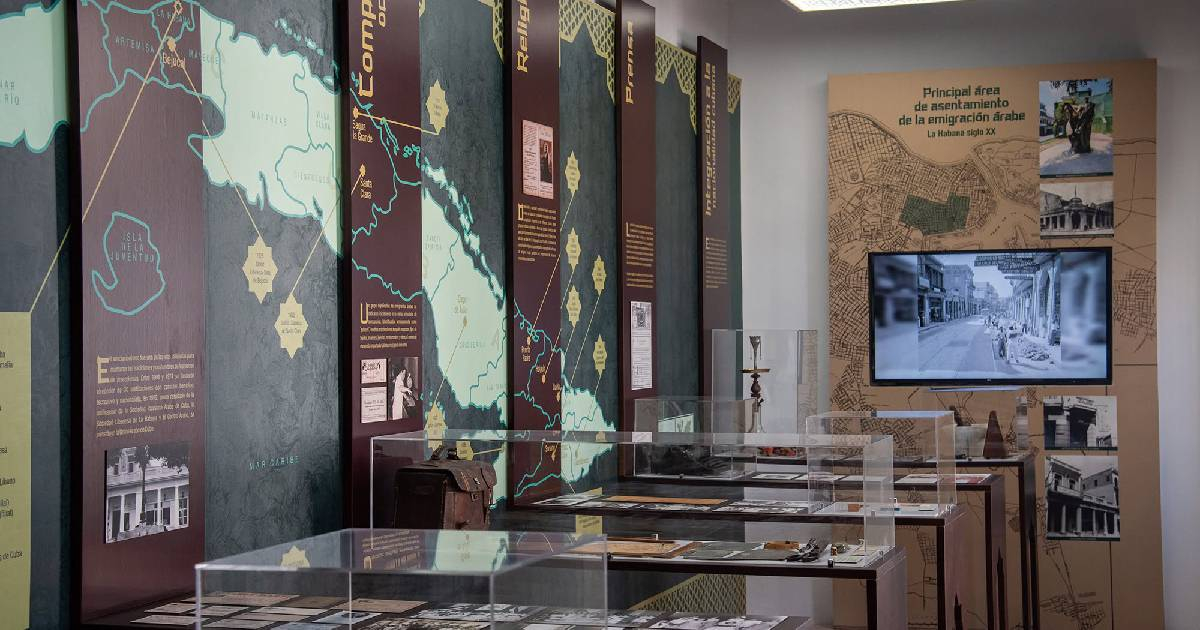
A report published this Friday by The National, the main newspaper of Abu Dhabi, highlights a little-known corner of Old Havana: the House of Arabs, a museum that documents Arab immigration to Cuba, and the impact that community has had on Cuban identity since the 19th century.
The report, written by Sara Ruthven from Havana, captures the testimony of Jackeline Díaz Fuentes, the museum's director, and comes at a time when Old Havana is experiencing structural collapses and power outages — the city loses nearly 1,000 buildings each year — while this cultural space remains operational on Oficios Street, within a 17th-century colonial building.
The first Arab immigrants arrived in Cuba in the second half of the 19th century, primarily from the Ottoman Levant: present-day Lebanon, Syria, and Palestine.
The reasons for the exodus were numerous: economic depression, high taxes, forced military conscription under the Ottoman Empire, the collapse of the silk trade, and a shortage of arable land.
For many, Cuba was a transit point to the United States, but a significant part of that migratory wave took root on the island.
"First, young men would arrive alone and engage in street vending until they established stable import businesses," Díaz Fuentes explained to The National.
Over time, immigrants stopped bringing wives from their home countries and began to integrate with the local population.
The integration was so profound that Cuban Arabs took up arms during the independence war of 1895.
"There are remarkable examples of Arabs who integrated themselves, who identified with the Cuban people and their struggle to improve their living conditions," noted the museum director.
The descendants of those immigrants founded the Arab Union of Cuba in 1979, bringing together the Lebanese, Palestinian, and Arab societies that had been operating separately since the 1920s.
The museum features three distinct halls: one showcasing traditional Arab weaponry—swords and rifles, some gifted to Fidel Castro by foreign dignitaries—another that recreates a Bedouin tent in the style of the Kuwaiti desert, and a third displaying photographs of immigrant families, letters, and personal items.
In front of the museum stands the Abdallah Mosque, inaugurated in 2015 with funding attributed to Saudi Arabia and capable of accommodating around 500 people, which replaced the small prayer room that existed within the House of the Arabs itself.
The Arab influence in Cuba, however, predates the arrival of those Levantine immigrants.
Díaz Fuentes recalls that Muslim rule in Spain for over 700 years left a deep imprint on the language and architecture that Spanish colonizers later brought to the island.
The most cited example is the word "ojalá," which comes from the Andalusian Arabic law šāʾ Allāh — "if God wills" — and which is recognized by the Royal Spanish Academy as derived from Arabic.
"There are many Arabic words that have entered the Spanish language; even our expression 'ojalá' comes from the Arabic phrase 'inshallah'," the director explained.
The National's report also attributes, according to the version held by the museum, the redesign and popularization of the guayabera to a Lebanese textile merchant, although it does not identify his name or the exact date.
This version lacks independent documentary corroboration: the most widely circulated story about the origin of the guayabera places it in Sancti Spíritus in the 18th century, and the City Council of that city authorized its use in official events in 1880.
Among the most well-known Cubans of Arab descent are the poet and painter Fayad Jamís (1930–1988), the son of a Lebanese father, and the music producer Emilio Estefan, born in Santiago de Cuba with Lebanese ancestry through his paternal line.
"There is an inextricable bond between Cubans and Arabs," summarized Díaz Fuentes. "They left an indelible mark on the national history of Cuba."
Related videos:
Filed under: