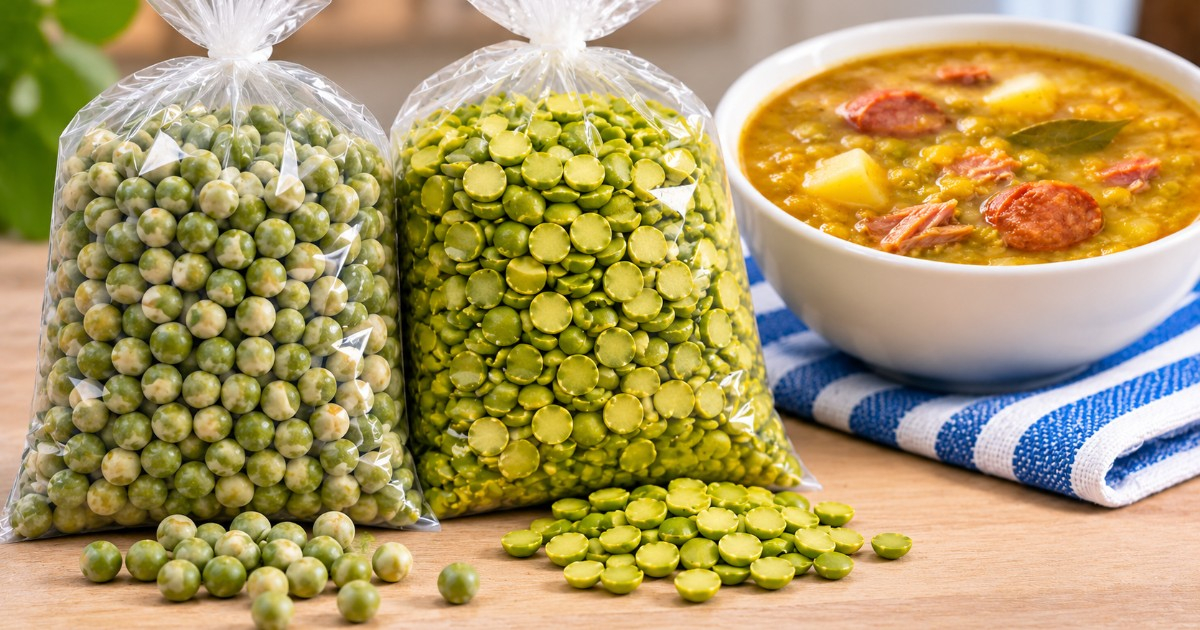
To prepare a creamy Cuban potage in the United States, the packages labeled green split peas are a convenient option: they contain split green peas that do not require soaking beforehand. You can also use the yellow ones. Before purchasing, pay attention to more than just the color: whether the grain is whole or split affects its preparation.
What are peas called in English?
Green split peas means split green peas; yellow split peas refers to split yellow peas. The packages labeled as whole dried peas or whole green peas contain whole dried grains; there is also a yellow variety, whole yellow peas. The USA Pulses variety guide displays these presentations.
Split peas are dried peas that have had their skin removed and are separated into two halves, as explained by the University of Illinois. Although they may resemble lentils due to their size, they are not the same food.
In Spanish, you will also find the names dried peas or split peas. Do not confuse peas with chickpeas: the latter are garbanzos. Also, do not choose fresh or frozen green peas thinking they will cook the same way as the dried ones in a stew.
Green or yellow: which ones are suitable for Cuban stew?
Both can be used to prepare soups and stews. The split ones are convenient when you're looking for a creamy base that breaks down during cooking; whole ones allow you to maintain a more distinct grain texture if you control the cooking time.
The University of Illinois describes green peas as sweeter than yellow ones. Choosing one or the other alters the color and some nuances of the dish, but yellow is not a spoiled green pea: it is a different variety.
To organize the preparation, it is important to distinguish the presentation: buying yellow split peas does not require soaking them due to their color. Similarly, a bag of whole green peas should not be cooked automatically with the instructions meant for split green peas.
Which ones need soaking and how to prepare them
Before cooking them, check the grains, remove any small stones or impurities, and rinse them in a colander. The split ones do not need to soak overnight: you can cook them right after washing.
For dry beans, the North Dakota State University recommends soaking them. Their slow method involves keeping them covered with plenty of water for six to eight hours or overnight in the refrigerator. After that, the soaking water is discarded, they are rinsed, and cooked with fresh water.
Soaking makes it easier to prepare whole grains, but it does not break them down nor eliminate the need to cook them. Also, check the package instructions, especially when switching products.
How to cook peas in a pot
To soften split peas, USA Pulses recommends using two cups of water for every cup of dry grains. Bring to a boil, then reduce the heat to maintain a gentle simmer for about 35 to 40 minutes, until tender.
That proportion corresponds to a basic cooking method, not a complete recipe for stew with potatoes, pumpkin, and meats. Follow the amount of broth from the chosen preparation and ensure it doesn’t dry out. Achieving a very creamy texture may require more cooking time than just softening the grains.
With the soaked beans, start with fresh water and check their tenderness during cooking. There is no single time that works for every batch: the guidelines published by Alberta Pulse Growers and North Dakota differ significantly. The package instructions and the final texture are more useful references than just copying the minutes from another variety.
In the pot, you can skim off the surface foam and stir, especially when the broth begins to thicken. If you crush a grain and still find a hard center, it needs to continue cooking with enough liquid.
How to give them the flavor of Cuban stew
A base of onion, garlic, and chili, accompanied by cumin, paprika, and bay leaf, allows you to achieve the flavor of home-cooked stew. The CiberCuba pea recipe also includes potatoes, zucchini, chorizo, bacon, and ham bone or hock.
In that preparation, the tomato sofrito and the root vegetables are added after ensuring that the peas are soft. You can follow that order and finish on low heat until the potatoes and squash are cooked, monitoring to prevent the bottom from sticking.
When switching from whole grains to split grains, do not repeat a long cooking time without checking: the latter can break down while other ingredients still need more time. If you are using meat that requires prolonged cooking, prepare it in advance or follow a recipe that accounts for that difference; the fact that the peas are soft does not guarantee that the meat is cooked.
In a pressure cooker, first check the model
Not all models allow cooking split peas. The manual for various Presto models prohibits pressure cooking split peas because they can produce foam and block the safety valves.
Instead, Instant Pot publishes recipes for split pea soup for its appliances. A recipe meant for a specific pot does not authorize the use of any other: check your model's manual before selecting that method. If it forbids it, cook them in a conventional pot.
When the team admits you, please follow their instructions regarding liquids, maximum amounts, and depressurization. For foods that expand or produce foam, do not exceed half of the total capacity, including ingredients and liquids, or the lower limit specified by the manufacturer. Do not force the lid or attempt a quick release of pressure.
How to adjust the texture and prevent sticking
If the grain is already tender but there's excess broth, finish cooking uncovered over low heat, stirring the bottom. The grains soften more as they cook; there's no need to keep them whole if you're aiming for a creamy stew.
If it becomes too thick, add water or broth gradually and mix before deciding if it needs more. The pea stew also thickens as it cools: don’t reduce all the liquid while it’s hot just because it still seems a bit loose. When reheating, incorporate the necessary liquid to regain the consistency you prefer.
Related videos:
Filed under: