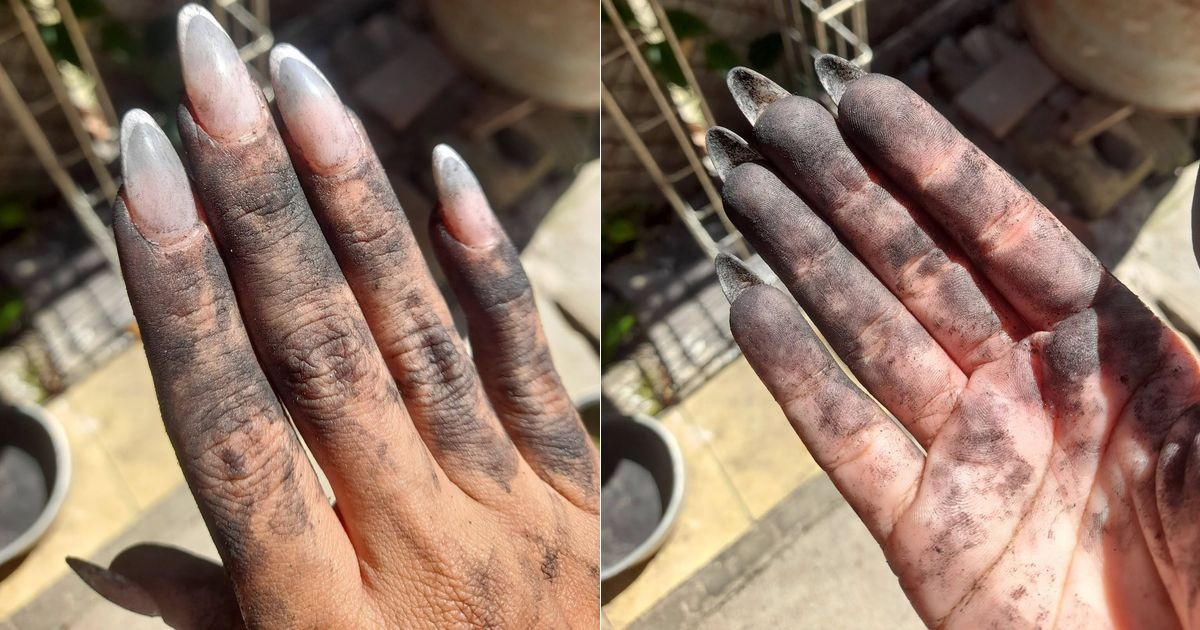
A Cuban manicurist who publishes under the name Ela Nail became the unwitting reflection of thousands of women on the island this Friday by sharing on Facebook two images that summarize the daily paradox of living in Cuba: long almond-shaped nails with a careful finish, completely blackened by the soot from the coal she used for cooking.
The headline that accompanied the photos said it all: "When you do a Pinterest design of a rich woman, but then realize you live in Cuba." The post sparked an avalanche of comments from Cuban women who not only laughed but also saw themselves in those dirty hands with intact manicures.
"Hands grabbing coal to cook, that's how many of us are," wrote a follower. Another admitted that she paints her nails black for very practical reasons: "I save myself the trouble, honestly, I can't deal with this." A third lamented a more permanent issue: "Mine don’t even grow anymore, all because of coal."
Despite everything, the prevailing tone was one of resistance with humor: "With coal but nails ready, I relate," commented another user, while someone else concluded with a statement that captured the spirit of the thread: "Poverty is not going to consume me, because when it comes to being or not being, I am."
The scene is not anecdotal. According to the National Food Security Survey 2025 from the Food Monitor Program, conducted between May and July 2025, with results published in May 2026, 35% of respondents relied on firewood or charcoal for cooking due to a lack of electricity and gas. The study also revealed that 80.4% of participants faced difficulties in preparing their meals due to blackouts. Since then, these figures have only worsened.
Coal has also become a relative luxury. A bag that could cost between 900 and 1,400 pesos at the end of 2024 rose to between 3,200 and 5,000 pesos in various provinces in June 2026, in contrast to an average state salary of around 7,000 pesos per month at that time. The situation worsened since January of this year, when CUPET indefinitely suspended the distribution of liquefied gas in Santiago de Cuba and other eastern provinces.
Getting your nails done is not free in that context either. While in 2025 a basic manicure could cost as little as 500 Cuban pesos and acrylic or polygel nails started at around 950 pesos, the prices documented in businesses during 2026 show significantly higher rates: from 1,000 pesos for a traditional manicure to 5,000 pesos for extra-long acrylic extensions at certain establishments, with more elaborate services reaching 6,000 pesos or more.
For many Cuban women, that expenditure is not vanity: it is a form of dignity in the face of precariousness. “Without losing the glamour, never,” summarized one commentator. “It doesn't matter, we always have to look regal,” added another.
The post from Ela Nail is not an isolated case. A publication from the page "Revolico Amancio" showed two hands covered in soot with metal rings in an almost identical image. The text accompanying the photo was eloquent: "What Cuban woman doesn't identify with this image?
The comedian Mario Sardiñas, known as Chequera, described his neighborhood Arroyo Arenas as "a tribe," for cooking with firewood without electricity or internet. And the pinera Idaneris Aguirre published a heartbreaking testimony on Friday: "I never imagined that the future would find me cooking with charcoal, like in a century I did not live through".
The backdrop that fuels these stories is brutal: the IX Report of the Cuban Human Rights Observatory estimated in August 2026 that 94% of Cubans live in extreme poverty, and Cepal projects a contraction of the Cuban GDP of 10.3% in 2026, the worst in Latin America.
In that scenario, even the Casa del Forestal in Villa Clara sold tea pine bags for 250 pesos to light the charcoal, described as "highly sought after."
Related videos:
Filed under: