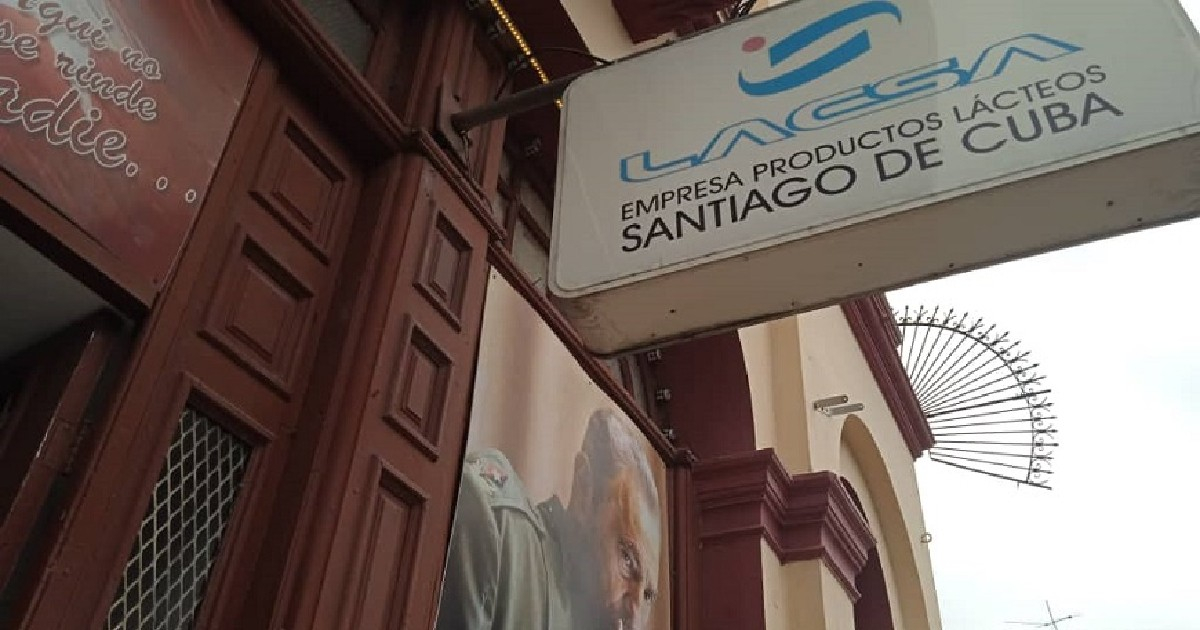
The Dairy Products Company of Santiago de Cuba is operating at levels far below what it was designed for, as acknowledged this Sunday by its general director, Eduardo Griñán, in a report by the state-run newspaper Sierra Maestra that captures his statements regarding the industry's situation in the eastern province.
Griñán noted that about 90% of the raw materials used by the industry in the eastern region were imported, primarily powdered milk, and that Santiago de Cuba lacks the necessary livestock capacity to replace that supply with local production.
The executive described a chain of deficiencies that feed into each other: without electricity or fuel, it is impossible to gather milk, maintain the cold chain, or transport finished products; without financial resources or technology, the equipment cannot be updated.
"When those supplies are not available, production comes to a halt or decreases," Griñán stated, also acknowledging that the country has internal issues that exacerbate its vulnerability, in addition to the external factors he identified as the main cause.
"The workers," said the executive, "keep the operation running with aging machinery: 'More than obsolete, they are necessary, because they are all we have.'"
The shortage of imported ammonia —a traditional industrial refrigerant— has forced some facilities to switch to freon, a change that allows them to continue operating but reduces production capacity.
The company has also sought energy alternatives in light of the power outages. A plant in Palma Soriano already has a solar installation that allows it to operate independently, without relying on the electrical grid. In the provincial capital, a similar project is underway for the pasteurizer, the largest factory of the entity, although that process has not yet been completed. Two other facilities depend on diesel generators and conventional fuel.
Griñán also mentioned that the company is exploring ways to increase its revenue, such as online sales, attracting foreign currency, and foreign investment projects, although none of these initiatives have been confirmed as contracts or available services.
What is at stake is not just production figures. The company's dairy products supply children, the elderly, hospitals, and schools in the province, a population that is particularly vulnerable in a city where authorities identified in October more than 10% of its inhabitants as being in a situation of social vulnerability.
The picture described by Griñán fits into a nationwide dairy crisis. In June, the Minister of Food Industry, Alberto López Díaz, admitted that more than 100,000 children were not receiving their daily milk ration and that the official plan was “impossible to fulfill.”
In July, Brazil sent 48 tons of powdered milk donated to Cuba on two flights from its Air Force that landed at the international airport of Santiago de Cuba, mainly aimed at children in the eastern provinces, illustrating the scale of the deficit that the local industry can no longer meet.
The national milk production dropped by 37.6% during the 2024-2025 campaign, and Cuba received only 30% of the powdered milk it had planned to import in 2025.
Related videos:
Filed under: