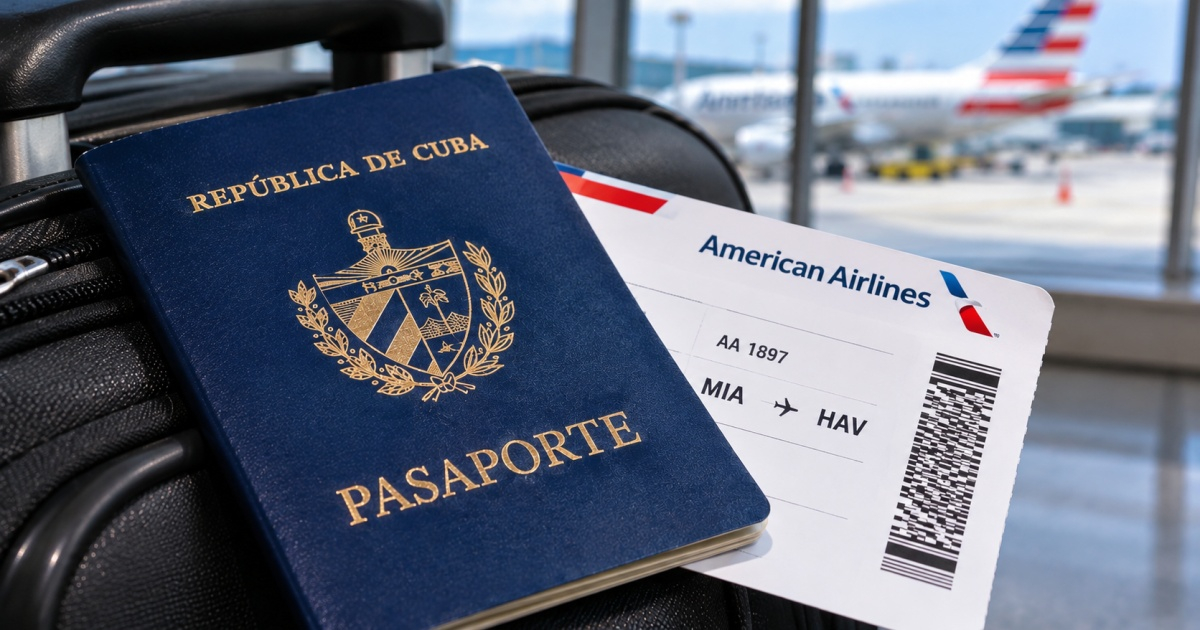
If you have your residency application pending under the Cuban Adjustment Act and are considering traveling to Cuba or another country, you need to be aware of the risks before leaving the United States.
As a general rule, those with the I-485 form in process need to obtain an advance travel permit, known as advance parole, before traveling.
There are exceptions for certain immigration categories, but they do not automatically apply to all applicants.
Leaving without the proper authorization may lead USCIS to consider your residency application abandoned. Even with approved permission, your return to the United States is not guaranteed.
Additionally, a decision by the Board of Immigration Appeals (BIA), issued on August 13, 2026, altered the interpretation of the consequences of traveling with advance parole for those who have accumulated at least one year of illegal presence in the country.
What changed with the Delcarmen-Lara decision in August 2026?
For years, the BIA maintained in Matter of Arrabally and Yerrabelly (2012) that temporarily traveling with an advanced travel permit did not constitute a departure that would trigger the ten-year inadmissibility bar for unlawful presence.
On August 13, 2026, the Board modified that criterion through Matter of Delcarmen-Lara, 29 I&N Dec. 830 (BIA 2026), determining that a departure with advance parole constitutes a departure for purposes of section 212(a)(9)(B)(i)(II) of the Immigration and Nationality Act.
The decision explicitly overturned the previous precedent, and it may have significant consequences for those who accumulated illegal presence before traveling.
U.S. legislation includes two primary prohibitions related to illegal presence:
- Three-year punishment: may be applied to those who accumulated more than 180 days but less than one year of illegal presence and subsequently left the United States voluntarily before the commencement of certain immigration proceedings, in accordance with the conditions set forth by law.
- Ten-year penalty: can be applied to those who accumulated one year or more of unlawful presence and then left the United States.
The ruling Delcarmen-Lara specifically examined the ten-year ban. It did not explicitly resolve the scope of the three-year ban for those traveling with advance parole.
These prohibitions do not automatically activate due to any irregular duration of stay. To determine whether a person has accumulated illegal presence, their entry dates, authorized periods of stay, submitted applications, and relevant legal exceptions must be examined.
A person may find themselves without valid immigration status and still have periods that are not counted as unlawful presence for the purposes of these prohibitions. The determination depends on individual circumstances and the applicable provisions.
The new interpretation means that an early travel permit should no longer be considered sufficient protection against the ten-year ban when the other legal requirements are met.
Does the new decision affect those who traveled before August 2026?
The BIA explicitly established that its new interpretation will be applied prospectively, after considering that it nullified a precedent that had been in place since 2012, which many applicants had relied on to make immigration decisions.
The Board examined, among other factors, the change in relation to the previous practice, the trust placed in the precedent, and the consequences that would result from applying the new interpretation retroactively.
For that reason, she decided not to apply the new criterion to the trip taken in January 2024 by the Salvadoran citizen who was the subject of the case.
The resolution does not explicitly set a general cutoff date nor does it address all possible situations for those who traveled before the ruling. Therefore, it is not appropriate to conclude that all those trips are automatically affected by the new interpretation.
Under the new criterion, a departure with advance parole may trigger the ten-year admission ban when the illegal presence requirements set forth in section 212(a)(9)(B)(i)(II) of the Immigration and Nationality Act are met.
The case Delcarmen-Lara was not directly related to the Cuban Adjustment Act, but rather involved a Salvadoran citizen who was applying for residency through a family petition.
However, the interpretation of the BIA may have consequences for applicants of other adjustment categories, including Cubans, when the appropriate legal conditions are met. Its application to a case under the Cuban Adjustment Act also requires examining the specific provisions of that immigration pathway.
What happens if you leave the U.S. with the I-485 pending?
According to the federal regulation 8 CFR 245.2(a)(4)(ii), leaving the United States while a status adjustment application is pending is generally considered an abandonment of the process.
The main exception for many applicants is having obtained a prior travel permit before departing and presenting it for inspection upon return.
The USCIS Policy Manual outlines this rule and its exceptions.
Some individuals who hold certain immigration statuses, such as specific H or L categories, can travel without their I-485 application being considered abandoned, provided they meet the relevant regulatory requirements.
For those who need advance parole, submitting the application for the permit is not enough: they must receive authorization before traveling.
Leaving while the permit is still pending can jeopardize the I-485 and result in the loss of the fees paid, which are generally non-refundable.
How to request an advance travel permit?
The permit is requested using the I-131 form, selecting the category corresponding to a person with a pending status adjustment application.
USCIS requires documentation to verify eligibility, including, when applicable, a copy of the I-485 receipt.
Before planning the trip, it is important to check:
- The approval of the permit: you should not leave relying solely on the fact that you submitted the I-131 form.
- The validity of the document: ensure that it authorizes the planned trip and allows for the request of return on the scheduled date.
- The passport: the advance travel permit does not replace the travel document required to enter other countries.
- The fees and processing times: check the current information on USCIS before submitting the application or purchasing a ticket.
It is important to distinguish between the I-131 application and the I-485 adjustment. The rules regarding the processing, validity, or possible abandonment of a travel permit application are not identical to those that determine whether a residency application is considered abandoned.
Advance parole does not guarantee reentry to the United States
The advance travel permit allows you to present yourself at a U.S. entry point and request permission to enter under parole, but it does not guarantee a favorable decision.
Upon arriving at an airport or border point, a Customs and Border Protection (CBP) officer determines whether to authorize entry in accordance with the applicable immigration provisions.
Entry on parole does not equate to formal immigration admission nor does it eliminate potential grounds for inadmissibility.
In addition, the regulation 8 CFR 245.2 includes specific consequences for those who return with travel permission and subsequently receive a denial of their adjustment of status.
If USCIS denies the I-485, the fact that the individual returned under parole does not, by itself, grant permanent immigration status nor does it prevent the person from being subject to immigration proceedings, depending on their specific situation.
What happens if your parole expired before you applied for residency?
For Cubans who entered with parole, an important issue is to determine whether there was any period of unlawful presence between the expiration of their stay authorization and the submission of a migration application that could affect that calculation.
The expiration of the parole does not, by itself, imply that a person is subject to a punishment of three or ten years.
The lack of a valid immigration status and the accumulation of illegal presence concerning admission prohibitions are related issues, but not necessarily equivalent.
It is necessary to review the entry dates, the duration of the granted authorization, the submitted immigration applications, and any exceptions or periods that should not legally be counted.
Those who find themselves in that situation can also consult what happens when the parole expires and what options Cubans have.
If you have an open deportation process, you must take extra precautions
Some Cubans who entered through the border, including those who received an I-220A document, have pending proceedings before an immigration court.
In those cases, traveling outside the United States can have additional consequences that depend on the type of procedure, existing orders, individual immigration status, and the authority responsible for resolving the adjustment of status.
The regulation 8 CFR 245.2 contains specific provisions regarding the abandonment of adjustment applications when certain applicants leave the country during exclusion, deportation, or removal proceedings.
A departure can also affect the possibility of returning and continuing the immigration process.
Therefore, a person with an open case before an immigration court must first verify any potential deportation orders, applicable restrictions, and the specific consequences of leaving the country.
Traveling to Cuba with pending adjustments: what should you keep in mind?
Visiting family in Cuba may be a reason to request an advance travel permit, but the destination does not eliminate U.S. immigration requirements.
Before making a decision, it is advisable to consider these aspects:
- The rules for adjusting status: traveling to Cuba does not constitute a general exception to the rules regarding abandonment of the I-485.
- The history of illegal presence: a departure may lead to inadmissibility consequences based on the criteria established in Delcarmen-Lara, when the corresponding legal requirements are met.
- The individual migration situation: the expiration of the parole, proceedings before an immigration court, or deportation orders can introduce additional risks.
- The conditions of fate: antes de viajar, conviene consultar el current travel advisory for Cuba from the United States Department of State, que informa sobre los riesgos y las recomendaciones de seguridad para los viajeros.
It is also important to consider the time remaining to obtain residency. According to the data from USCIS collected by CiberCuba in October, some adjustment processes under the Cuban Adjustment Act were nearing a year of waiting, although the timelines vary depending on the case.
Waiting to receive permanent residency can avoid the specific risks of traveling with a pending I-485, although having a green card does not eliminate all potential immigration restrictions or consequences of a prolonged absence.
What to do before buying a ticket?
If you have the Cuban adjustment pending, it is advisable to have an immigration attorney review your history before traveling, especially if you have accumulated unlawful presence, your parole has expired, or you have an open deportation proceeding.
The review must take into account the dates of entry and exit, the received immigration authorizations, the computable periods of illegal presence, and the possible application of Matter of Delcarmen-Lara, including the specifics of the Cuban Adjustment Act.
Legal notice: this article provides general information updated as of November 2, 2026, and does not constitute legal advice. To assess a specific case, consult with a licensed immigration attorney or a representative accredited by the Department of Justice.
Related videos:
Filed under: