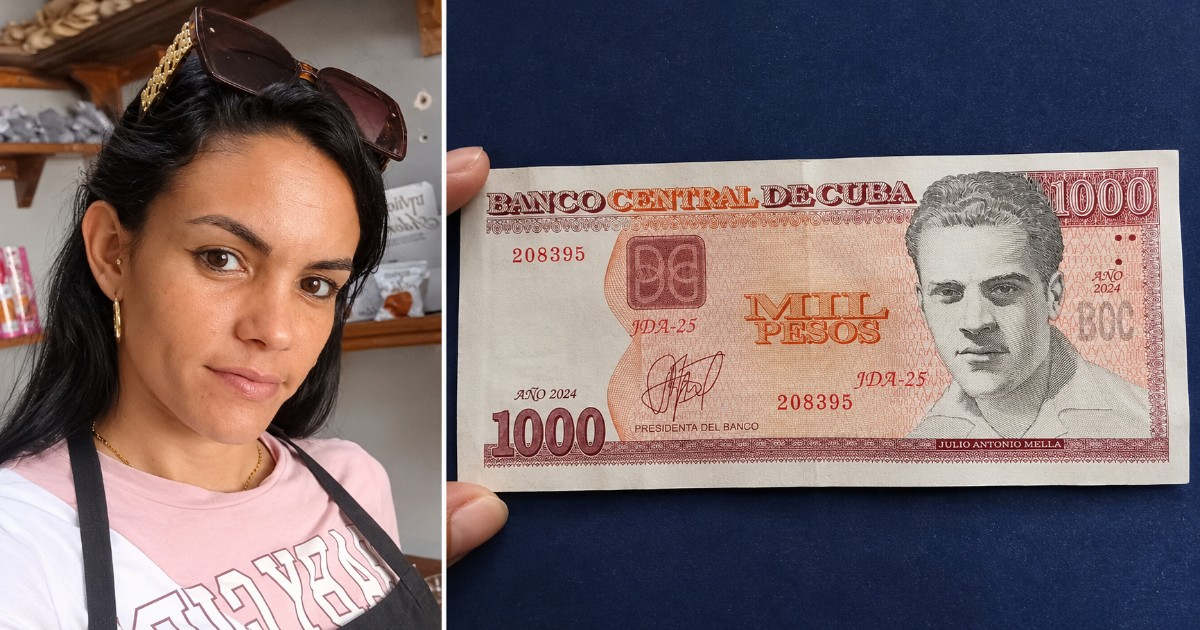
A Cuban worker recounted how she was on the verge of losing 1,000 pesos while attending to several customers, after a stranger asked her to change a bill in order to pay for a car. A quick intervention from a colleague prevented her from accepting the money, which both considered to be counterfeit.
Suzel Sanguinety shared her experience on Friday in a Facebook post, where she explained that the incident occurred while she was working and had several people waiting to be served.
According to her account, the man approached her and asked for help changing a 1,000 Cuban peso (CUP) bill, without her initially suspecting any wrongdoing.
It was a colleague, whom he identified as Rachel, who took the bill and examined it against the light. Upon observing its watermarks, she warned the man that, in her opinion, the money was not authentic.
The worker explained that she could not know if the stranger was trying to deceive her deliberately or if he himself had received the bill without being aware of its possible counterfeit status.
What was clear to him was the economic harm that accepting it would entail. As he recounted, he would have to answer to the business owner for the 1,000 pesos, an amount that represented part of the money he earns with his work to support his children.
The Cuban woman insisted on the sacrifices she makes to earn money for her children and explained that, after the incident, she decided to also warn other customers about the importance of checking banknotes before accepting them.
The man received the explanation regarding the alleged irregularities of the bill without the employee describing any argument or confrontation.
She emphasized that both the warning and the treatment towards the stranger were respectful.
The post generated numerous reactions from people who thanked for the alert and shared similar experiences.
A user claimed that her aunt lost merchandise and 30,000 Cuban pesos in change after accepting a 100-dollar bill that later turned out to be fake, according to her testimony.
Another person reported that they had received a fake 50-dollar bill in a money transfer operation and only discovered the irregularity when they tried to use it in a store.
There were also comments from users who reported having issues with Cuban bills of 5,000 pesos.
Alerts about counterfeit bills have recent precedents in Cuba.
In July 2026, a new method of counterfeiting 1,000 peso bills was reported in Guantánamo, using genuine 200 CUP notes, altered to resemble a higher denomination.
In those cases, according to the alert circulated, one of the signs that allowed for the detection of the alteration was to hold the money up to the light, as the original denomination of 200 pesos could be distinguished.
In September, authorities reported the arrest of six individuals in Manzanillo, Granma, for their alleged involvement in the circulation of counterfeit 2,000 and 5,000 peso bills. These denominations had started to circulate in 2026.
The counterfeit 1,000 peso bills are not a recent phenomenon either.
In 2023, a public complaint raised awareness about one-thousand peso bills printed on previously bleached five peso notes, a technique that could retain some of the characteristics of the original banknote.
The Central Bank of Cuba has recommended reviewing the security features of cash, particularly the watermarks, the denominations visible when held up to the light, and the security threads.
For cases where doubts persist, the institution advises visiting a bank office to verify the authenticity of the bill.
Related videos:
Filed under: