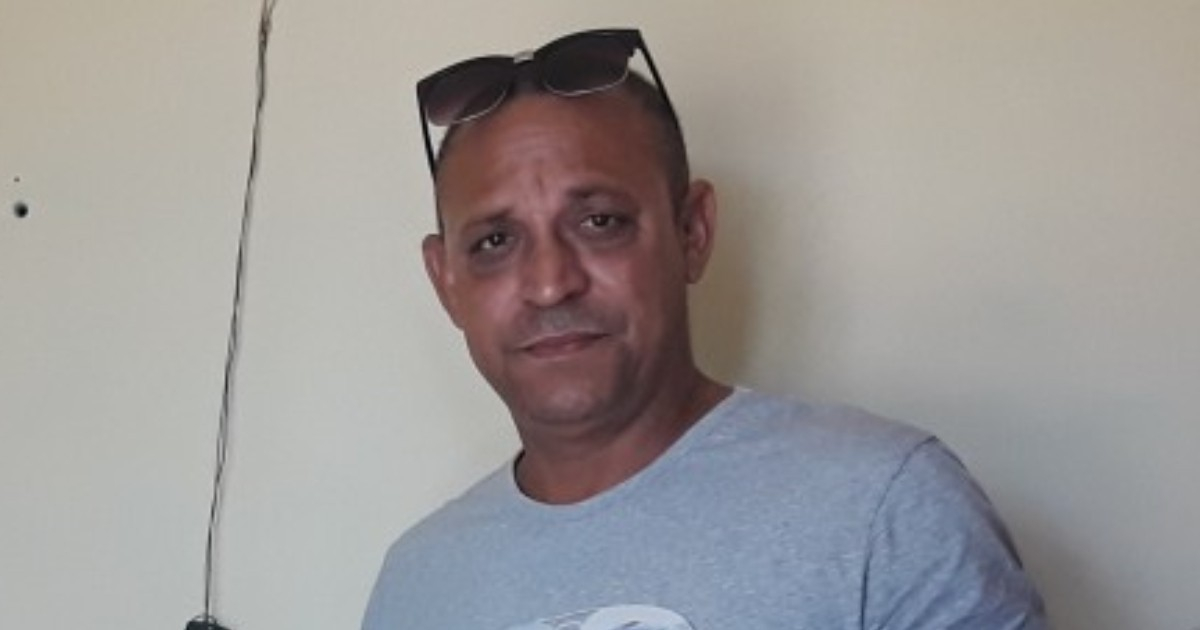
The political prisoner and independent journalist Jorge Bello Domínguez was taken on Friday, October 30, from the maximum-security prison in Guanajay to a hospital, but returned to the prison without being examined by any doctor, according to his mother’s report in an interview with Martí Noticias.
Marta Domínguez Galero recounted that the doctor at the hospital refused to attend to her son because the custodians had not arranged the appointment in advance, as it was their responsibility. "They finally brought Jorge to the hospital to see him. When they arrived, the doctor did not attend to him because she told the custodian that they knew very well they needed to schedule the appointment in advance. It was all for nothing, no doctor saw him," she stated.
Bello Domínguez, 50 years old, has been waiting for over a year for a surgical intervention to treat two testicular cysts that cause him episodes of bleeding, inflammation, and severe pain.
The surgery was recommended by a urologist when the journalist was still confined in Combinado del Este in Havana, prior to his transfer to Guanajay in March 2025. The prison in Artemisa does not have urology specialists, and according to his mother, the failed transfer on Friday was the first time the authorities had attempted to take him for specialized care.
Domínguez Galero did not hide his outrage at what happened: "The same situation exists with his testicles, the two cysts, and Jorge is there suffering through pain and crises. If they know that they have to call in advance to take him to a doctor, how long will this abuse and disrespect continue? Even the doctors refuse to treat a prisoner simply because they oppose the dictatorship."
The health condition of the journalist is more complex. According to documents from Prisoners Defenders, Bello also suffers from type II diabetes, high blood pressure, and asthma. In June 2025, his mother was already warning that he had been without insulin or blood pressure medication for two months following his transfer to Guanajay.
In June 2026, Bello himself sent a letter from prison in which he accused prison officials of sabotaging his insulin syringes and tampering with his medication, directly blaming Captain Camilo Ernesto Hernández Ortega and First Lieutenant Lis Marelis Ajete Suárez. “I know I am walking on the edge of an abyss and I am certain that something is being plotted against me”, he wrote at that time.
In March 2026, the Inter-American Commission on Human Rights (IACHR) adopted Resolution 21/2026 (MC-203-26), which granted precautionary measures in favor of Bello and three family members —his mother, his wife Yuleydi López González, and his daughter Yésica Bello—, demanding that the Cuban regime provide a comprehensive medical assessment and specialized treatment. The Cuban state did not respond to this resolution or provide any information during the proceedings.
Bello Domínguez, a member of the Cuban Institute for Freedom of Expression and the Press (ICLEP) and a promoter of Cuba Decide, is serving a sentence of 15 years in prison imposed in April 2022 by a military court, on charges related to his participation in the protests of July 11, 2021, in Güira de Melena, Artemisa. His family and human rights organizations have reported irregularities in the trial, including the absence of physical evidence and the use of testimony from a co-defendant who was a collaborator with State Security.
The case fits into a broader pattern: according to Prisoners Defenders, in September 2026 there were 1,351 political prisoners in Cuba, of which 476 were suffering from serious illnesses with medical attention denied partially or completely.
Related videos:
Filed under: