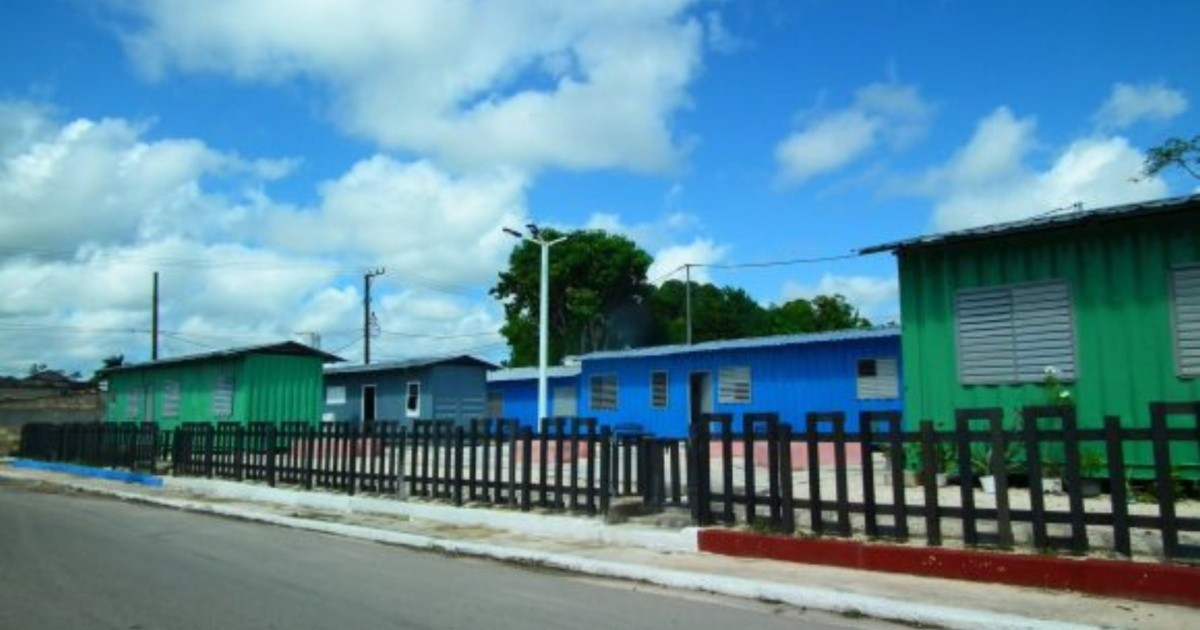
The official media outlet Cubadebate published a laudatory report this Sunday about the so-called "metallic" housing development in San Sebastián, located in the Pueblo Nuevo district of Matanzas, where seven vulnerable families received homes constructed from recycled shipping containers as part of the housing program of the Cuban regime.
The text, signed by Arnaldo Mirabal Hernández, gathers testimonies from the beneficiaries in a triumphalist tone. The most revealing statement was made by Aneity Sosa, who lives in the complex with her son, who suffers from West Syndrome and is also celiac: "For having nothing, this is really great! The house I lived in before even had a pit in the middle of the living room."
The statement, far from being a praise of the program, starkly depicts the level of precariousness that thousands of Cubans have reached after decades of dictatorship: a mother expresses gratitude for living in a 25-square-meter metal container because her previous situation was even worse.
Another beneficiary, Ana Lidia Gutiérrez, 64 years old, admitted that her first reaction upon learning about the assignment was one of rejection: "What?! Live in that tin can?!" Her granddaughter Yelay Naray summarized the prior conditions: "We were living in a small room without the most basic necessities for living; we didn't even have a bathroom."
Each module features two rooms, a tiled kitchen, a bathroom, interior thermal insulation, an exterior cover to reduce solar radiation, cross ventilation, and an elevated tank. Additionally, the complex includes a park with photovoltaic lighting. Hidovaldo Díaz Martínez, Coordinator of Programs and Objectives of the Provincial Government of Matanzas, acknowledged that there are "aspects to improve," such as the metal carpentry, and described the task of urbanizing the land as "titantic," referring to its location in a swampy area where turf had to be extracted until stable ground was found.
The containers come from the packaging used to transport components from China for five photovoltaic solar parks built in the province. Matanzas has 100 of these structures.
What the official report omits is the real context of the program. Prime Minister Manuel Marrero Cruz announced it in December 2025 with the goal of converting more than 3,500 containers into housing, but progress has been minimal: by April 2026, only 133 units had been delivered across the country and hardly 19 were completely finished.
The housing deficit in Cuba exceeds 929,000 homes, and in 2025 only 2,382 units were built out of the planned 10,795, which is 22% of the annual plan.
It also does not mention the cost. Each container home costs around one million Cuban pesos, financed through loans, compared to approximately 225,000 pesos for a conventional masonry home. In Ciego de Ávila, the reconversion can reach 1,830,000 pesos.
The architect Abel Tablada warned in May 2026 that metal containers can reach extreme temperatures under the Cuban tropical climate without permanent air conditioning, which is practically unfeasible in a country with power outages exceeding twenty hours a day. On social media, Cubans have already nicknamed these homes "the Microwave."
The teenager Mónica, who lives in the neighborhood, inadvertently provided the most telling detail of the report when she described why she enjoys the well-lit little park: "especially sitting at night to chat in the illuminated park when the power goes out."
While the regime boasts about these deliveries as housing achievements, Aneity Sosa awaits something more tangible: a small refrigerator to keep the special foods her celiac son needs. “Even if it’s just a small one, like those mini bars that are common around here,” she requested.
Related videos:
Filed under: