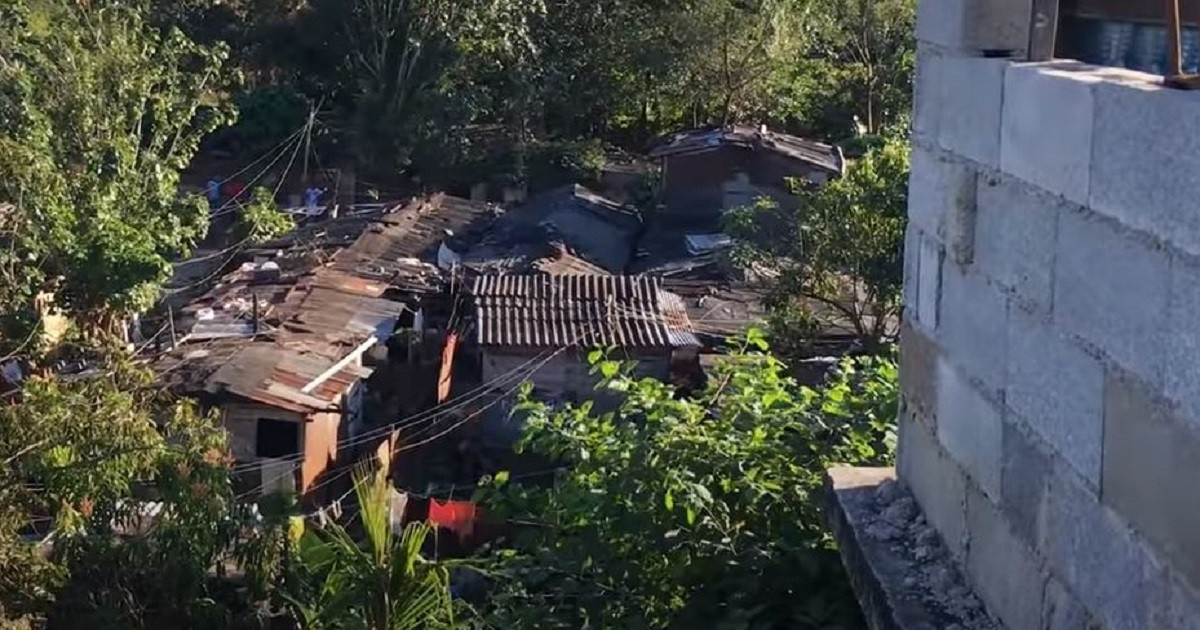
Adiuska Suárez Morton, a mother who works as a cleaning staff member in a Havana hospital, shared with CubaNet how she tries to survive with her young son in an informal settlement in the municipality of Marianao, where her salary, child care, and lack of water create a situation that just doesn't add up.
The woman lives with her three-year-old son in a small wooden house that she purchased with her savings after moving from Guantánamo to start anew.
"I live in a wooden house, but it's still my home. I'm fighting here on my own," she stated.
His monthly salary is 20,000 Cuban pesos, a figure that is nearly three times the national average salary —which was 7,354 CUP in August 2026, equivalent to about nine dollars at the informal exchange rate— but is still insufficient given the actual cost of living.
"I earn 20,000 pesos, which isn't much because everything has gone up in price," he explained.
From that income, she allocates 4,000 CUP monthly for the child's care while she works, an expense that does not cover the child's meals during the day.
"Additionally, I have to bring him his little rolls, the food, a juice or yogurt, whatever it is to make sure he eats," she added.
The Cuba Capacity Building Project estimated in May 2026 that a person needs about 96,000 CUP per month to meet basic needs, more than four times what this worker earns.
"I'm having a lot of trouble with prices being so high; it's driving me crazy," she summarized.
Without water and without a tank
One of the most urgent needs in their home is access to water.
Without a tank to store it, she turns to her neighbors to obtain the water she needs for cooking, cleaning, and taking care of the child.
"We are having a lot of trouble with water here. I have to go to some neighbors' houses to get water, and I don't have a tank; I have to fill any containers I can find to be able to store it," he explained.
Marianao is one of the most affected municipalities in the capital due to the water crisis: a resident reported in July that her community had gone 12 consecutive days without drinking water.
Nationally, the regime admitted in October that 2.5 million Cubans are affected by the supply, and Human Rights Watch documented in July that in some neighborhoods of Havana, running water only arrived once every 10 to 20 days.
The fluctuations in electrical voltage further exacerbated his situation: the instabilities damaged his television, a replacement expense he cannot afford with his current income.
Solidarity as a survival network
When money is not enough to eat, the neighborhood network of the settlement operates as a last resort.
"Sometimes the neighbors help me, and I help them. Two days ago, I had nothing to eat, and the neighbor gave me a little bit of bean stew," she remembered.
The informal settlements known as "llega y pon" have grown in various areas of Havana due to the inability to access formal housing. Cuba is experiencing a housing deficit of between 800,000 and 929,000 units and there are 961 informal neighborhoods in the country, 513 of which lack official recognition.
In those spaces, families resolve construction, supply, and service issues on their own, which in other environments rely on state infrastructures.
For this mother, the immediate aspiration is not abstract: to continue working, to ensure her child's nutrition, and to secure water for the household needs.
"This has to change one day because this isn't easy," he insisted, with a statement that sounds less like a slogan and more like the only certainty he has left.
Related videos:
Filed under: