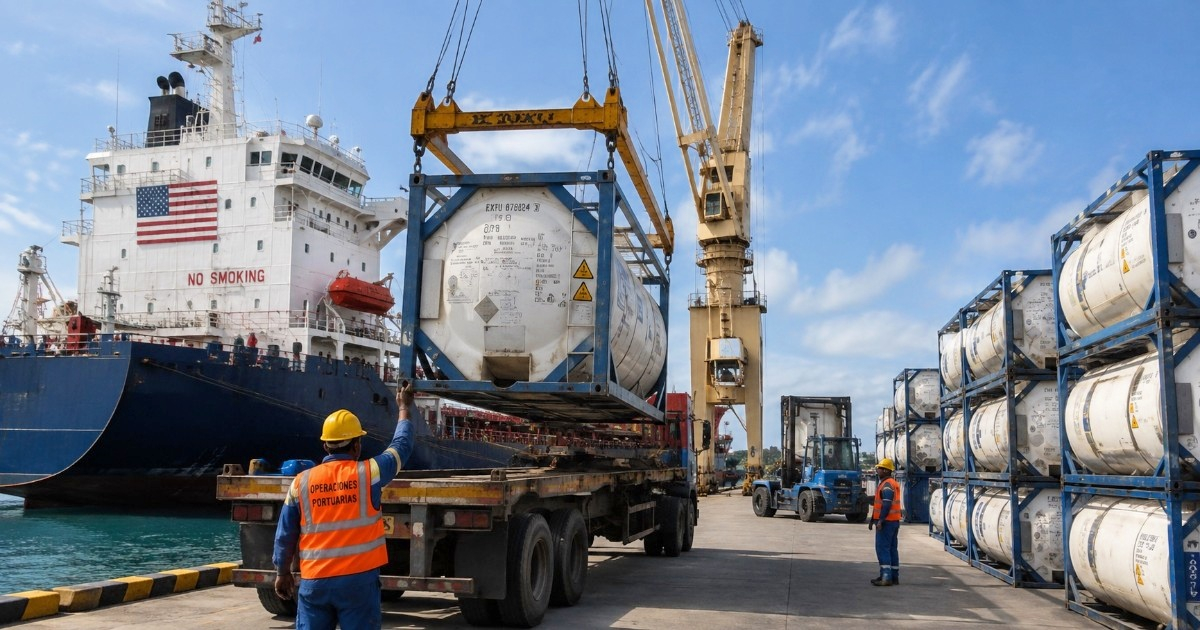
The Cuban military conglomerate GAESA is reportedly using small and medium-sized private enterprises (MIPYMES) to access imported fuel from the United States and circumvent U.S. sanctions through a scheme that would allow it to control its distribution and the generated revenue.
This is asserted by economist Emilio Morales, vice president of Cuba Siglo 21 and president of Havana Consulting Group, in his report The control of fuel: a new tool of pressure on the Cuban mafia state, published this Tuesday.
The research describes how the fuel authorized by Washington for the Cuban private sector would ultimately be marketed through facilities and financial mechanisms controlled by companies linked to GAESA.
SMEs and the Fuel Business
After the capture of Nicolás Maduro in January 2026 and the interruption of Venezuelan oil supplies, the United States updated the regulations that allow for certain fuel exports to eligible private Cuban companies.
According to Morales, out of nearly 390 initially called MIPYMES, about 42 received authorization in the early stages. The researcher maintains that some maintain connections with GAESA's corporate environment.
Among the mentioned participants are Servitec Mariel, Cubapac Internacional, and Galla, as well as the Chinese company Fujian Trebor Trading Company and Vanguard Energy, based in Florida.
An investigation by ADN Cuba cited by Morales identified 21 fuel suppliers of CIMEX, including at least 16 SMEs, through internal documents issued between May and September 2026.
Among the documented transactions, there is an invoice from KRV Partes y Piezas for 23,000 liters of gasoline, valued at approximately 53,000 dollars, intended for a servicenter Oro Negro.
The documents also show that CIMEX set margins of between 17 and 30 cents per liter over the purchase prices from private suppliers.
How GAESA would control revenues
Morales argues that importing MIPYMES depend on a commercial and financial infrastructure dominated by the military conglomerate.
The gas stations belong to Inmobiliaria CIMEX, while consumers pay using Clásica and Clásica Empresarial cards issued by FINCIMEX.
According to the report, the income is deposited in the Banco Financiero Internacional (BFI), an entity linked to GAESA that, according to the researcher's estimates, handles more than 95% of business and commercial transactions in foreign currency in Cuba.
This circuit would allow the military conglomerate to benefit from operations formally conducted by private companies, despite U.S. restrictions aimed at preventing advantages for sanctioned military entities.
The high costs of importing fuel
The study estimates that acquiring and shipping a 25,000-liter gasoline isotank can cost approximately $90,487, while a diesel one would reach $134,262.
Once the container is purchased, the subsequent operations would cost around $40,487 for gasoline and $84,262 for diesel, not including all internal distribution expenses.
Morales estimates that a company would need at least ten isotanks to develop a commercial operation and would have to pay for the shipments in cash.
These demands, he argues, make it difficult for small independent businesses to finance their operations without the support of structures that have access to capital and foreign currency.
More than 232 million dollars in American fuel
According to data from the U.S.-Cuba Trade and Economic Council cited in the report, U.S. exports of fuel and derivatives to Cuba reached approximately 232 million dollars between January and August of 2026.
In August alone, they totaled 74.86 million dollars.
Energy specialist Jorge Piñón from the University of Texas believes that this volume indicates that CUPET continues to play a fundamental role in the reception and distribution of fuel.
The research also includes records from ADN Cuba regarding 1,628 returns of isotanks since April 2026, through operations linked to the Taína Maritime Agency and Seaboard Marine.
For Morales, these figures raise concerns about the financial capacity of independent SMEs to sustain such a commercial volume.
The background of Venezuelan oil
Morales estimates that GAESA obtained around 30 billion dollars between 2010 and 2025 through the resale to third parties of Venezuelan oil received by Cuba.
According to their calculations, between 40% and 50% of that fuel was subsequently sold in Asian markets.
The researcher believes that the interruption of Venezuelan shipments forced the military conglomerate to seek alternative mechanisms to maintain supply and its income.
Sanctions and fuel diversions
Washington has intensified restrictions against Cuban companies related to the energy sector, including CUPET, ENETEC, and COREYDAN.
The U.S. authorities also reported the interception of 90 fuel shipments destined for ENETEC: 71 in Port Everglades and 19 in Houston.
The seizures totaled approximately 600,000 gallons, equivalent to 2.27 million liters, valued at 2.8 million dollars.
In September, 14ymedio documented that a gas station near Villa Marista, the headquarters of State Security, was supplying vehicles linked to the Ministry of the Interior.
The State Department acknowledged in October that it could not rule out the possibility that some of the fuel exported to the private sector ended up in the hands of entities linked to the Cuban government.
Morales concludes that as long as GAESA controls the facilities, payment mechanisms, and financial infrastructure, small and medium-sized enterprises (MIPYMES) will hardly be able to operate with full independence in the Cuban fuel market.
Related videos:
Filed under: