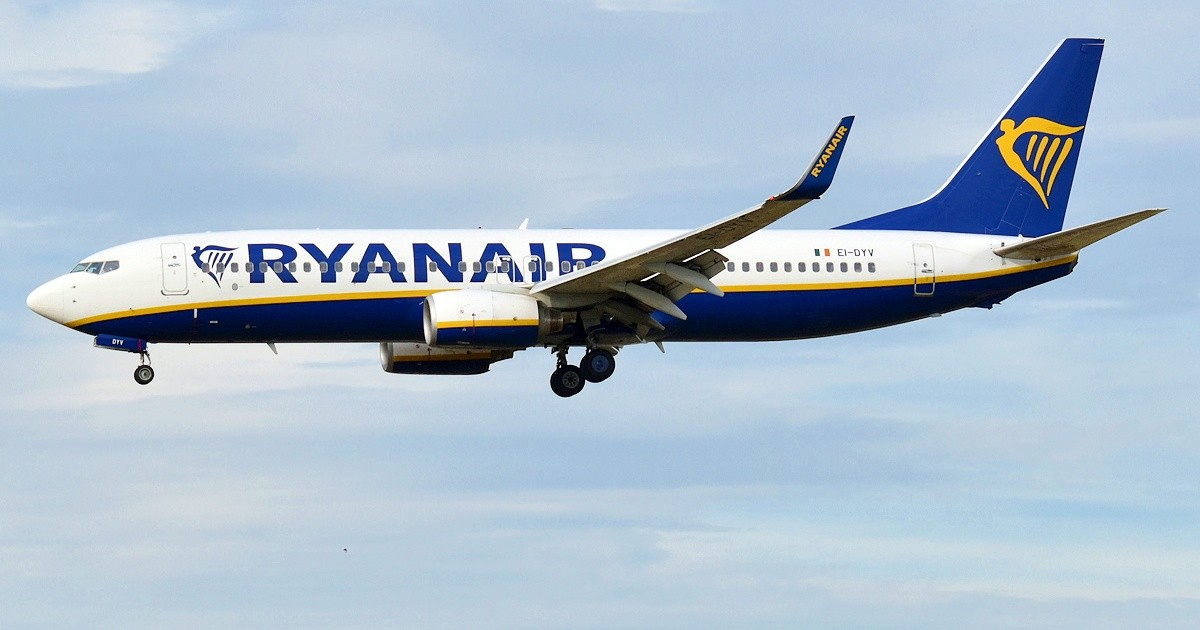
A wave of bomb threats against at least seven commercial flights prompted a significant security response on Tuesday, November 3, across four European countries, with planes escorted by military jets, airports temporarily closed, passengers evacuated, and emergency inspections conducted.
The incidents were recorded in Spain, Italy, Poland, and Bulgaria, with authorities finding no explosives on any of the affected aircraft.
The notices, several of which were received via email, affected flights from the companies Ryanair, LOT Polish Airlines, Scandinavian Airlines (SAS), and Wizz Air.
Although all the aircraft landed safely and no injuries were reported, the alerts necessitated the mobilization of specialized police units for explosives, emergency services, and in Italy, combat jets from the Air Force.
Authorities are investigating the origin of the threats and whether there is any connection among them.
So far, those responsible have not been publicly identified, nor has it been established that the warnings are part of a coordinated operation.
The confirmed balance includes two flights to Warsaw, two to Rome, two to Sofia, and one to Murcia.
A similar incident occurred on Monday when a Wizz Air flight traveling from London to Bulgaria had to divert to Budapest.
Poland: a plane with 181 people is diverted, temporarily closing an airport
One of the incidents that caused the most disruptions occurred in Poland. A Boeing 737 MAX from LOT Polish Airlines, arriving from London Heathrow Airport, had to change its destination while en route to Warsaw Chopin Airport after receiving a bomb threat.
The aircraft, with 181 people on board, was diverted to Warsaw-Modlin Airport, located about 36 kilometers from the Polish capital.
According to information released by airport authorities, the alert was received at 09:54 local time, and the plane landed at 10:01.
After landing, the aircraft was taken to an area designated for security operations. The passengers disembarked under supervision while specialized teams inspected the aircraft for possible explosives.
The situation forced the temporary suspension of operations at Modlin Airport and caused delays in some departures.
Airport authorities announced that the alert had been lifted at 12:21, after specialists ruled out the presence of explosive devices.
LOT confirmed that the inspection concluded without findings.
According to Associated Press, passengers were required to complete border controls before being transported by bus to Chopin Airport, their original destination.
That same morning, another flight heading to Warsaw, operated by Scandinavian Airlines (SAS) and coming from Copenhagen, also triggered a security alert.
In this second case, the plane was able to land normally at Chopin Airport at approximately 09:28, according to air traffic tracking records cited by the press. Passengers disembarked, and inspection procedures were initiated.
The intervention forced the temporary closure of one of the airport runways, although the facilities remained operational. The specialists did not find any explosives.
SAS spokesperson Alexandra Lindgren Kaoukji confirmed that the company had received a threat and that the information was relayed to the Polish police. She also clarified that the landing had occurred normally and should not be considered an emergency landing.
Murcia: 121 people disembarked and a strong police presence
In Spain, the alert affected a Ryanair flight from Manchester that was heading to the International Airport of the Region of Murcia.
The plane landed at 10:50 AM with 114 passengers and seven crew members, totaling 121 people. After receiving a report of a possible bomb, authorities activated emergency protocols and established a crisis committee to coordinate the response.
The operation involved personnel from emergency services, agents from the National Police, explosives disposal specialists, and members of the Civil Guard.
The passengers and crew left the aircraft and were subjected to security checks while specialists inspected the plane to determine if there was any explosive device.
The government delegate in Murcia, Francisco Lucas, confirmed that checks had been carried out both on the aircraft and among its occupants.
He later reported that the Civil Guard had ruled out the presence of explosives and that the airport was returning to normal operations.
The emergency also disrupted the operations of other flights. During the activation of the device, airport activity was temporarily restricted, and a flight from Binter Canarias, identified as IBB5702, which was scheduled to land in Murcia at 12:20, was diverted to Alicante Airport.
The testimony of a passenger: "They didn't tell us anything during the flight."
A passenger identified as Sarah reported to the BBC that those on the plane coming from Manchester were unaware of the threat while they were in the air.
According to their testimony, after landing, the aircraft came to a stop and the passengers waited for approximately 30 minutes until emergency teams began to arrive.
The woman explained that the plane was surrounded by fire trucks, police officers, and explosives specialists. Later, the occupants were instructed to leave the aircraft and were escorted by the police to the airport facilities.
Travelers had to leave their belongings on the plane while the inspections were carried out. The passenger stated that they were only informed afterward that the evacuation was due to a bomb threat directed at the aircraft.
The inspections concluded without detecting explosives, and the alert was deactivated.
Italy: two Ryanair flights inspected and military jets deployed
In Italy, two Ryanair flights headed to Rome-Fiumicino airport received bomb threats via email.
The first had taken off from Lisbon, Portugal. After receiving the alert about a possible explosive on board, the aircraft landed in Rome and underwent the necessary checks.
Police specialists in explosive deactivation inspected the plane, the passengers, the crew, and their luggage.
The checks revealed no presence of hazardous devices.
A second alert affected another Ryanair flight that had departed from Dublin, Ireland, also heading to Fiumicino.
In this case, the Italian Air Force mobilized two Eurofighter jets to intercept and escort the commercial aircraft until its arrival at the Roman airport.
The Air Force itself confirmed to the Associated Press that it had intervened after receiving information about a potential threat to a civilian aircraft flying from Dublin to Rome.
Once on the ground, the flight underwent the established security procedures. The specialists found no explosives or other elements that confirmed the threat.
According to information provided by airport sources to Reuters, the alert was lifted and Fiumicino Airport was able to continue operating without significant disruptions to other flights.
Bulgaria: two planes land in Sofia after receiving threats
Bulgarian authorities also activated their security measures after receiving threats against two commercial flights heading to Sofia International Airport.
One of the planes, operated by Wizz Air, was coming from Bergamo, Italy, and was carrying 176 passengers.
The second was a flight from Ryanair arriving from Dublin, Ireland.
The Bulgarian Ministry of Transport confirmed that both aircraft landed without incident and did not need to modify their destinations.
After the landing, agents from the Specialized Unit for the Fight Against Terrorism conducted inspections to rule out the presence of explosives.
The Minister of Transport and Communications, Georgi Peev, announced that the inspections were completed without finding any dangerous devices.
Peev explained that, at least in one of the cases, the pilot received information about the threat through the communication channels of their own airline. Subsequently, air traffic controllers implemented the established protocols to allow the plane to land safely.
During the early hours, information circulated suggesting that an aircraft coming from Israel may have been affected by a threat in Sofia. However, Bulgarian authorities later clarified that this alert did not pertain to a third flight threatened that day.
The confusion contributed to some initial reports providing differing accounts of the number of affected aircraft.
The background from Monday: a Wizz Air plane was diverted to Budapest and escorted by a fighter jet
The series of incidents began at least one day before the seven threats documented on Tuesday.
On Monday, November 2, an Airbus A321 from Wizz Air that had taken off from London Luton Airport en route to Sofia received a bomb threat while in mid-flight.
As a precautionary measure, the aircraft was diverted to Budapest Ferenc Liszt International Airport in Hungary.
The Hungarian Air Force deployed a Gripen fighter jet to intercept and escort the commercial aircraft until it landed safely.
The authorities subsequently inspected the aircraft and its occupants, finding no explosives. Once the danger was ruled out, the flight was able to continue its journey to Sofia.
This incident adds to the tally of seven threatened flights on Tuesday, bringing the total to eight affected flights between Monday and Tuesday.
Who is behind the bomb threats in Europe?
The coincidence of numerous alerts in such a short period has led authorities and aviation security specialists to examine whether the incidents may be related.
However, the investigations have not publicly established a common authorship, identified the senders of the threats, or determined if there was any coordination among the different incidents.
Matthew Borie, co-founder and director of intelligence at Osprey Flight Solutions, a company specializing in risk analysis for aviation, explained to Associated Press that there are several hypotheses to interpret the sequence of alerts.
One possibility is that an initial threat caused imitation warnings. Another is that the same person or group sent multiple messages to different airlines and airports.
The specialist also mentioned the possibility that this could be related to hybrid warfare activities, a type of destabilization operations that may include sabotage, cyberattacks, and other actions aimed at disrupting services or creating uncertainty.
These explanations are analytical hypotheses, not conclusions from police investigations. No authority has attributed the incidents to a specific state, organization, or group.
Reuters also reported statements from Eric Schouten, head of the aviation security company Dyami, who noted that false threats can be used to cause disruptions at a relatively low cost and make it difficult to identify the perpetrators.
European authorities have previously warned about sabotage operations and hybrid threats on the continent, but there is no official attribution linking the bomb threats on November 3 to those activities.
Why are emergency protocols activated even when the threats are false?
Bomb threats against commercial aircraft necessitate the activation of preventive procedures even when there is no evidence of explosives being present.
Depending on the available information, authorities may decide that an aircraft continues to its intended airport, is diverted to another facility, or receives military escort during the approach.
After landing, specialized teams may order disembarkation, inspect luggage and aircraft, isolate airport areas, or temporarily suspend certain operations.
Decisions are made based on the circumstances of each threat and the risk assessment conducted by the relevant authorities.
Tuesday's events showed different responses to similar situations: the LOT flight was redirected to Modlin, the threatened flights in Sofia landed at their original destinations, the Murcia airport activated an emergency protocol, and the Italian authorities deployed fighter jets to escort an aircraft to Rome.
Although the inspections allowed for the alerts to be lifted and airport operations to be restored, the authorities of the affected countries continue investigations to determine the source of the warnings.
The investigation must determine how the threats were sent, who carried them out, and whether the messages received in different countries are related in any way.
So far, the authorities have not announced any arrests related to this series of incidents nor have they confirmed that it was a coordinated action.
Related videos:
Filed under: