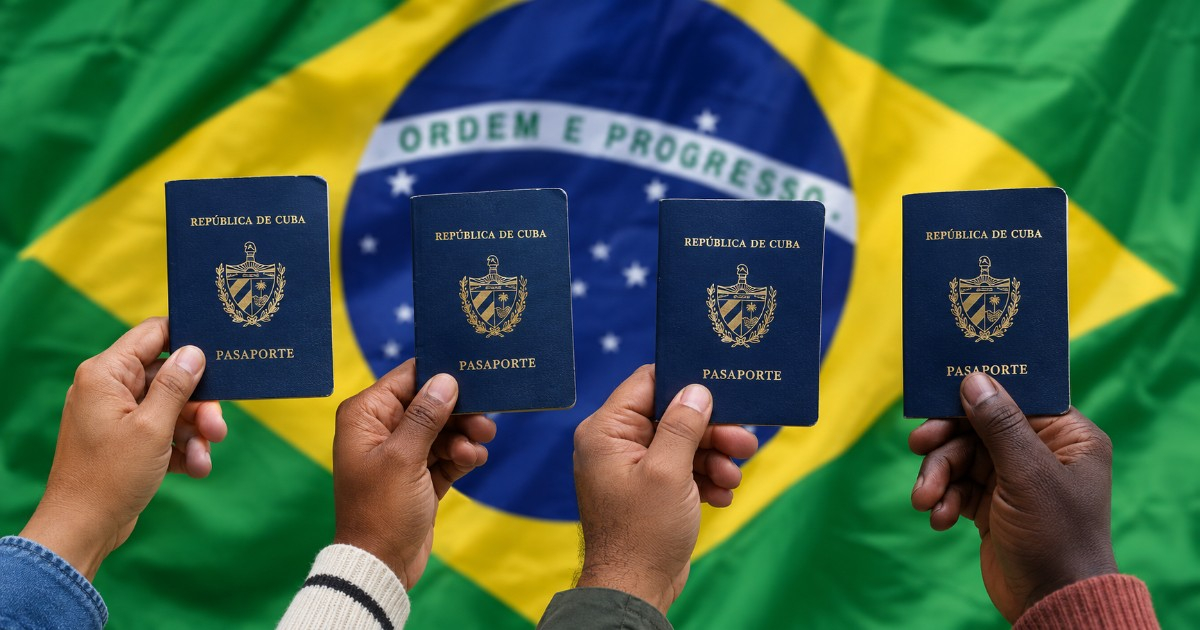
Brazil received 33,185 applications for asylum from Cuban citizens between January and September 2026, according to the monthly reports from the International Migration Observatory (OBMigra), which is part of the Brazilian Ministry of Justice and Public Security.
The volume grew throughout the year: from 3,448 requests in January, it increased to 4,885 in September, the month with the highest record among the nine analyzed.
That increase in September represented a rise of 13.8% compared to August and 19.6% compared to the same month in 2025, when 4,084 applications were recorded.
In that month, Cubans topped the ranking of asylum seekers in Brazil by a wide margin: their 4,885 applications accounted for 62.9% of the 7,772 registered in the country across all nationalities.
Of the requests from September, 2,513 were from men and 2,371 from women.
At the end of that month, there were also 99,306 pending Cuban cases awaiting resolution, making up 58.7% of the 169,136 unresolved cases of all nationalities, a total that reflects years of applications without a definitive response.
Obtaining formal recognition is extremely difficult: the process before the National Committee for Refugees (CONARE) can extend for more than five years, and in the first quarter of 2026 no Cuban has attained that status.
The phenomenon is part of a trend of sustained acceleration. In 2024, Cubans filed 22,288 applications in Brazil; in 2025 that number jumped to 41,919, an increase of 88.1%, displacing Venezuelans for the first time in a decade as the leading nationality applying.
Behind the exodus are two main drivers: the internal collapse of Cuba—characterized by chronic blackouts, shortages of food and medicine, and an economy that has dropped by more than 15% since 2020—and the closure of the route to the United States following the tightening of immigration policies by the Trump administration since January 2025.
That closure massively redirected traffic towards South America. The Darién Gap, for years the most trafficked corridor on the continent, recorded only 280 crossings in the first half of 2026, compared to 201,063 during the same period in 2024.
The main route departs from Havana on a flight to Georgetown, the capital of Guyana—the only country in South America that does not require a visa for Cubans—continues overland to Lethem, and irregularly crosses the Tacutu River into the Brazilian state of Roraima.
The International Organization for Migration (IOM) estimates that around 3,000 Cubans enter Brazil each month through this route, and warns that illicit human trafficking networks charge between $1,200 and $10,000 per migrant.
In the formal labor market, OBMigra data records 39,212 hires of Cuban workers and 26,075 separations between January and August 2026, resulting in a positive balance of 13,137 jobs, which reflects an active labor integration of the community.
Brazil also granted 4,331 visas to Cuban citizens in the first nine months of the year; the 497 issued in September represented a 51.1% increase compared to the 329 granted in the same month of 2025.
The Brazilian Ministry of Justice estimates that the country currently hosts around 84,000 Cubans, and Curitiba —the capital of the state of Paraná— has established itself as the main settlement hub, to the point that local media refer to it as "the new Miami."
With the current trend, Brazil is emerging as the main migration destination for Cubans in South America, a trend summarized by the IOM as follows: "This route has gained significance in a context where Brazil is receiving an increasing number of Cubans seeking international protection and economic opportunities."
Related videos:
Filed under: