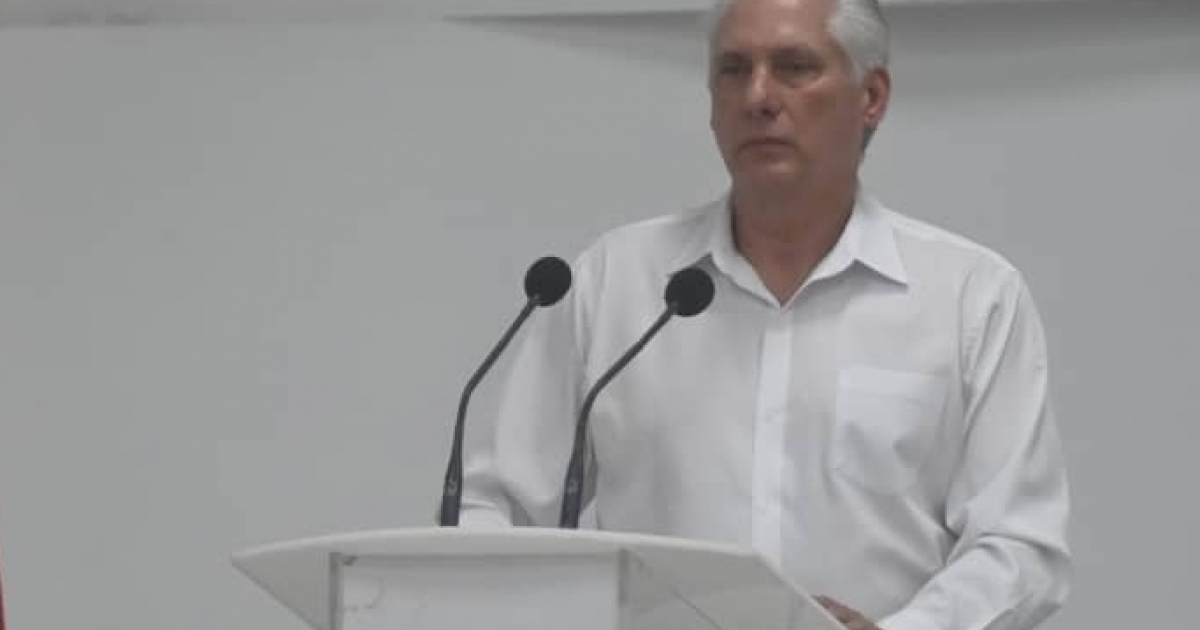
Miguel Díaz-Canel said that public health in Cuba "is a central social achievement of the country and for that reason it cannot be neglected", during the closing event of a visit by the Central Committee of the Communist Party to the Ministry of Public Health (MINSAP) and several health institutions in the country, according to a report from the official press.
The leader added that "in Cuba, health is a fundamental human right, an achievement of the Revolution, and not a commodity or a privilege." Díaz-Canel's words stand in stark contrast to the reality denounced by Cubans and which the regime itself partially acknowledges.
In that same event, the president acknowledged that more than 90,000 people are waiting for surgical operations on the island, that tens of thousands are struggling to access radiotherapy, chemotherapy, and dialysis, and that over 34,000 pregnant women are not receiving all the medical check-ups they need. Díaz-Canel, however, blamed the U.S. "blockade" for this situation.
The Minister of Public Health, José Ángel Portal Miranda, acknowledged in the same session that the limitations of the system generate "justified dissatisfaction among the population with the services we provide" and admitted to a shortage of medications, disposable materials, reagents, and high-tech equipment, in addition to breakdowns in elevators, boilers, generators, laundry equipment, water supply, cold storage, and medical transportation, with recovery programs that "are not sufficient."
Citizen reactions came swiftly. After publishing a video of his visit to the William Soler Pediatric Hospital, Cubans confronted Díaz-Canel on social media with questions like "Did they take you to the restrooms? Did you see the ambulances?", pointing out that only the best-conditioned areas of the facility were shown. Photos circulated months earlier had documented dilapidated restrooms, toilets without lids, moisture, and rusty sinks in that same pediatric hospital.
This weekend, a portion of the front structure of the Carlos Enrique Font Pupo Clinical-Surgical Teaching Hospital collapsed in Banes, Holguín, an area that had been closed off due to collapse risk since August 2026, with no repairs carried out.
Related videos:
Filed under: