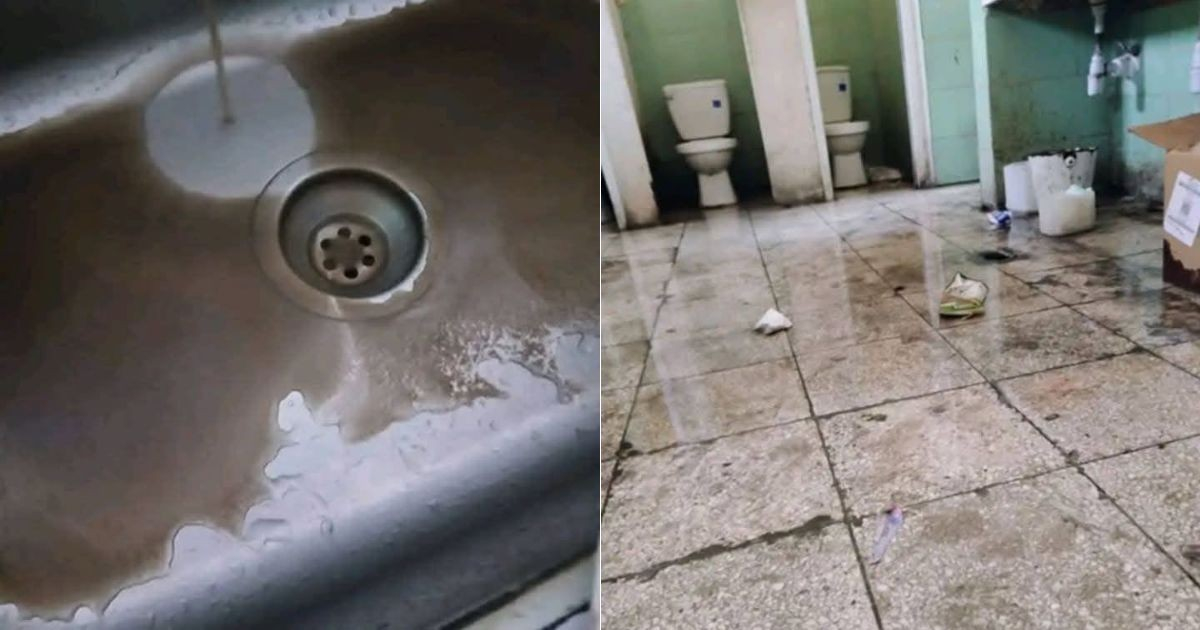
Photographs of the William Soler University Pediatric Hospital, located in the Boyeros municipality of Havana, are circulating on social media, showing restrooms with toilet bowls lacking lids, wet floors covered in trash, rusty sinks, and service areas with debris on the ground, all at the main national referral center for pediatric cardiology and cardiovascular surgery in Cuba.
The images were posted on Facebook by the user Julio Cesar Perez, who accompanied the photographs with a question that encapsulates the collective outrage: "What child would be safe in a hospital with those conditions?"
The photographs document the condition of the restroom facilities at the center: cubicles without complete doors, damaged toilets, walls with damp stains, and scattered trash on the floor—used toilet paper, plastic bags—over blackened and cracked tiles. The stainless steel sinks are covered in rust and accumulated dirt. The service areas appear neglected, with discarded items lying on the ground.
In the comments, dozens of users expressed their outrage. "Why does a hospital have these conditions while luxury hotels are being built and renovated every day?" wrote the original poster. A netizen who said she was treated there as a child lamented: "My school hospital, where I was treated as a child, had excellent doctors, what destruction." Another warned about the risks: "How many types of bacteria, fungi, etc., must have accumulated in that hospital? Where is the hygiene that is supposed to exist in a hospital? It's a complete disgrace." And one more summarized the fears of many: "How disgusting, that's why people go to hospitals for one illness and leave with ten."
The contrast between investment in tourism and the neglect of public health was another recurring theme. "There's no money for that, but there is for your good life and luxury hotels," wrote one user. Others pointed ironically to the official narrative: "The achievements of the Medical Power in Cuba," someone wrote sarcastically.
What the images show is not a new situation. In October 2025, relatives of patients had already reported that the William Soler was "completely overwhelmed", with emergency services overloaded, a shortage of supplies, and such a severe staff deficit that in critical areas there were "only two students and one doctor" to manage the demand. During that same period, two child deaths from hemorrhagic dengue were reported at the center.
The deterioration of the William Soler is part of a systemic health crisis that the regime has partially acknowledged. In July 2025, the Minister of Public Health, José Ángel Portal Miranda, admitted before the National Assembly that there was coverage of barely 30% of the basic medication list and a "widespread deterioration of medical services." By April 2026, the majority of essential medications had no stock in state pharmacies, according to reports from international media.
Other hospitals have been reported during the same period for similar conditions: the Vladimir Ilich Lenin Hospital in Holguín with bathrooms without water and broken toilets, the Calixto García Hospital in Havana with part of its ceiling collapsed in November 2025, and the Juan Bruno Zayas Hospital in Santiago de Cuba with sewage running under the patients' beds.
In June of last year, the Ministry of the Revolutionary Armed Forces organized a propaganda event with children at the William Soler, while the facilities of the center remained in the condition now documented by photographs. “From what it was to what it is today, a lot of sadness,” wrote a netizen, summarizing the feelings of those who remember the William Soler as an emblem of Cuban medicine.
Related videos:
Filed under: