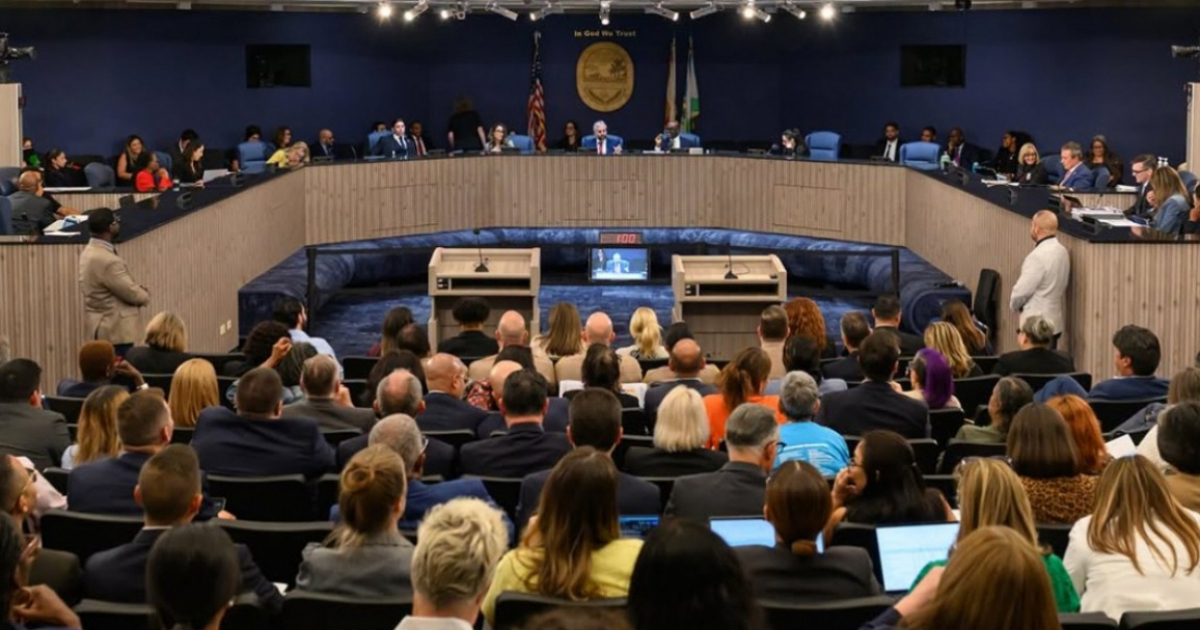
Voters in Miami-Dade ended more than six decades of unsuccessful attempts on Tuesday by narrowly approving an amendment to the county's Home Rule Charter that creates an independent board with the authority to set the salaries of the 13 commissioners, reported the Miami Herald.
Referendum 1 received support from 367,272 votes in favor (51.63%) compared to 344,037 against (48.37%), with nearly 99% of the expected votes counted, making it the tightest result of the day.
The county's Organic Charter, adopted in 1957, sets the base salary for commissioners at $6,000 per year, a figure that has not changed in nearly seventy years, despite additional supplements bringing the actual compensation to around $83,000 annually.
Approximately a dozen proposals to amend that base salary have failed at the polls since the 1960s, including one in 1961 and another in 2012.
The approved amendment does not set a specific salary: it creates a commission of five independent, unpaid members, appointed by the presiding judge of the Eleventh Judicial Circuit, the state attorney, the public defender, the executive director of the Ethics Commission, and the county Inspector General.
Their decisions will be final and cannot be modified by the Commission itself, with a reference ceiling of approximately $127,779 per year, derived from the state formula for counties with more than one million inhabitants.
With the approval of Referendum 1, the new independent salary commission must be established and issue its first determination before the commissioners can see changes to their base compensation, a process whose timeline has yet to be defined by the county.
At the other end of the day, voters decisively rejected Referendum 6, which would have eased restrictions on commercial advertising in county parks: 440,809 votes against (60.34%) compared to 289,731 in favor (39.66%).
Although the proposal did not explicitly mention any company, the debate was marked by the controversy surrounding the marketing campaign for Grand Theft Auto VI in public spaces of the county, which included a "Welcome to Vice City" sign on the roof of the Kaseya Center for $975,000, part of a total advertising package of $3.9 million with Rockstar Games in facilities such as the airport, PortMiami, and the public transportation system.
Sheriff Rosie Cordero-Stutz and Commissioner Juan Carlos Bermúdez had led the opposition with the slogan "Miami-Dade County is not Vice City," arguing that public resources should not be used to promote "a video game franchise built around criminal activity."
The other four referendums put to a vote were approved by wide margins.
Referendum 2, which extends the residency requirement in the district for commissioner candidates from six months to one year, received 76.96% support.
Referendum 3, which allows special elections to fill vacancies to be synchronized with already scheduled elections, was supported by 73.61% of voters.
Referendum 4 updated the Organic Charter to align with the reorganization of the county's constitutional offices — sheriff, tax collector, property appraiser, and elections supervisor — resulting from a constitutional reform in Florida approved in 2018 and implemented in 2025. Referendum 5 introduced technical changes, such as updating names of county facilities, modifications to public notification mechanisms, and allowing commissioners to participate virtually in meetings when permitted by state legislation.
Related videos:
Filed under: