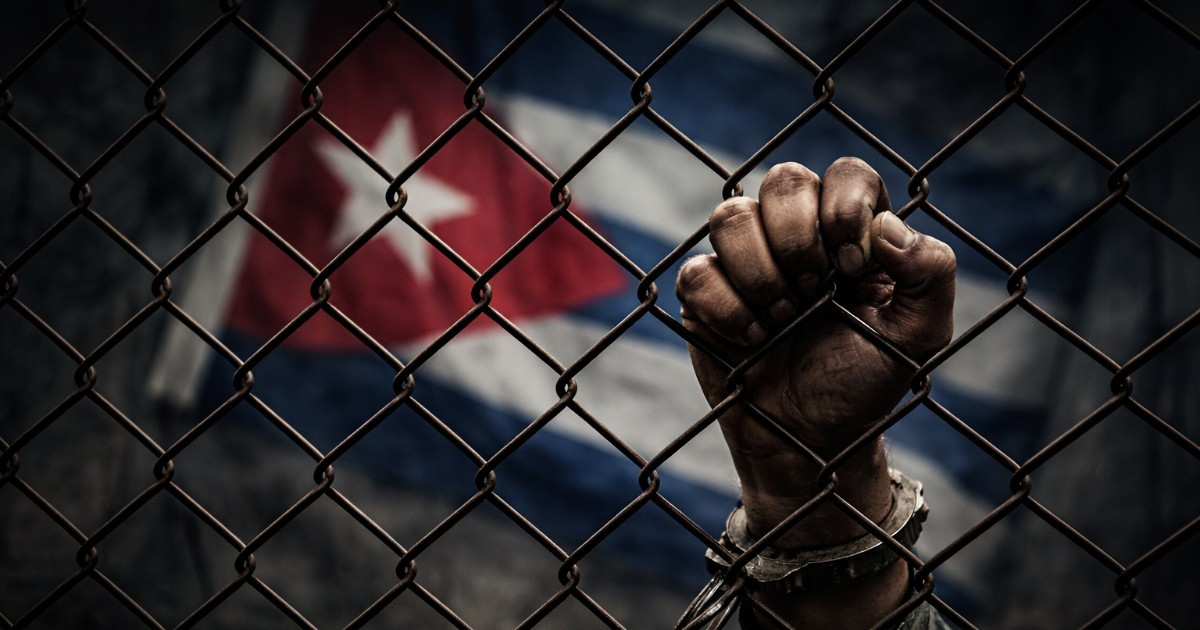
The political prisoner of 11J Denis Hernández Ramírez reported, through the organization Cubalex, that inmates at the maximum-security prison in Guanajay, Artemisa, have been unable to go out to the yard or to the areas designated for sunbathing for over a week.
According to the information, the restriction was imposed by an officer identified as Lieutenant Colonel Edgar, and it affects both political prisoners and common inmates.
Among the political prisoners affected by the measure are Marcos de la Luz Caballero Granados, Alexander Fábregas, and Jorge Martín Perdomo, as well as Hernández Ramírez himself.
He was sentenced to six years in prison following the events of July 11 and was released in January 2025 as part of the agreement between Cuba and the Vatican. However, his parole was revoked last March after he posted on social media allegations of surveillance and harassment by State Security.
Cubalex frames the prohibition as a potential reprisal or collective punishment, and warns that deliberately depriving inmates of access to the yard could violate international human rights standards when used as a mechanism of pressure or sanction.
The organization recalls that Rule 23.1 of the United Nations Standard Minimum Rules for the Treatment of Prisoners —known as the Mandela Rules— states that every prisoner who does not work outdoors must have at least one hour of physical exercise outside their cell each day, provided that weather conditions allow it.
Rule 43 of that same instrument expressly prohibits collective punishment and any sanctions that constitute torture or cruel, inhuman, or degrading treatment.
A report from the UN Subcommittee on the Prevention of Torture, published in 2023, specified that outdoor exercise is a basic right that cannot be left to the discretion of prison staff or taken away as a privilege.
Guanajay is not an isolated case. Cubalex documented similar restrictions on access to the outside in 2026 at El Pre (Santa Clara), prison 1580, the forced labor camp El 18, the Women's Prison of the West (Havana), and the Ho Chi Minh camp (Bainoa, Mayabeque).
This pattern is part of a broader repressive escalation: the organization recorded 18 incidents of isolation in punishment cells just between October 1 and 26, affecting 95 inmates, and 85 incidents of this type during the first half of the year, within a total of 1,894 documented human rights violations, a 48% increase compared to the second half of 2025.
Guanajay is also the prison where the rapper Maykel Osorbo remains incarcerated, who in October was handcuffed and forced to shave his head during a search involving more than thirty guards from a special brigade.
Cubalex called for the release of all individuals arbitrarily imprisoned for exercising their rights to expression, assembly, and peaceful protest, and emphasized that exposure to natural light and basic health needs should not become instruments of punishment in the hands of prison authorities.
On October 1st, Prisoners Defenders reported 1,372 political prisoners in Cuba, a historic record, with 193 more cases than in the same month of 2025.
Related videos:
Filed under: