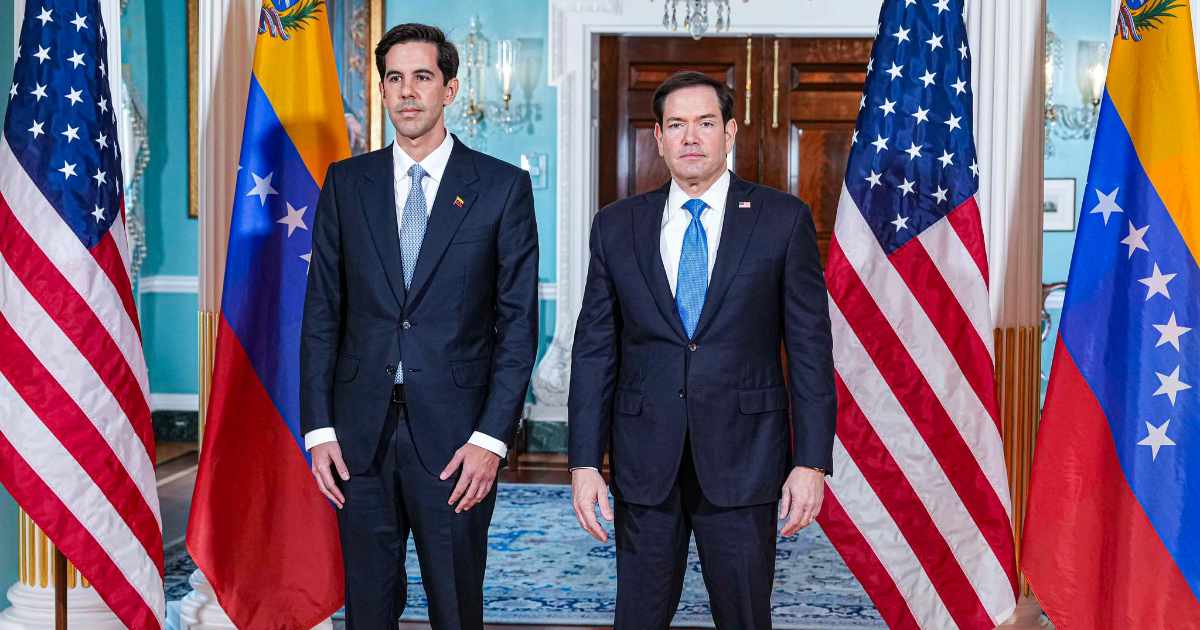
The Secretary of State of the United States, Marco Rubio, met on Monday with Venezuelan Chancellor Oliver Blanco at the State Department in Washington, marking the first high-level diplomatic meeting between the two countries since the restoration of relations following the capture of Nicolás Maduro earlier this year.
The official statement from the State Department confirmed that Rubio reaffirmed President Trump's three-phase plan for Venezuela: stabilization, economic recovery, political reconciliation, and democratic transition.
Both officials discussed the progress of the reconciliation talks led by Venezuelans, with particular attention to the institutional reforms needed to ensure "free, fair, and credible" elections.
However, according to the correspondent David Alandete at the White House, who cited sources from the State Department, no specific dates were set for the holding of elections during the meeting.
"Rubio particularly emphasized the need to free all political prisoners who remain incarcerated; it's an issue that the White House considers more urgent than the electoral agenda itself, which is yet to come," Alandete noted on the social media platform X.
The release of those detained for political reasons is thus shaping up to be the most immediate condition that Washington requires from the Chavista regime before proceeding with the electoral roadmap.
The meeting took place a day after the organization Foro Penal verified 104 releases in Venezuela, although the NGO still accounted for 322 political prisoners as of October 26, including 171 without sentences.
There is also a significant gap between the official figures provided by the Venezuelan government—claiming to have released over 626 detainees since December—and the independently verified numbers from Foro Penal, which are considerably lower.
Blanco, 34 years old, is an atypical chancellor within chavismo: he was a member of Acción Democrática and served as the campaign chief for the opposition Diego Arria in the 2012 primaries. He was appointed by the interim president Delcy Rodríguez at the end of October, replacing Félix Plasencia, and his appointment was interpreted as a sign of political openness from the Venezuelan government.
The meeting on Monday is part of a diplomatic normalization process that Washington has structured around the democratic transition plan promoted by Rubio, which includes, among other requirements, the renewal of the Supreme Court of Justice before mid-December, the reform of the National Electoral Council, and the calling of presidential elections in 2027.
Rubio has repeatedly asserted that the Venezuelan electoral infrastructure was designed during Maduro's government to manipulate results and must be completely replaced before any electoral process.
The meeting took place about two weeks after Venezuelan authorities and opposition sectors agreed on an electoral reform framework in preparation for potential elections in 2027, positioning this encounter as a key step in the international verification of that process.
Related videos:
Filed under: