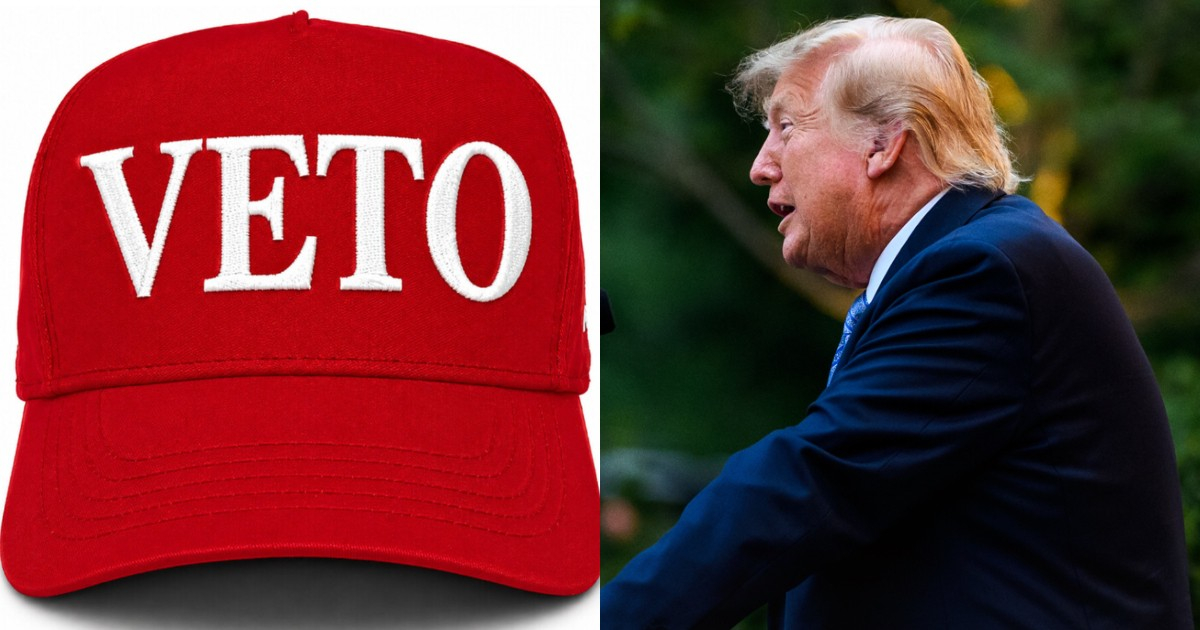
In the early hours of this Wednesday, just a few hours after the Democrats regained control of both chambers of Congress, Donald Trump posted on Truth Social an image of a red cap with the word "VETO" embroidered in white letters, without adding any text. The message was clear: the iconic campaign cap that for a decade bore the slogan "Make America Great Again" now has a new inscription.
The gesture was not improvised. On November 1, in an interview with Fox News, Trump had already anticipated his strategy: "I guess I'll become Mr. Veto", describing a plan for the systematic blocking of all Democratic legislative initiatives.
"It wouldn’t be the first time. You have a president who doesn’t have the House of Representatives or the Senate; they send proposals, they veto them, and finally, after a month or two of vetoing everything, they come around and you reach an agreement," he explained then.
The democratic wave that changed the balance of power was decisive: The Democrats would secure approximately 244 seats in the House of Representatives, well above the 218 needed for a majority, and would reclaim the Senate with a net gain of at least seven seats, achieving historic victories in Texas, Kansas, South Carolina, Ohio, and Iowa.
Trump thus became the fourth president since 1950 to lose both chambers in a midterm election, a circumstance that had only occurred before with Eisenhower in 1954, Clinton in 1994, and George W. Bush in 2006.
In this new scenario, the presidential veto is the main constitutional tool that Trump has left to stop the legislative agenda of the opposition.
According to Article I, Section 7 of the Constitution, the president can reject any bill approved by Congress and return it with an explanatory message. To override that veto, the opposition would need two-thirds in both chambers: 290 votes in the House and 67 in the Senate, a threshold that Democrats would hardly reach without Republican support.
There is also what is known as the "pocket veto": if the president does not sign a bill within ten working days and Congress goes into recess, the text simply does not become law.
During his first term, Trump resorted to the veto 10 times, especially after losing the House in 2018. In his second term, he had issued two vetoes before this new confrontation, bringing the historical total to 12.
Trump's reactions following the defeat were multiple and contradictory: he blamed Fox News for giving too much airtime to the Democrats, labeled Texas Governor Greg Abbott a "RINO" —Republican in name only— despite having supported him, and claimed that Republicans would have swept if he had been on the ballot, contradicting his own campaign strategy, where he repeatedly urged his supporters to vote "as if he were on the ballot."
The institutional consequences will begin to materialize on January 3, 2027, when the new Congress is established: the Democratic majority will be able to influence confirmations of federal positions and judges, lead investigative committees —Representative Robert García has already announced his intention to investigate the Trump family's business dealings and the handling of Jeffrey Epstein's files— and set the legislative agenda, while Trump retains his executive powers and veto authority as the main counterbalance.
By replacing "MAGA" with "VETO" in the same visual format that accompanied it since 2016, Trump transforms a campaign symbol into a statement of institutional confrontation: his political identity for the remaining two years of his term will, according to him, be that of the chief blocker.
Related videos:
Filed under: