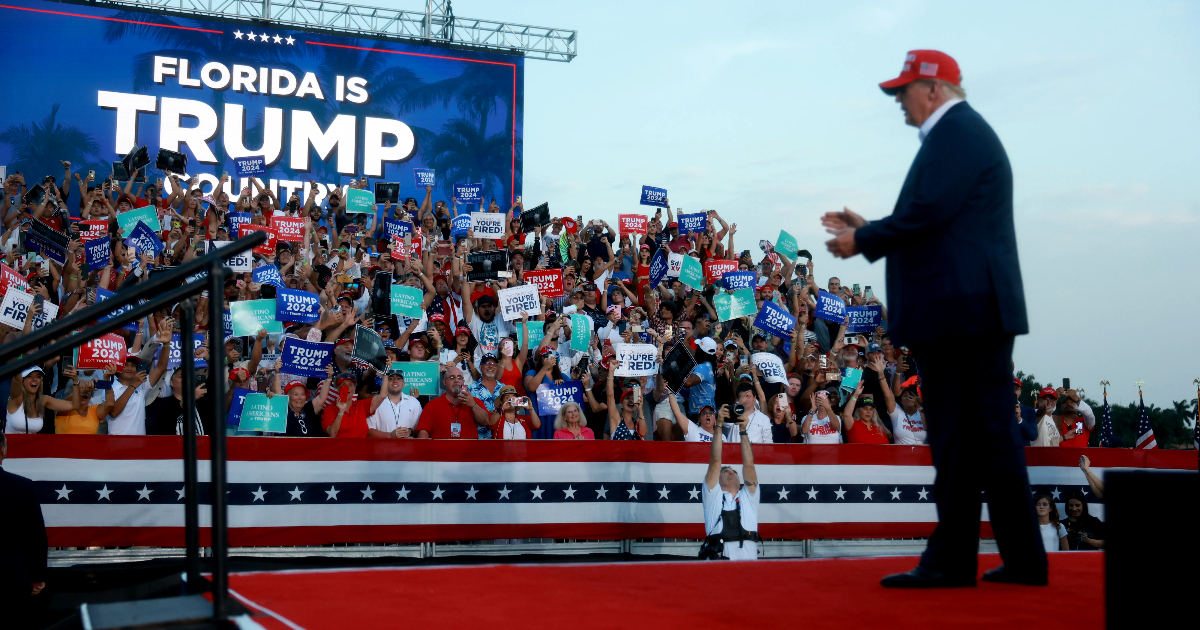
During decades, Texas was the stronghold of the Republican Party, while Florida represented one of the most contested states in the United States —what is known as a pendulum state (swing state in English)—.
The midterm elections on November 3 have painted an almost opposite picture: Republicans lost Texas but managed to retain Florida amid a resounding national Democratic victory.
In Texas, the Democrats James Talarico and Gina Hinojosa won the Senate and the governorship, respectively, bringing an end to decades of Republican dominance. In Florida, however, Trump-supporter Byron Donalds won the governorship and Ashley Moody retained her seat in the Senate.
Florida was among the states that simultaneously maintained the governorship and a seat in the federal Senate, although their victories were much narrower than those achieved in previous cycles. Its resilience is particularly significant due to the state's political importance and its transformation over the last decade from an electorally undecided territory to a conservative stronghold.
The contrast raises a question: Is Florida replacing Texas as the main Republican stronghold, or does it represent an exceptional refuge for the MAGA movement amidst Donald Trump's national weariness?
DeSantis warns of a historic crisis
The governor of Florida, Ron DeSantis, described his party's national defeat on Wednesday as an event akin to political "extinction," the consequences of which could last a decade or more.
«Throughout my life, Texas has been the crown jewel of Republican politics», he stated at a press conference reported by Politico. He also cautioned that, without Texas as one of its main supports, the party would face serious challenges in maintaining its national competitiveness.
The concern is justified: Texas contributes 40 votes to the Electoral College, compared to 30 from Florida. Its loss as a traditionally Republican territory would pose a significant challenge to the party's presidential ambitions in 2028.
Florida, meanwhile, has undergone a profound transformation. The state that decided the presidential election of 2000 by a mere 537 votes went from electing DeSantis in 2018 by less than half a point to re-electing him in 2022 with a lead of 19.4 points. Trump won there in 2024 by about 13 points.
However, Donalds' victory in 2026 was by only 1.31 points, while Moody won by a margin of nearly three points. Florida withstood the Democratic wave, but the results reveal a significant Republican setback compared to the last election cycles.
The Cuban-American vote and the strength of MAGA
One of the keys to Florida's conservative resistance lies in its unique electoral composition, especially in the southern part of the state.
The Cuban-American community has been one of the main Republican supports for decades. Its conservative identification, historically linked to anti-communism and the rejection of the regime in Havana, predates Trump’s rise, although the MAGA movement has managed to strengthen that alliance.
The FIU Cuba Poll 2026, conducted among 1,004 Cuban-Americans in Miami-Dade, found that 68% of respondents expressed their intention to vote for Republican candidates for Congress.
The data contrasts with the 76% rejection of the deportation of Cubans without criminal records, suggesting that Republican loyalty may endure even amid disagreement with certain immigration policies of Trump.
But the Cuban-American support does not equate to a widespread adherence to Trumpism in Florida. The state's conservatism is also bolstered by retirees, voters from other regions, and Latin American communities, particularly the Venezuelan.
Moreover, the results from November come with a warning: Miami-Dade voted Democrat again in the gubernatorial election, having supported DeSantis in 2022 and Trump in 2024.
That shift, along with Donalds' narrow victory, indicates that even South Florida is starting to show signs of Republican weariness.
A model for the republican future?
Florida has a peculiar feature: its conservative strength combines Trumpism with the political structure built during the administrations of DeSantis, two leaders who came to clash over the party's leadership.
Donalds, initially backed by Trump and ultimately supported by DeSantis, represents that convergence between the MAGA movement and the state's institutional republicanism.
The question is whether that formula can be replicated in other territories or if it depends on exceptional demographic and political conditions.
Texas suggests that discontent with Trump could even fracture historically solid Republican majorities. Florida shows that the party still has resilience, but its results also call into question the depth of that strength.
Perhaps Florida is becoming the main political reference of American republicanism precisely when the party realizes that it can no longer take its old strongholds for granted.
Looking ahead to 2028, the Republican challenge will not only be to retain Florida but also to win back voters who have left the party in key states like Texas. For that, support from MAGA may prove insufficient.
Related videos:
Filed under: