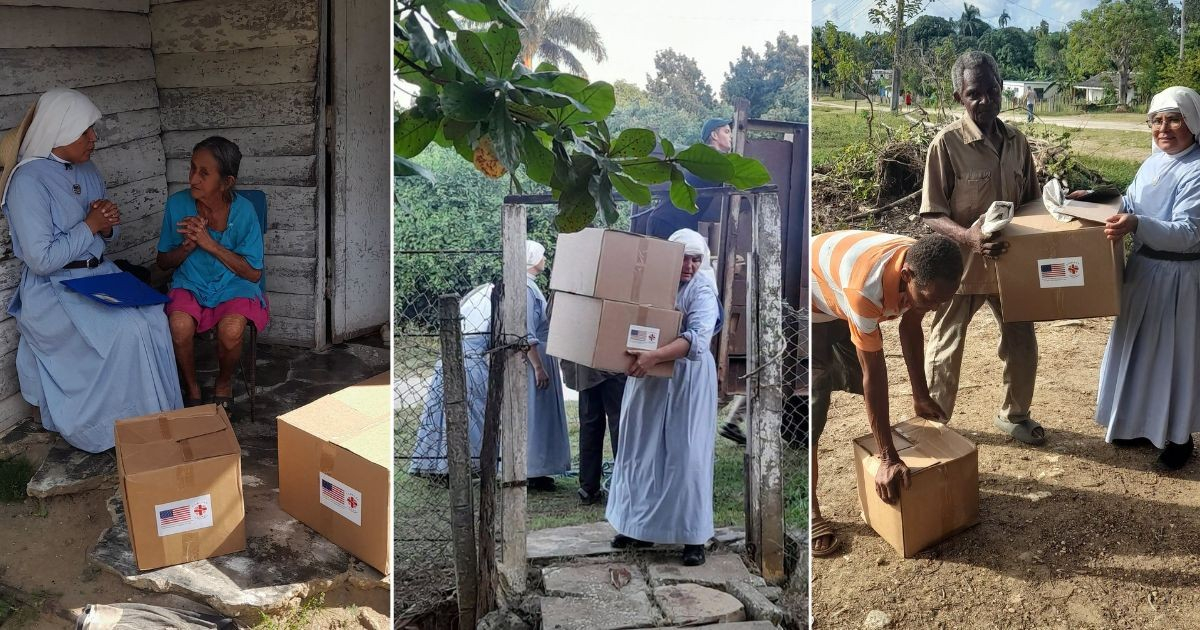
In the midst of the hardships affecting many Cuban families, a group of nuns brought more than just food and essential products to rural communities in Sancti Spíritus: their presence, their words, and the spiritual support provided moments of closeness and comfort to individuals facing difficult situations.
The organization Cáritas Santa Clara announced this Thursday on Facebook that it has completed the distribution of humanitarian aid from the United States in the towns of Guasimal and Paredes, located in the province of Sancti Spíritus, during events involving volunteers and religious members of the Missionaries of Jesus Verbo y Víctima congregation.
The deliveries were marked by scenes of gratitude and emotion among the beneficiary families, many of whom found in the sisters not only individuals providing material assistance but also a supportive presence in times of need.
“Many families, with tears in their eyes, prayed to God and to Our Lady of Charity in gratitude for all those who made the arrival and distribution of these donations possible,” Cáritas reported.
The organization described the days as times of intense labor, but also of deeply human experiences for the families, volunteers, and religious sisters involved.
The Missionaries of Jesus Verbo y Víctima engage in pastoral and assistance work in this region of Sancti Spíritus. Their involvement ensured that the help arrived accompanied by a spiritual dimension that is especially meaningful for those who find strength in their faith when facing daily challenges.
The value of those visits was not solely in the products delivered. In homes where material needs are plentiful, the willingness to listen, share, and provide support can be just as comforting as the donation itself.
The closeness of the religious with the communities also reflects a part of the work carried out by Catholic congregations and volunteers in Cuban localities, where assistance to vulnerable individuals is a daily task.
According to the publication, the participants experienced moments that "marked and filled the heart," a phrase that Cáritas used to summarize the emotional impact of the events.
The shipment distributed in Guasimal and Paredes contained 700 food modules and another 700 hygiene products, sent by the Government of the United States and received by the Diocese of Santa Clara on October 29.
The organization confirmed that the distribution of those supplies has now concluded in both communities, following several days of work by volunteers and religious sisters.
“This marks the closing of a phase of commitment in these communities, characterized by solidarity, the efforts of volunteers, and the gratitude of the families benefiting,” expressed Cáritas Santa Clara.
The presence of the nuns had been announced since the arrival of the shipment. On October 29, a second shipment of American aid destined for the Diocese of Santa Clara landed at Abel Santamaría International Airport in Villa Clara, carrying supplies intended for communities in the south of Sancti Spíritus.
The cargo was transferred to the parish of La Purísima Concepción in Guasimal, which is pastorally attended by the Missionaries of Jesus Word and Victim, who had received guidelines from Cáritas to organize the distribution alongside local volunteers.
The bishop of Santa Clara, Monsignor Arturo González Amador, had then requested that the deliveries not only provide food and hygiene products but also serve as a gesture of compassion towards those who are suffering.
In his message, he urged participants to act like the good Samaritan, stopping for "the poor and the suffering" to offer them help and companionship.
The October shipment was the second destined for this diocese. The first arrived on September 10, also with 700 food kits and 700 hygiene kits, primarily distributed in the communities of Quemado de Güines and Rancho Veloz, in the northern part of Villa Clara.
On that occasion, Monsignor González Amador acknowledged that the resources would not be sufficient for all those in need and that the distributions should focus on the most vulnerable households.
"We will only be able to assist the most urgent cases and the most painful situations," the bishop warned, recalling that humanitarian aid provides temporary relief but does not constitute a permanent solution to the needs of Cuban families.
The aid is part of the assistance program announced by Washington for Cuba in 2026, valued at 100 million dollars, of which 60 million is channeled through Cáritas Cuba and Catholic Relief Services, including supplies and the necessary costs for their distribution.
Related videos:
Filed under: