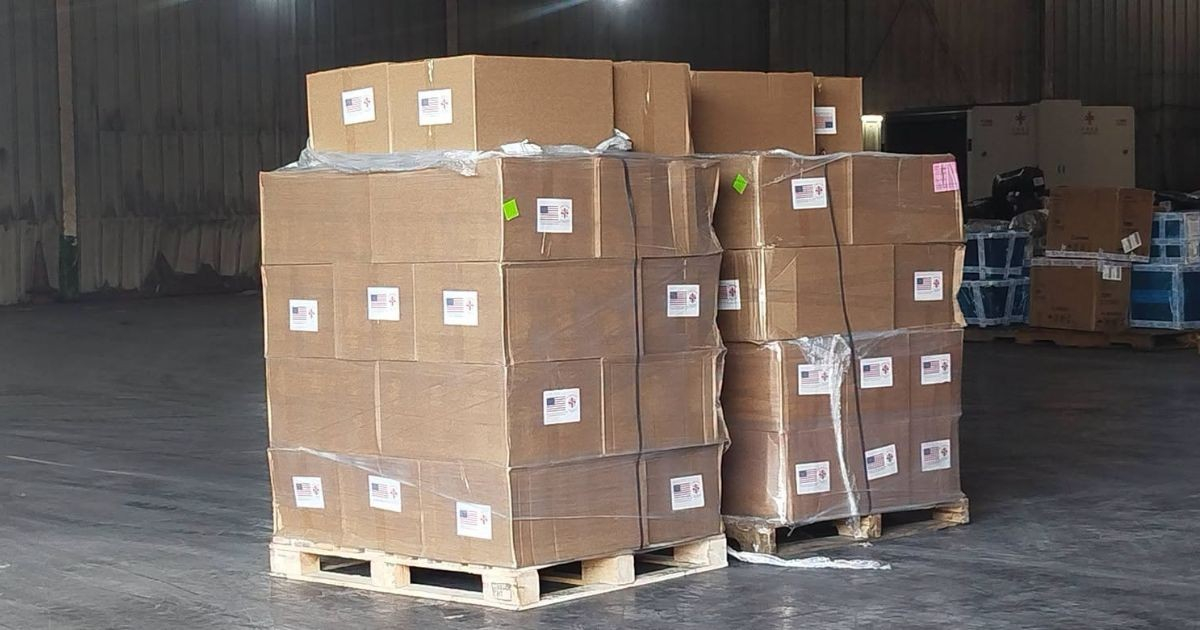
The Archdiocese of Havana received the fourth flight of humanitarian aid sent by the Government of the United States, a shipment that will be entirely allocated to families in the parish area of Güines, in the province of Mayabeque, as announced by the Catholic organization Cáritas Habana.
“Good news that fills us with hope!” the institution expressed in a post made this Wednesday on Facebook, where it confirmed the arrival of a new shipment of resources and donations from the United States.
"We are very pleased to share that today we received the 4th humanitarian aid flight from the government of the United States for the Archdiocese of Havana," the organization stated.
Cáritas specified that, on this occasion, all of the supplies received will be dedicated to supporting families in the parish area of Güines, without announcing deliveries to other locations.
"We sincerely thank all the individuals and institutions whose generosity has made this shipment possible. Your solidarity is a blessing and a comforting embrace for those in greatest need," the organization stated.
The organization concluded its message by reiterating its commitment to continue its assistance efforts: "We continue to work together for the good of our brothers!"
The publication does not specify the quantity of food, hygiene products, or other items transported on this fourth flight. It also does not indicate how many families will benefit, when the distribution will begin, or what the delivery points will be.
The new shipment is part of the humanitarian assistance efforts funded by the United States and coordinated with Catholic Church institutions to support Cuban households struggling to access food and essential items.
The first flight of the 100 million dollar program arrived in Havana on July 21, coming from Miami, with 700 food modules and another 700 hygiene modules intended for the same number of families in the archdiocese.
That shipment was received at José Martí International Airport by Cardinal Juan de la Caridad García Rodríguez, the national director of Cáritas Cuba, Carmen María Nodal Martínez, and the diocesan director of Cáritas Habana, Ángel Miguel Gutiérrez Valdivia.
The distribution later began in communities such as Bejucal, in Mayabeque, and Alquízar, in Artemisa, where Caritas volunteers organized the delivery of supplies to families previously identified due to their vulnerable conditions.
The packages from that first operation contained food such as rice, beans, oil, sugar, pasta, sardines, and tuna, as well as hygiene products, containers for storing water, water purification tablets, and rechargeable lamps.
Assistance is delivered through the network of parishes and volunteers from Cáritas, in coordination with Catholic Relief Services, an organization involved in the procurement and logistics of supplies.
Of the 100 million dollar humanitarian program announced by Washington in May, 60 million is being channeled through organizations linked to the Catholic Church, while the remaining 40 million is allocated to other independent humanitarian entities.
The initiative started with deliveries in the western part of Cuba and later expanded to various provinces, through shipments directed to the dioceses responsible for identifying and assisting the most needy households.
At the end of October, for example, the Diocese of Pinar del Río received its second shipment from the United States, containing another 700 food modules and 700 hygiene modules for vulnerable communities.
On the last Tuesday, a new shipment of 700 food kits and 700 hygiene kits arrived in Santa Clara, intended for families in the municipality of Cruces, in Cienfuegos. This was also the second shipment received by that diocese.
These shipments are distributed based on needs identified by parish teams, prioritizing elderly individuals, people with disabilities, bedridden patients, pregnant women, breastfeeding mothers, and households with young children in vulnerable situations.
The Catholic organization has acknowledged that the available resources are insufficient to assist all those in need and that aid must be focused on the most urgent cases, following visits and evaluations of households.
Related videos:
Filed under: