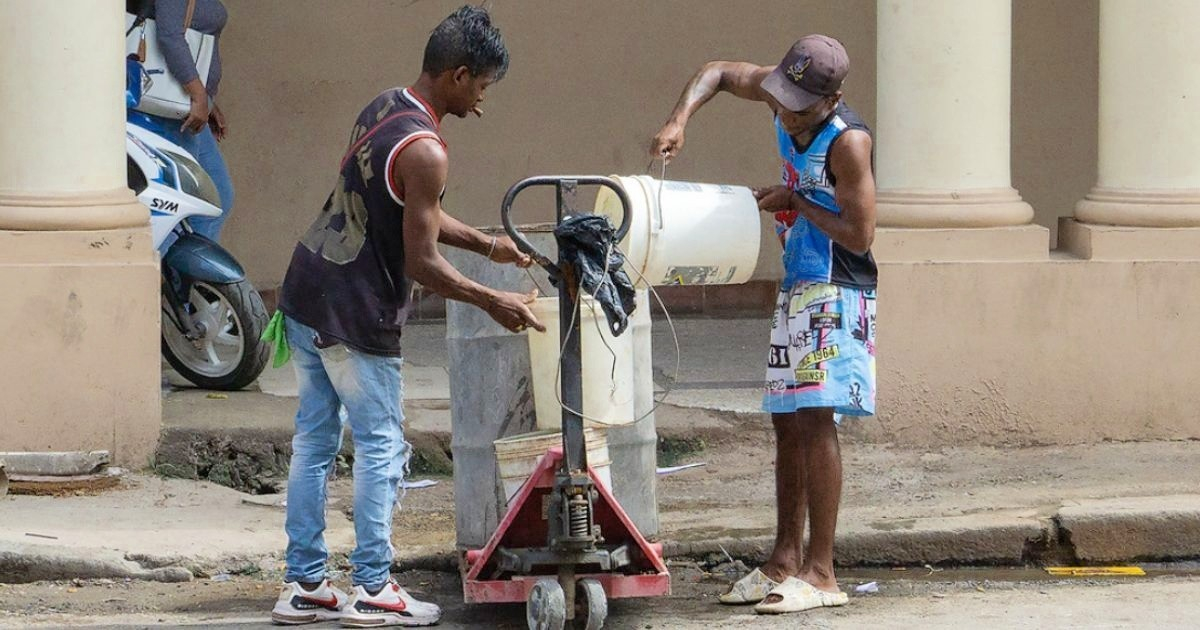
A Cuban from the Zamora neighborhood in the Havana municipality of Marianao, launched a solidarity campaign to provide safe drinking water to vulnerable families in her community, where there are areas that have gone more than six months without receiving potable water, and residents are collecting rainwater for drinking and cooking.
The initiative, called “Safe Water for Cuba” and driven by the Humanitarian Aid Network, has its first pilot program in the Zamora neighborhood and aims to raise funds to send water purification tablets, water filters, and ozonators to those who need it most.
Zea Gisselle, the neighbor leading the campaign, described scenes that pushed her to her limit: “I arrived at a house and there is an elderly woman over 60 years old who is taking care of a 2-year-old boy. He is her grandson, the baby of her son who has passed away. After months without access to drinking water, they began to collect rainwater to meet their needs at home.”
"The situation is not just unsustainable; it is criminal. I have visited homes where most residents are elderly individuals living alone, as well as elderly people caring for small children," wrote Gisselle, who also reports an outbreak of environmental hepatitis in the neighborhood, which she partly attributes to the consumption of unsafe water.
The only response the community received from the authorities was a pipe of murky yellow water, insufficient to supply more than four blocks. "I don't know if it's their way of mocking the population and saying 'screw you' or their way of 'cleaning their hands' and saying 'we did something,'" Gisselle wrote.
Donations for the campaign are channeled through Zelle (thegrassthatgrows@yahoo.es), Bizum (616 551 908), and PayPal. The coordinating contact is a Spanish number: +34 616 551 908.
"Today, my neighborhood is the first pilot experience, but if we succeed in this step, we can expand, we can reach other neighborhoods," wrote Gisselle, leaving open the possibility of extending the initiative to other communities in Cuba.
On July 1st, residents of the same neighborhood staged pot-banging protests demanding "water and electricity" after more than 24 hours without power. Days later, Gisselle herself reported 38 consecutive hours without light and a week without water, and by mid-month another resident of Marianao reported 12 days without supply.
The associated health deterioration is already acknowledged by the authorities themselves. The Ministry of Public Health admitted in September a simultaneous increase in diarrheal diseases and hepatitis linked to deficiencies in sanitation, and a Cuban pediatrician warned about the rise of hepatitis and diarrheal infections in children, linking them to the consumption of contaminated water or food.
Related videos:
Filed under: