An advertisement from a private company offering water truck services in Cuba sparked a debate on social media after being shared by Fabio Fernández Batista, historian and professor in the Department of History of Cuba at the University of Havana.
While posting the flyer from the company "agranel", this Saturday, the academic included a reflection that summarizes the phenomenon: "When the State fails to guarantee a right, the market—ever astute—finds a niche to profit from."
The "bulk" announcement offers water supply through tanker trucks with the slogan "Tailored to You" and "May You Never Run Out of Water!", targeting homes, businesses, institutions, and construction sites.
The post accumulated hundreds of interactions and sparked a chain of comments in which Cubans debated the privatization of basic services and the contradiction between official rhetoric and everyday reality.
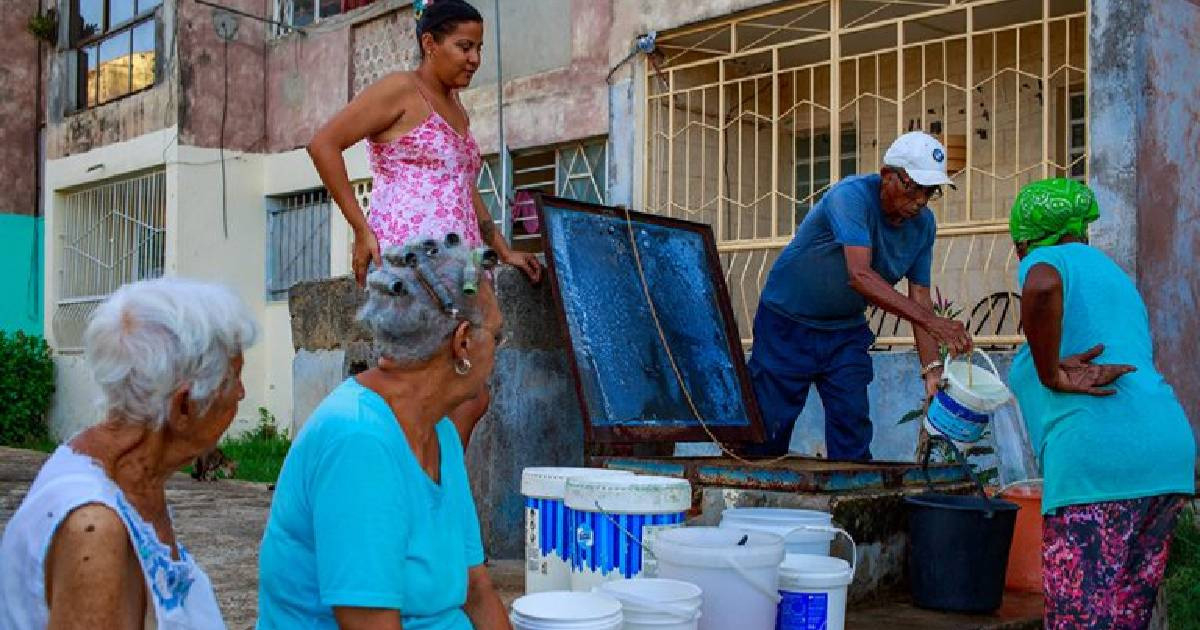
The paradox highlighted by Fernández Batista has a concrete legal basis: the article 76 of the Cuban Constitution of 2019 states that "everyone has the right to water" and obligates the State to create conditions to ensure access to drinking water and sanitation. However, millions of Cubans struggle to receive water from the public supply, and some are forced to turn to private providers.
The magnitude of the crisis is striking. According to data from the National Institute of Hydraulic Resources (INRH), as of October 29, approximately 2.14 million Cubans were experiencing total or partial disruptions in their water supply due to the networks. The causes are structural; among them, one can mention the decades-old pipes that lose a significant percentage of water before it reaches households and the fact that more than 80% of the pumping stations depend on the National Electric System, which means that power outages impact the operation of the pumping stations and exacerbate supply issues.
In that void, the private market operates. The prices of water trucks vary by area: in Havana, they range from 18,000 to 50,000 Cuban pesos; in Santiago de Cuba, reports indicate prices between 7,000 and more than 15,000 pesos; in San Juan and Martínez and Songo-La Maya, residents reported prices between 15,000 and 20,000 pesos per truck.
In Pinar del Río, residents of Calle Real were without water for over 50 days, and a neighbor even went on to request that the aqueduct be handed over to a small and medium-sized enterprise due to the inefficacy of the state system.
The comments on the post reflect different interpretations of the phenomenon. One Internet user noted that "the State guarantees little or nothing, and I have no doubt that it is part of the [privatization] plan," drawing a parallel with the scarcity of domestic gas: "We need to look at the private dollarized options (which are extremely high) that exist to buy a small gas canister at prices that even Trump wouldn’t pay for something so basic yet so necessary."
Another voice pointed out that the country is moving forward with "a government that claims to continue betting on a kind of socialism that no one understands, while the economic reality is increasingly guided by the logic of neoliberal capitalism." A third voice added a layer of opacity: "The problem with Cuba is that many of these new businesses are simply the State disguised as small and medium-sized enterprises."
The phenomenon of private water trucks and wells to obtain water in Cuba is not new, but it has intensified in 2026 in the wake of blackouts and the deterioration of the water infrastructure.
The gap between the percentage of Cubans who gain regular access to the service and the constitutional mandate is, in itself, a measure of the failure that Fernández Batista summarized in a single phrase.
Fernández Batista has expressed his criticisms of the country's reality on other occasions. In January 2023, he questioned during the Roundtable the idea of a patriotism based solely on resistance and warned about the loss of pride in being Cuban among the youth. More recently, in July, he described the everyday reality of Cuba as a "zombie apocalypse", depicting scenes of accumulated garbage, scarcity, blackouts, and lack of water.
Related videos:
Filed under: