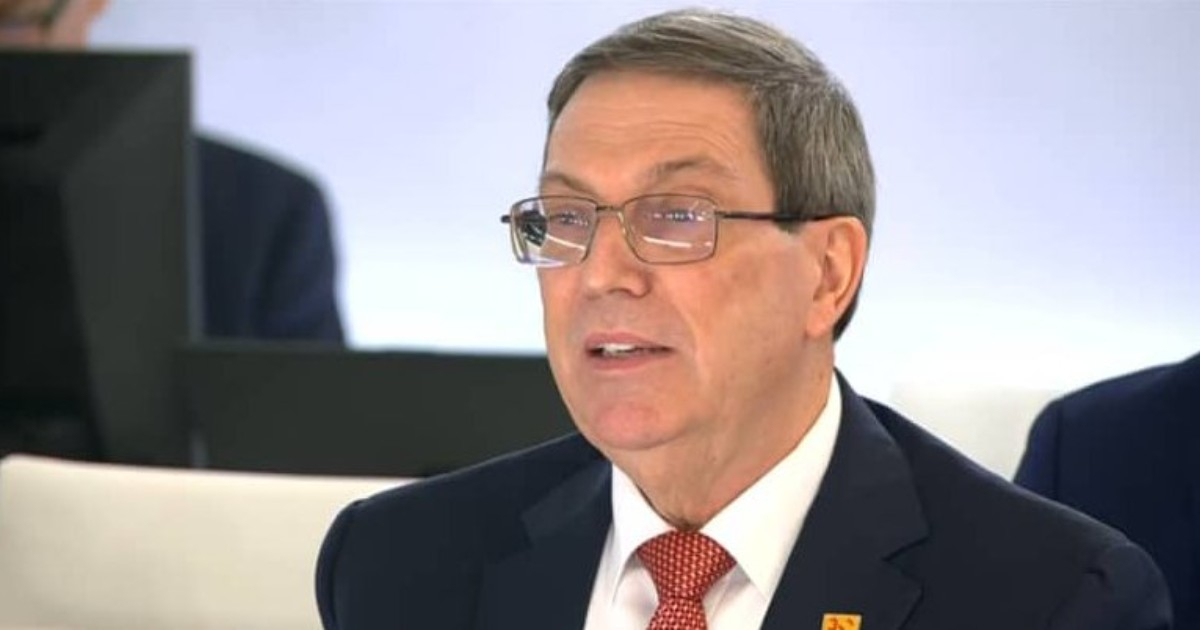
The Cuban Foreign Minister Bruno Rodríguez Parrilla led the Cuban delegation at the plenary session of the XXX Ibero-American Summit held in Madrid this Thursday, where he seized the opportunity to denounce the U.S. sanctions against the island in front of representatives from the 22 countries of the Ibero-American Community of Nations.
Rodríguez, who replaced President Miguel Díaz-Canel at the event held in the Royal Collections Gallery in Madrid, focused his remarks on criticizing Washington's policy towards Havana, which he described as "the obsessive economic suffocation war against Cuba that the United States has taken to inhumane limits of collective punishment".
On his account on the social network X, Rodríguez expanded his complaint: "The Cuban people have suffered from the unprecedented strengthening of the U.S. economic blockade, the imposition of an energy siege, equivalent to a naval blockade, and the application of secondary sanctions on individuals or entities that establish trade relations with Cuba."
The chancellor also thanked the Ibero-American countries that supported the resolution passed by the UN General Assembly on October 28 against the embargo.
The resolution received 130 votes in favor, 17 against, and 25 abstentions, compared to the 165 supports recorded in 2025. This was the lowest level of favorable support since 1995.
In his speech, Rodríguez urged that the Ibero-American Conference act "without interference, exclusions, or external pressures" and welcomed the establishment of the Ibero-American Alliance for Artificial Intelligence, the Ibero-American Network for Disaster Risk Reduction and Civil Protection, and the approval of the Ibero-American Environmental Agenda.
The intervention of the Cuban chancellor occurred just a few days after he was involved in an altercation at the UN General Assembly on October 27, when he and other members of the Cuban delegation interrupted the speech of U.S. Ambassador Mike Waltz with at least three points of order, all of which were rejected.
In the lead-up to the summit, the opposition figure Rosa María Payá presented in Madrid the "Cuba on the Threshold" plan, which proposes four phases of transition that include the release of over 1,000 political prisoners and the holding of elections under international supervision.
The final declaration of the summit, comprised of 20 points, rejected "coercion" and measures contrary to international law, but did not explicitly mention the U.S. embargo against Cuba.
Argentina, Colombia, Costa Rica, and Paraguay explicitly distanced themselves from that paragraph, while only Brazil, Nicaragua, Uruguay, and Mexico explicitly rejected the embargo among the 22 participating countries, which highlighted, according to El País, the deep ideological rifts that run through the Ibero-American bloc.
Related videos:
Filed under: