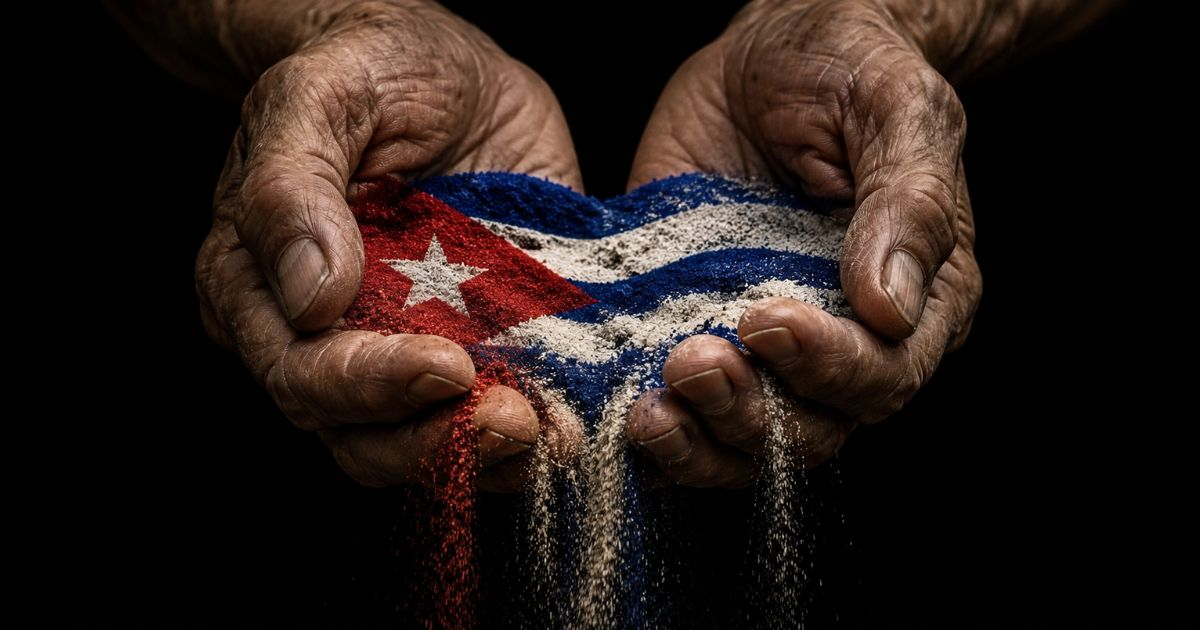
The Cuban activist José E. González Marín issued a stern reflection on the devaluation of the Cuban peso and its consequences for millions of people who rely on state salaries and pensions, warning that the economic deterioration is not only destroying the purchasing power of the population but also their chances of building a future.
In a Facebook post, González Marín questioned how much further the depreciation of the national currency can continue before making daily life for Cubans completely unsustainable.
"And how much more can the Cuban peso devalue before our lives become unsustainable?" she asked.
His reflection comes as the US dollar continues to reach new highs in the informal market. This Thursday, the currency hit 920 Cuban pesos (CUP), while the euro reached 1,000 CUP, according to the day's reference rates.
"Today the dollar started at 920 pesos in the Cuban informal market. Tomorrow it could be more expensive. And the day after tomorrow, who knows," wrote the activist, describing a rise that seems to have no end in sight.
However, González insisted that the real issue is not only how much the dollar costs, but how much the money that Cuban workers receive has diminished in value.
The activist described a reality in which income remains in the national currency, while an increasing portion of prices and commercial operations depends directly or indirectly on foreign currencies.
“We earn in one currency, but we buy in an economy that increasingly looks towards another. We work for an entire month, and when the time comes to make purchases, we find that our salary goes less far than it did yesterday,” they lamented.
The loss of purchasing power that is being reported is reflected in the official statistics. In October, it was revealed that the average monthly salary in Cuba had risen to 7,354 CUP, a figure that, despite the nominal increase, remains insufficient to meet many basic needs.
In July, officials from the Ministry of Labor and Social Security acknowledged that the minimum wage of 3,210 CUP was insufficient to cover the basic basket of goods and services.
The situation is also reflected in daily expenses. In October, a Cuban woman showed a grocery purchase of 5,160 pesos which, as she explained, did not include large quantities of products and consumed a considerable portion of a healthcare professional's monthly salary.
On this very topic, González drew attention to the inequality between those who receive remittances or have access to foreign currencies and those who must survive solely on income in CUP.
“What happens to the retiree, the worker, the teacher, the doctor, the father, or the mother who depend solely on a salary in Cuban pesos?”, he questioned.
It was also questioned how a family can organize its expenses when it is unaware of how much food and other products will cost the next day, which they can barely afford to buy.
"Savings are fading, prices are skyrocketing, projects are being postponed, and the most basic needs are turning into impossible bills," he wrote.
For González, the problem extends beyond current difficulties, as he does not see clear signs of recovery for the coming year either.
"If this spiral continues, it will not only be the value of money that we lose. Opportunities, peace of mind, the ability to save, and hopes of building a better life will also continue to be lost," he warned.
The activist rejected the notion that Cubans should get used to a whole month of work not being enough to meet their families' needs.
“A country cannot become accustomed to the fact that working is no longer enough to live on, nor can it condemn its citizens to wake up every morning wondering how much more their salary has shrunk,” he expressed.
González concluded his reflection with a warning about the human consequences of the economic crisis, beyond the numbers of the currency market.
"Because when a currency loses its value, an economy becomes impoverished; but when work no longer guarantees a dignified life, what is being lost is much more than money: it is the hope of an entire people," he concluded.
Beyond the appreciation, the decline in income has been documented by various studies. In June, an estimate by Cuban economist José Luis Pérez Capdevila placed the cost of a basic needs basket at around 96,000 CUP per month, well above the national average salary.
For its part, a study by the Cuban Observatory for Human Rights released in August estimated that 94% of Cubans lived in extreme poverty.
The research also found that eight out of ten respondents had skipped a meal at least once in the six months prior due to a lack of money or food.
Related videos:
Filed under: