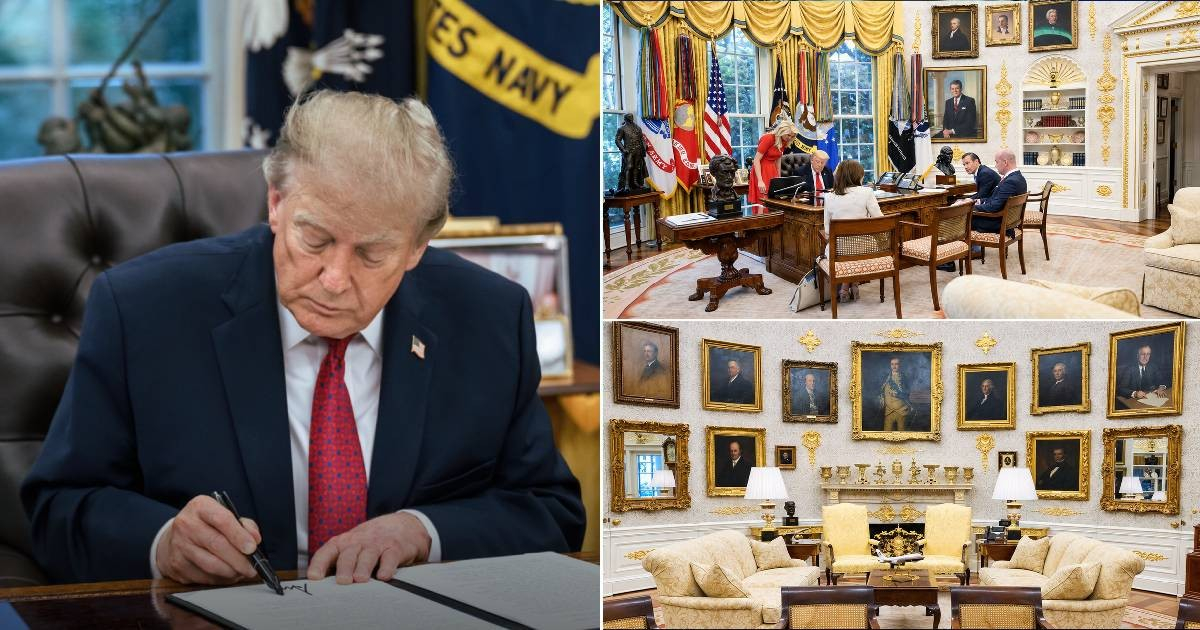
President Donald Trump signed on Thursday a proclamation to designate the Oval Office, the Outer Oval Office, and the Cabinet Room as a national monument of the United States, with the stated purpose of preserving these historic spaces for future generations.
The decision, announced by the White House on November 5, is based on the Antiquities Act of 1906 and establishes protection mechanisms aimed at preserving these spaces "for posterity" and subjecting any substantial modifications to their historical structure to evaluation.
Likewise, the proclamation comes just a few days after former President Barack Obama mocked the ostentatious gold decoration of the Oval Office and compared the White House to a restaurant from the Cheesecake Factory.
In the presidential office, there are now figures made of gilded silver on the shelf, medallions on the fireplace, golden eagles on side tables, rococo mirrors on the doors, and cherubs brought from Mar-a-Lago.
The order tasks the Secretary of the Interior, Doug Burgum, with developing a management and conservation plan, in coordination with the Committee for the Preservation of the White House and other relevant entities.
Although the Trump Administration presents the measure as a recognition of the historical significance of the main U.S. presidential office, the announcement comes amid controversy over the decorative changes made by the president since his return to power.
On October 24, during a rally in Cleveland, Ohio, Obama made a sarcastic remark about the transformation of the Oval Office, stating that Trump had left the White House "as if Saddam Hussein had opened a Cheesecake Factory," and concluded: "They are not serious people."
The comparison provoked a reaction from officials in the Trump Administration, which the former Democratic president later mocked by describing it as "a whole government response to a joke."
The new proclamation, however, does not prohibit any future modifications to the Oval Office. The document outlines evaluation and conservation mechanisms in the event of substantial changes, so its scope does not prevent future presidents from altering the furniture or decor of those spaces.
"It is about the Oval Office and the Cabinet Room, very important spaces. I am going to sign a document that will turn them into a monument for posterity," Trump had announced in the morning to the gathered journalists in the Oval Office.
Trump also announced that the document would be sent to Congress for ratification, although that requirement is not mentioned in the text of the proclamation published by the White House.
The signing took place just two days after the midterm elections on November 3, 2026, in which the Republican Party suffered a historic defeat: the Democrats regained control of both the Senate and the House of Representatives.
It was the third event of the week featuring Trump related to construction or renovation projects in Washington, initiatives that have enjoyed little popularity among voters.
From a legal perspective, the scope of the proclamation is limited. The text expressly preserves the presidential authority to change furnishings and make operational or security modifications that do not substantially impair the architectural structure, allowing a successor to redecorate the spaces without violating the regulation.
Additionally, a later administration could attempt to revoke the proclamation, although the extent of that power remains a subject of legal debate. Trump himself has reduced the protected area of national monuments designated by his predecessors.
Kentucky Governor Andy Beshear was more straightforward this Thursday, indicating that he would remove the gold from the Oval Office if he were ever to become president, suggesting that the proclamation signed by Trump could face political and legal challenges in the future.
Related videos:
Filed under: