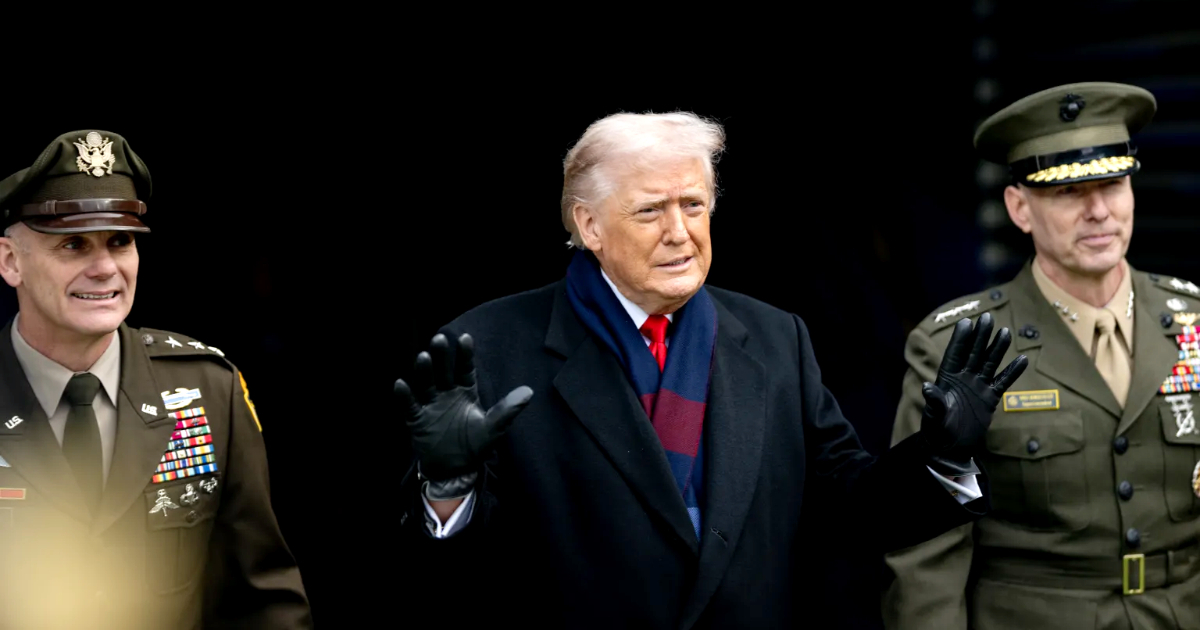
The resounding defeat of the Republicans in the legislative elections on November 3 heralds a new chapter for the administration of Donald Trump.
The Democrats regained control of both chambers of Congress, driven by economic discontent and opposition to the war with Iran. But to what extent can this electoral setback alter the U.S. offensive against the Cuban regime?
The response requires distinguishing between Congress's ability to control a prolonged war and the powers that the president retains to order specific military operations.
It also requires examining a reality that transcends domestic politics: Cuba is among the priorities of a new U.S. doctrine that has placed the security of the Western Hemisphere at the center of its foreign strategy.
Elections change the political conditions in Washington, but they do not automatically deactivate that strategy.
A Democratic Congress does not paralyze the commander in chief
Starting January 3, 2027, Trump will have to govern with both chambers under Democratic control. The new majority will be able to investigate his decisions, block legislative initiatives, examine budgets, and hold account for U.S. military operations.
The War Powers Act of 1973 states that the president must inform Congress within 48 hours when deploying U.S. forces in certain hostile situations. It also provides for a general limit of 60 days for combat deployment without legislative authorization, with a possible extension of 30 days under exceptional circumstances.
But that legislation does not necessarily prevent the president from ordering a specific military operation of limited duration, although the constitutionality of a particular action will depend on its basis and circumstances.
A prolonged intervention or occupation of Cuba would encounter significant political and budgetary obstacles. A brief operation, similar to the one carried out in Venezuela, presents a different situation.
On January 3rd, U.S. forces captured Nicolás Maduro without prior specific authorization from Congress. The Administration defended this action as a limited operation, although its legality both nationally and internationally has been questioned.
The Donroe Doctrine and military signals towards Cuba
The so-called Donroe Doctrine, formulated as an update to the historic Monroe Doctrine, establishes the recovery of American dominance in the hemisphere and the containment of opposing powers such as China, Russia, and Iran.
The 2026 National Defense Strategy explicitly outlines swift and decisive military actions when Washington deems its regional interests threatened, and presents the operation against Maduro as an example of this approach.
Cuba holds a special place in that design.
On January 29, Trump signed an executive order declaring a national emergency due to the actions of the Cuban government, which he accused of collaborating with countries and organizations hostile to the United States.
The measure served to reinforce economic pressure on Havana. It does not, in itself, constitute authorization to use force, but it is part of the political and strategic framework through which Washington presents its confrontation with the regime.
Military signs have also accumulated during 2026.
In May, CBS News reported that U.S. intelligence services were studying potential Cuban responses to an attack. In July, the same outlet revealed that the Pentagon had examined various options, including an airlift operation involving the 101st Division.
In September, another investigation by CBS documented consultations regarding the availability of medical, logistical, and military police units for potential missions under Southern Command. The officials consulted linked these activities to planning concerning Cuba, although no deployment orders were in place.
More recently, CiberCuba reported on anti-drone exercises at Guantánamo Naval Base and the strengthening of defense capabilities against unmanned aerial threats.
None of these moves indicate that Trump has decided to attack Cuba. However, collectively, they show that the military option is being considered as part of a hemispheric strategy that has already resorted to the use of force in Venezuela.
The Venezuelan precedent and the problem of the day after
An operation against Cuban leaders might have limited objectives, but its execution would present political challenges different from those encountered in Venezuela.
An analysis by the Center for Strategic and International Studies (CSIS), published in June, examined various military scenarios and warned that the capture or elimination of figures from the regime would not guarantee its downfall.
Unlike Venezuelan chavismo, the Cuban system has more institutionalized power structures, organized around the Communist Party, the Armed Forces, intelligence services, and the military business conglomerate GAESA.
In Venezuela, Washington found interlocutors within the government of Delcy Rodríguez willing to cooperate following Maduro's capture. In Cuba, there has not been a publicly identified equivalent sector capable of ensuring a transition under the conditions required by the United States.
The military superiority of the United States could allow for a targeted operation without necessarily resolving the political issue that prompted it.
That is one of the main dilemmas of any strategy aimed at effecting a regime change through force.
Iran, the political cost and Cuban expectations
The war with Iran adds a significant difficulty.
According to Associated Press, Vice President JD Vance attributed part of the Republican defeat to voters' rejection of the conflict. The new Democratic majority has also announced its intention to intensify oversight of presidential decisions.
Engaging in another military operation, especially if there is a risk of escalation, would need to be assessed against that political weariness.
However, Cuba has a particularity: the support for strong measures among broad sectors of the Cuban-American community in Florida.
The FIU Cuba Poll 2026, conducted among 1,004 Cuban-Americans in Miami-Dade, found that 73% supported U.S. military action to overthrow the government in Havana. Among the proposed options, covert operations received more support than a ground invasion.
This support contrasts with a national survey by Marist conducted in January, in which 61% of Americans opposed military intervention in Cuba.
The figures relate to different populations and moments, but they illustrate a reality that Washington cannot ignore: political support for an operation against Cuba is not uniform within the United States, although there is a significant favorable current among Cuban Americans in Miami.
Will Trump change his strategy?
The president himself has reiterated his intention to achieve a political transformation in Cuba before the end of his term, linking his upcoming actions to the evolution of the conflict with Iran.
On October 31, he mentioned that objective again and assured that Marco Rubio was closely monitoring the Cuban issue.
Even more significantly, the State Department released an article on November 4 about the Monroe Doctrine in which a senior U.S. official stated, "We carried out the entire project in Venezuela while the one in Iran was underway, and we are dealing with Cuba."
The statement does not announce an intervention, but indicates the continuation of the hemispheric strategy despite the events in the Middle East.
The Democratic victory could intensify Congressional oversight, raise the political cost of new operations, and favor diplomatic alternatives. But it also leaves Trump and Rubio with broad executive tools to maintain sanctions, negotiations, and other forms of pressure.
On the other hand, Havana could interpret the electoral outcome as an opportunity to buy time, endure until the end of the presidential term, and hope for a change in policy in Washington. This strategy does not guarantee a solution either: sanctions may persist, and the economic crisis in Cuba continues to worsen.
The midterm elections have not diminished the likely military option against Cuba, nor have they put an end to the U.S. pressure strategy. However, there is also no public evidence that Trump has decided to order an intervention.
The fundamental question goes beyond presidential powers or moves by the Pentagon: if Washington were able to weaken or decapitate the regime through a limited operation, who would take power and how would a political transition be ensured?
The answer to that question will determine whether a potential military victory can transform into the political change that the Trump administration claims to seek.
Related videos:
Filed under: