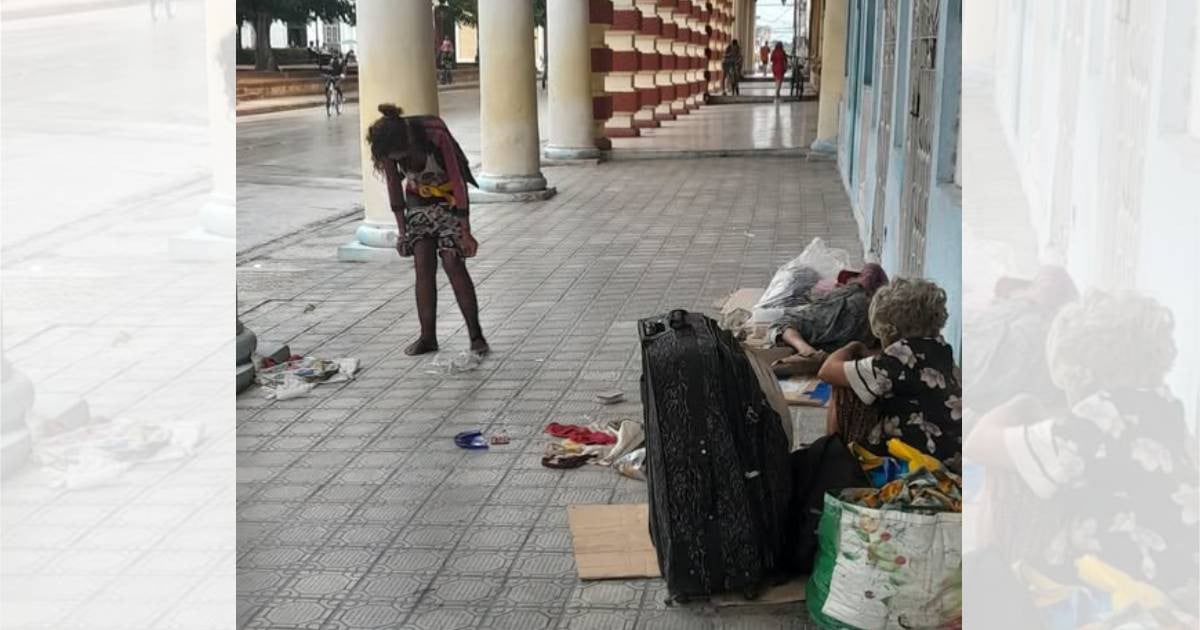
Homeless individuals sleep on cardboard in the doorways of homes facing the central San José park in the city of Holguín, a scene that highlights social neglect and the lack of response from local authorities.
The report was published on Thursday by user Irma Lidia Broek in the group Facebook "Revolico Holguín (This Group is for Sale)." Comments from residents described elderly individuals spending the night on the ground and people searching for food among the trash to survive.
One of the most harrowing testimonies was from a citizen who claimed to have seen one of the women in the photographs plucking a pigeon to feed herself.
Several residents questioned why the municipal authorities had not intervened, despite the fact that the Municipal Government offices are only a few meters away, on the other side of San José Park.
"And the Municipal Government offices are on the street parallel to that one, just cross San José Park on foot; no fuel is needed. Could it be that they're turning a blind eye? They are the ones who need to resolve this; they have the authority and the RESPONSIBILITY," wrote a citizen.
Other comments noted that the situation is not exclusive to that part of the city and also affects the Carlos García neighborhood and other areas of Holguín. A resident recalled that for many years it was officially stated that there was no begging in Cuba.
A person who participated in assistance efforts alongside a church in the Alcides Pino neighborhood shared that they previously brought food, clothing, and other materials to those staying in the doorways, but explained that the pastors who were driving that aid emigrated. Other citizens questioned why a church located across from the park keeps its doors closed and does not offer assistance to these individuals.
Another commentator described a mechanism that, according to their testimony, does not solve the problem. Ambulances periodically pick up some of these individuals and take them to shelters, but they return to wandering the streets in less than 24 hours.
"For decades, we were told that there were no beggars in Cuba, that no one was left homeless, and that the Revolution ensured the well-being of everyone. But one thing is the official rhetoric, and another is the very different reality that these people live," summarized a resident of Holguín in the comments.
In September, the authorities in Santiago de Cuba acknowledged an increase in begging, including child begging, in central areas. A month later, a scene of urban poverty was also documented in El Vedado, in Havana.
In the province of Holguín, the authorities themselves acknowledged before committees of the National Assembly that 90,148 people, equivalent to 10.1% of the provincial population, are in a vulnerable situation.
At the beginning of October, Prime Minister Manuel Marrero Cruz announced a monthly food assistance program providing five pounds of rice, one pound of sugar, and one pound of grains for 883,000 people classified as vulnerable, a figure that nearly tripled what was recorded just a year earlier.
After conducting 1,318 interviews between June 27 and July 29 in 79 Cuban municipalities, the Cuban Observatory of Human Rights (OCDH) found that 94% of the surveyed population lived in extreme poverty.
Related videos:
Filed under: