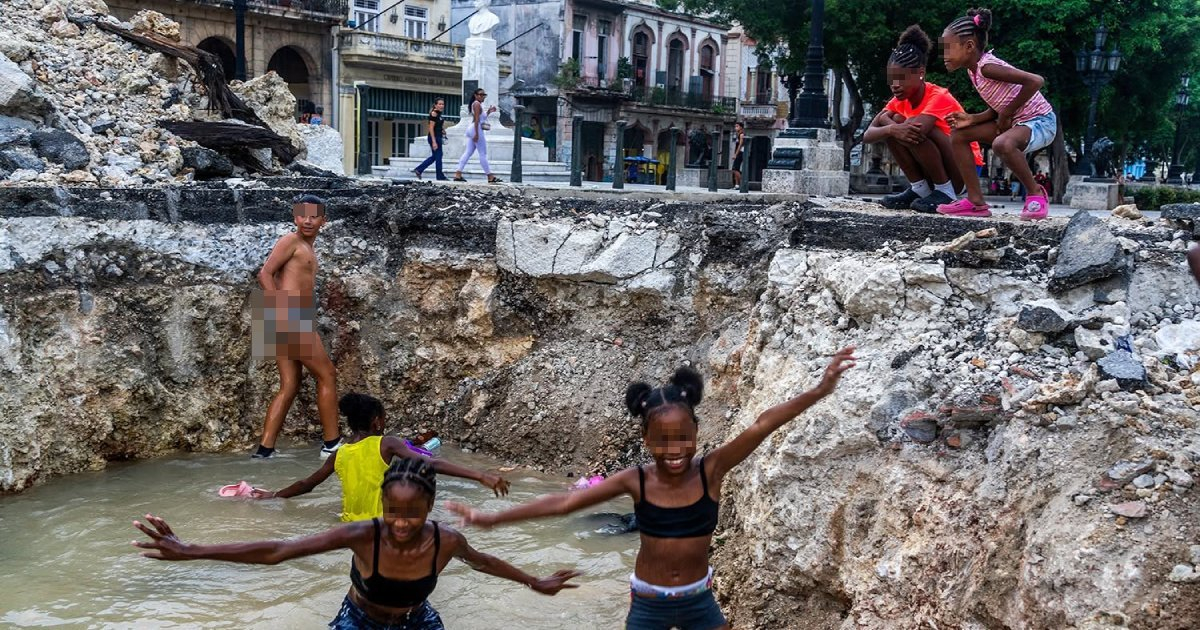
A huge open excavation at the corner of Prado y Neptuno, one of the most iconic intersections in downtown Havana, transformed this Friday into an improvised "beach" for a group of children who found in that flooded hole a place to play amid the collapse of the capital's hydraulic infrastructure.
The images were captured and posted on Facebook by photographer Alina Sardiñas, who described the scene with a mix of wonder and bitterness. The photographs depict minors—including a girl in a pink shirt and a boy without a shirt wearing blue shorts—peering over the edge of the ditch and, in some shots, partially submerged in the murky water that had collected inside.
In the background, you can see the Gran Teatro de La Habana and the sign of the Hotel Inglaterra.
Before the children arrived, the place was utilized by adults who collected water in buckets to fill large barrels transported in handmade carts. "Some sell it, others use it for their own consumption. Everyone makes do as best they can. We've reached a point where chaos also provides," Sardiñas wrote.
The photographer recounted how the scene changed in a matter of minutes: "While I was taking photos of the water collectors, the children appeared, and that spot at Prado and Neptuno transformed from the bitterness caused by scarcity to the joy of having a beach, a lake, a river in the middle of the city."
Sardiñas also recalled a photograph of Syrian children playing in a bomb crater filled with water, drawing a parallel between the devastation of war and the decline in Cuba: "I thought that for children there is almost always a way to escape the terrible, the bombing, the poor management of a type of system that condemns a people to suffering."
The writer Jorge de Mello also shared the images and reported on Facebook that the excavation has been open for weeks without repairs between the Hotel Parque Central, the Paseo del Prado, and the Parque Central. "A while ago, Havana stopped resembling the elegant capital of Cuba that we all knew; now it resembles any city in Haiti," he wrote, describing the situation as "yet another indication of the civilizational regression process" in the country.
The scene is not an isolated event. In March 2026, children played in a drain near a school in San Miguel del Padrón; in April, minors used a flooded pothole as a pool in Pinar del Río; and in September, residents of Yaguajay ironically named a huge pothole “jacuzzi” in Perea.
The situation is a response to a structural crisis. The pipes in Havana have been in use for between 60 and 70 years, according to Aguas de La Habana. As of November 4, 536,000 residents of Havana were experiencing water supply issues, and the impact across the country reached 2,681,770 people, as acknowledged by the regime itself, according to Infobae.
This Friday, residents of Neptuno Street reported separately on unsanitary conditions involving garbage, worms, and rodents in the same area where children discovered their makeshift "beach." "While the government focuses on erecting unnecessary ideological barricades with the debris of the nation, we Cubans endure the inhumane consequences of the collapse that will eventually be permanent," concluded De Mello.
Related videos:
Filed under: