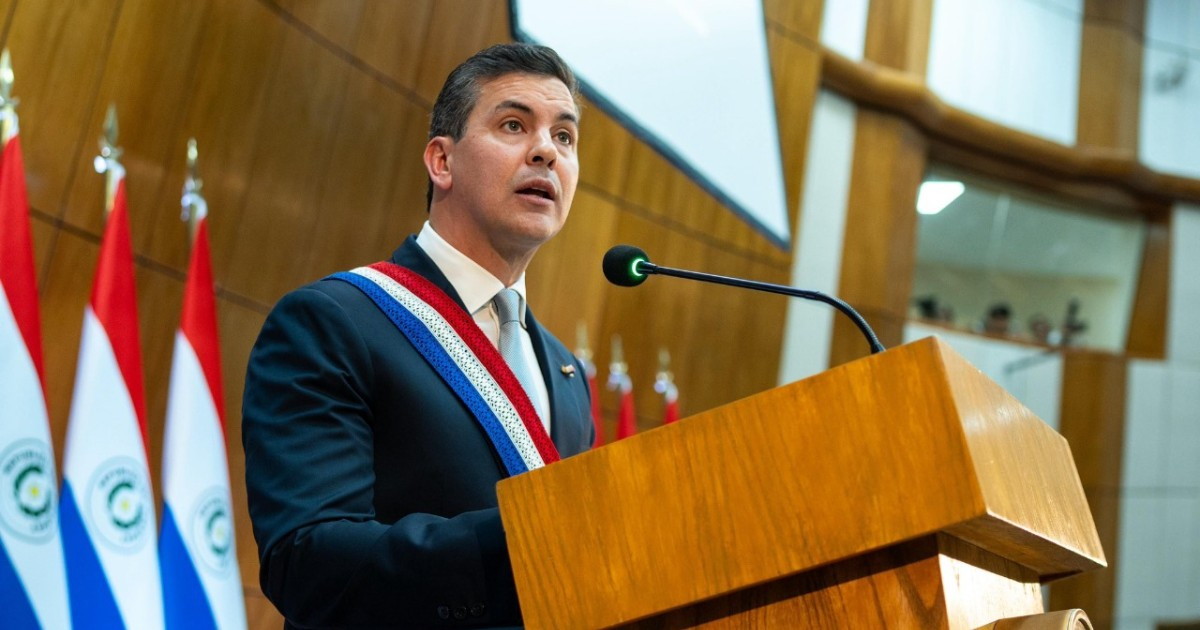
The criminal guarantees judge Humberto Otazú ordered this Saturday the preventive detention of former President of Paraguay Santiago Peña, who will serve the measure at the premises of the Presidential Escort Regiment in Asunción, as reported by the country's General Prosecutor's Office.
The court ruling arrived hours after charges were formally brought against the former president in criminal case No. 92/2026, related to the collapse of Ueno Bank, a digital entity that left millions of Paraguayan citizens without access to their savings.
The prosecutors charged Peña with "the alleged commission of breach of trust, as an instigator, and self-benefiting administration, as the author," according to Public Prosecutor's Office Act No. 7.
Alongside him, Carlos Dagoberto Carvallo Spalding was also arrested and charged. He served as the president of the Central Bank of Paraguay until November 3, when he resigned amid the resolution process of Ueno Bank.
Carvallo, who previously headed Financiera Ueno —the predecessor of the bank— faces charges of breach of trust, the production of false public documents, and self-serving administration.
The fiscal hypothesis asserts that between 2023 and 2026, Ueno Bank received substantial deposits from public and social security entities while allegedly engaging in irregular credit operations with companies linked to its economic group.
According to a report from the General Directorate of the Public Treasury, as of September 2026, the state funds deposited in the entity amounted to approximately USD 233,400,495, in addition to guaraníes equivalent to more than three trillion of the local currency.
The investigation indicates that Peña, during his tenure, intervened in decisions regarding the placement and retention of public funds in Ueno Bank, an institution with which he reportedly maintained shareholder ties: the former president was a shareholder of Ueno Holding S.A.E.C.A. until March 2025.
In total, the Prosecutor's Office has charged 27 individuals in the case, including Miguel Vásquez, one of the founders of the bank, who has been moved to prison along with five other executives.
After Peña announced his resignation on November 5 through a video on social media, ruling party legislators blocked the session to formally accept it —as a maneuver to prevent him from holding the lifelong senator position granted by the Constitution to elected former presidents— and the Senate dismissed him on Friday with 44 out of 45 votes for "malfeasance in office."
That same night, protesters surrounded his residence in Asunción with drums and slogans: "The clown has fallen, now for the circus!", "Return the money from your pocket!", "Stealing is a crime only for the poor."
In response to the advancing protesters, the police moved Peña to the Presidential Escort Regiment, the same barracks where the dictator Alfredo Stroessner took refuge in February 1989 when the Armed Forces overthrew him.
This Saturday, the police took him from there to the Prosecutor's Office to give a statement, and hours later, Judge Otazú ordered his preventive detention in that same military facility.
While Peña faces justice, the new president Pedro Alliana —who took office on Friday to replace the ousted leader— promised to return the savings to those affected and announced that banks would exceptionally operate this Sunday to facilitate transactions for Ueno Bank customers, an entity that had approximately 2.9 million customers in a country of 6.1 million inhabitants.
Related videos:
Filed under: