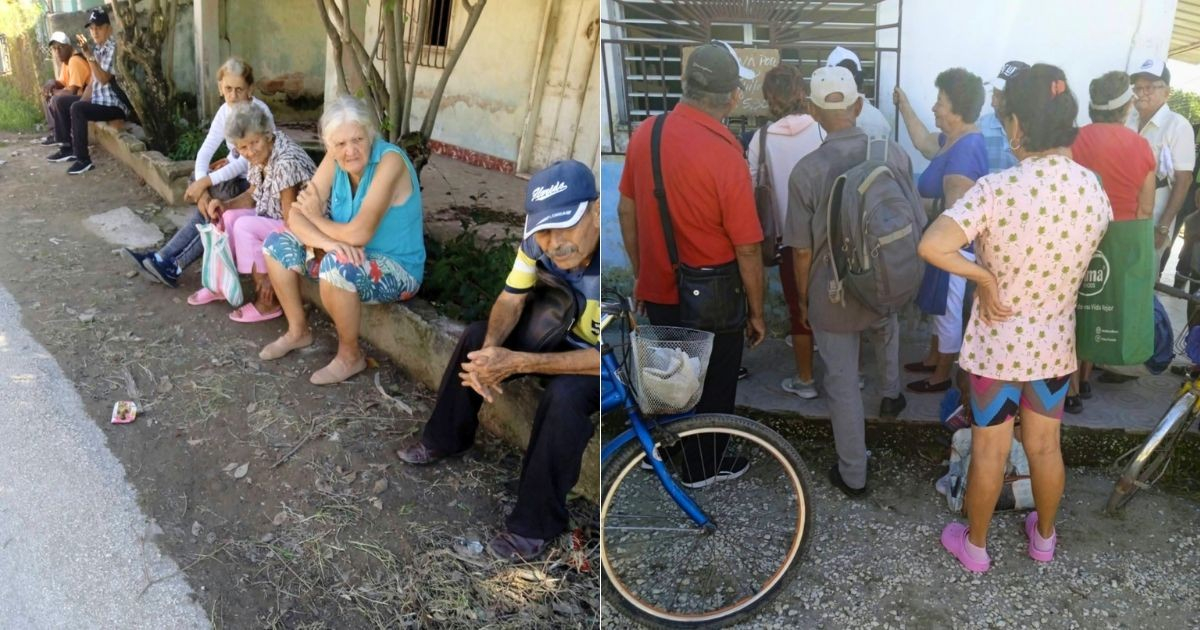
Elderly individuals from the La Gloria neighborhood in Camagüey reported this Saturday that they are unable to access the food distribution lists intended for adults over 65 years old, according to a post by journalist José L. Tan Estrada in his segment #TanteandoCuba.
Several elderly individuals are not listed in the program's records and have been forced to seek out the staff of Trabajo Social located on Primera Street, between Segunda and Carretera Santa Cruz, to request their inclusion, the source indicates.
Those affected have been trying to resolve the situation for two days without success. On Friday, no worker showed up at the establishment. This Saturday, around two in the afternoon, a worker arrived at the grocery store to gather information, but, according to the complainant, she did not have any paperwork to take notes, the journalist reported.
In addition, other issues were raised: the establishment remains closed, lacks visible identification, and does not have posted hours of operation, forcing the elderly to wander around the area without knowing where or when they can receive assistance.
Tan Estrada summarized the outrage of those affected: "The complainants consider it a lack of respect that elderly individuals, some with mobility difficulties, have to go through this situation to claim assistance that is intended precisely to address their needs."
The post generated numerous comments from citizens who shared similar situations. One internet user described the case of her 85-year-old mother, who went twice without being able to receive assistance: "The first time they couldn't find her on the list; [...] the store clerk told her she was going to have lunch and asked if she wanted to wait until 3 PM. The second time they told her that even if she appeared on the list, she had to line up again. Neither time was she able to receive the assistance. [...] The way they are operating is criminal; everything has been lost, it's sad."
Another internet user pointed out that her grandmother was excluded because the lists were made using an outdated census: "They're using the old census; before doing that, they should have conducted a new census, but no, it's easier to steal."
A 72-year-old woman, a resident of the Lenin neighborhood, wrote: "I have never seen the face of a social worker," and added that 12 days ago she was registered, was promised a visit that never came, and in the meantime, eight more pounds were distributed without her receiving anything.
Concerns were also raised about the criteria for accessing the program. "Not all of us over 65 are receiving that help; in the city of Camagüey, I was told it was only for those living alone. And what about the elderly over 65 who are suffering from cancer [...] who have never received their diet, what will happen to them?" wrote another internet user.
The approved economic reform package by the Cuban authorities in June 2026 includes the gradual replacement of universal subsidies with targeted assistance for vulnerable individuals. In implementing food assistance programs, selection criteria are used, which include men over 65 years old and women over 60 living alone, as well as the evaluation of household per capita income below 4,000 Cuban pesos per month, among other socioeconomic factors.
The issues in Camagüey are not an isolated case. A retired heart patient from Bayamo was registered as vulnerable but did not appear on the list when he went to collect his module. In Guantánamo, the oil and peas were limited to 11,653 people from a registry of nearly 50,000 registered, due to a lack of inventory: a general impact that is felt more acutely by the elderly.
The demographic context intensifies the urgency. By the end of 2025, Cuba had 2,519,823 individuals aged 60 or older, accounting for 26.7% of the population, according to official statistics, which makes it the most aged country in Latin America and the Caribbean. The state quota, according to estimates, covers barely 10% of the food needed by a family.
Tan Estrada concluded her complaint with a question that encapsulates the outrage of those affected: "Who is responsible for the elderly who were left off the lists, and what mechanisms are in place to ensure that they can receive food?"
Related videos:
Filed under: