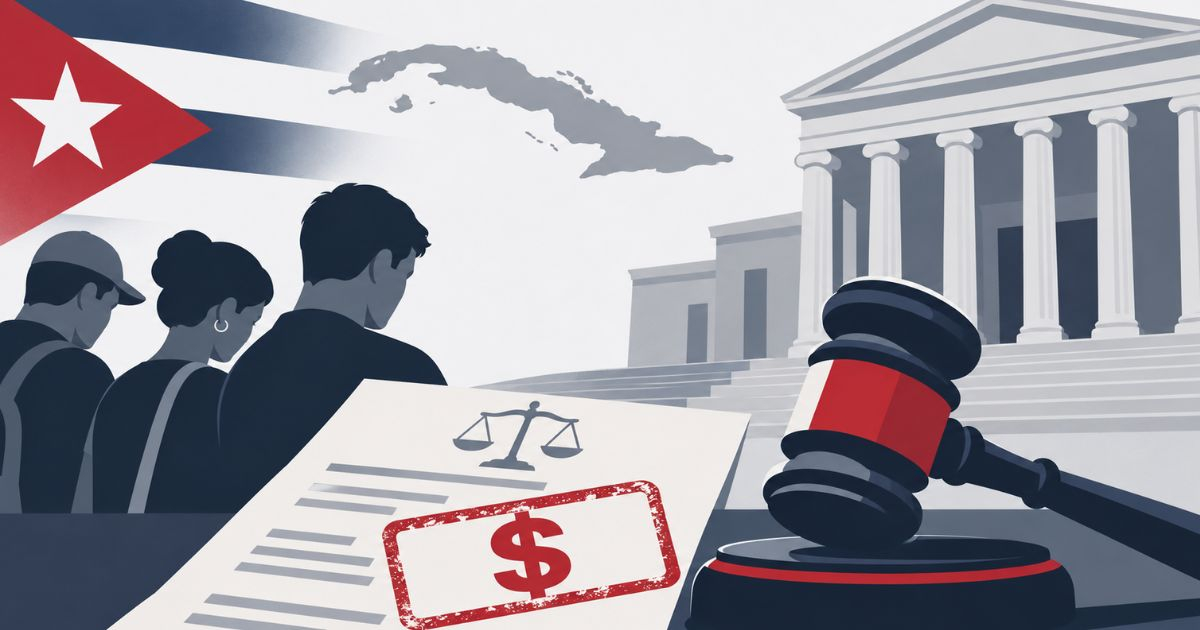
Immigration fines of up to millions of dollars imposed on foreigners who did not leave the United States, including Cuban citizens, are facing a new legal battle.
The plaintiffs in a class action lawsuit accuse the Department of Homeland Security (DHS) of trying to enforce sanctions that had been suspended by a federal judge.
Last Friday, the plaintiffs' attorneys filed two emergency motions before the United States District Court for Massachusetts, claiming that the Government violated a court order by approving a new regulation and ratifying fines issued under the suspended procedure, according to the legal publication Law360.
The controversy is part of the case Maria L. v. Mullin, identified by the number 1:25-cv-13471, which is being processed before federal judge George A. O'Toole Jr.
The lawsuit challenges the legality of a system that allows for the imposition of significant economic sanctions on immigrants accused of violating deportation or voluntary departure orders.
The conflict dates back to September 30, when Judge O'Toole ordered the suspension of the provisional regulation approved in June 2025 and the fines imposed under that procedure, while the litigation continues.
As was explained when the judicial halt to the million-dollar immigration sanctions became known, the magistrate believed that the plaintiffs had a chance to prove that the authorities had followed an illegal procedure and had not adequately assessed the individual circumstances of the fined persons.
One of the central issues is that U.S. legislation does not simply penalize a person's presence in the country after a final deportation order.
To impose certain fines, the authorities must establish that there was a deliberate refusal to leave the territory or a voluntary failure to comply with legal obligations.
However, the federal government later made two decisions that are now the subject of controversy.
The first one arrived on October 14, when the DHS and the Department of Justice published a final regulation on the imposition and collection of civil immigration penalties. The rule largely preserved the procedure established in June 2025.
The second occurred on October 26, with the publication of an official notice that affirmed certain final fines imposed between June 27, 2025, and October 13, 2026.
The ratification excludes the sanctions revoked on appeal, those that still have an appeal pending, and those that were reopened and nullified in accordance with the corresponding procedure.
The DHS explained that the ratification aimed to resolve potential uncertainties regarding previous administrative decisions. It also stated that adopting this measure did not imply an acknowledgment that the fines had been invalid.
The plaintiffs precisely question that the Government resorted to those decisions after the judge suspended the application of the provisional regulation and the penalties issued under it. In their view, the subsequent actions of the DHS contradict the court order from September.
The presentation of the motions does not mean that the judge has declared the Government in contempt nor that the confirmed fines have been definitively annulled. The controversy must be resolved in court, where the discussion about the legality of these sanctions is still pending.
What it means for Cubans with a deportation order
The procedure has particularly significant consequences for Cuban immigrants who remain in the United States with final deportation orders and who, for various reasons, have been unable to return to Cuba.
One of the known cases is that of a Cuban resident in Arizona, identified as Sánchez, who received a fine of $1,820,252 for remaining in U.S. territory despite having a deportation order.
The man, who works as a gardener and is the father of three children born in the United States, reported that the sanction caused him deep concern for the future of his family.
Fines for willfully violating a final deportation order can reach 998 dollars for each day of violation, which explains how some penalties have ended up accumulating amounts exceeding one million dollars.
The class action was filed on November 20, 2025, by legal assistance organizations, including Public Justice, The Legal Aid Society, and RAICES, on behalf of two immigrants identified as Maria L. and Nancy M., as well as the Immigrant Legal Resource Center.
According to the information released by Public Justice when the lawsuit was filed, the litigation aimed to represent over 21,500 individuals impacted by fines totaling more than $6 billion at that time.
For Cubans with immigration documents such as the I-220A, it is important to distinguish between being under the supervision of authorities and having a final deportation order.
The I-220A, by itself, does not mean that a final order of deportation exists nor does it automatically impose these fines.
Cases of individuals whose deportation has not been carried out must also be examined individually, either because the Cuban authorities have not accepted their return or due to documentation and administrative difficulties.
Those circumstances may be relevant in determining whether there was indeed a voluntary refusal to leave the United States.
While the litigation continues, there is another urgent matter for those who received final fines confirmed by the DHS: the administrative claim deadline set by the Government is November 16, 2026.
The notice published in the Federal Register grants 21 days for affected individuals to file claims with ICE for specific damages arising from the provisional procedure used to impose the sanctions.
This possibility had already been explained in the information regarding the ratification of fines and the deadline for claims. The mechanism does not constitute a new general appeal nor does it guarantee that ICE will cancel or reduce the amounts demanded.
The affected individuals must identify the fine, provide the data required by the agency, and explain what specific harm they believe was caused by the application of the provisional procedure.
The existence of a legal claim should not be interpreted as an automatic extension of that deadline. Sanctioned individuals need to review their specific situation and the available legal mechanisms before the established period expires.
The final regulation also introduced an exception to accept certain appeals submitted past the deadline when there is evidence of postal delays beyond the immigrant's control. This is a different procedure from the extraordinary claim of 21 days.
The economic effects of these sanctions can extend beyond the administrative decisions of ICE.
On October 21, a federal judge in Florida issued a ruling of more than $668,000 against a Honduran immigrant for willfully violating a final deportation order.
In that case, the sanction became an enforceable judicial ruling, allowing the Government to resort to legal collection mechanisms.
Moreover, she was not a Cuban citizen, and the ruling pertains to a procedure distinct from the collective litigation taking place in Massachusetts, although it is an important precedent.
Este caso podría afectar a miles de cubanos con órdenes de deportación en Estados Unidos. Sigue todos los detalles y las novedades legales en nuestra sección de
Related videos:
Filed under: