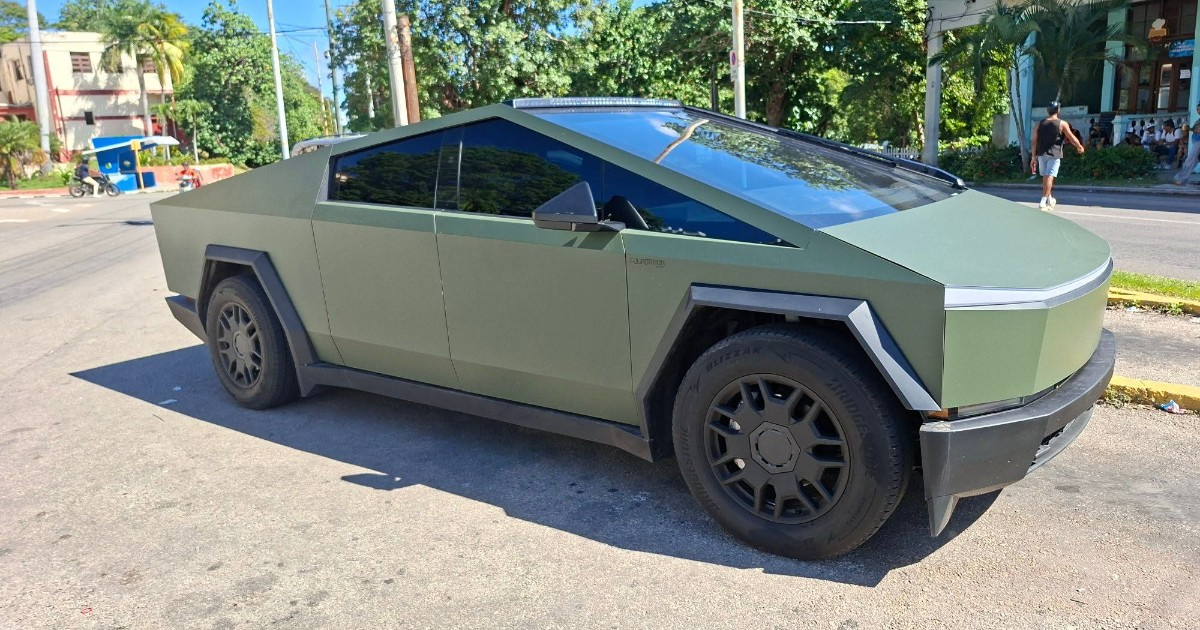
The Cybertruck, the electric truck with which Elon Musk promised to revolutionize the automotive industry, is nearing the end of its manufacturing stage in Texas.
Tesla is preparing for a gradual reduction in its production to prioritize the Cybercab, after the futuristic vehicle has seen several years of sales well below expectations.
The decision was announced on Friday by Musk himself and assessed this Sunday by the agency EFE, which regards the Cybertruck as one of Tesla's biggest commercial failures in the automotive industry.
The manufacturer plans to reduce its production at the Texas gigafactory by mid-2027 to allocate more capacity to its autonomous robotaxi project.
“Tesla will gradually reduce the production of the Cybertruck at the Texas gigafactory by mid-next year to make room for increased production of the Cybercab,” Musk announced on his X account.
The announcement represents a significant shift in strategy for a truck that had been showcased as one of the major symbols of the company's future, thanks to its angular design, stainless steel body, and technological features.
The subsequent statements from Musk added an important element: the production line for the model in Texas will be dismantled.
On Saturday, the businessman announced that Tesla will add an additional production shift to try to fulfill pending orders before the dismantling of that line.
According to the explanation, the order backlog for the Cybertruck exceeds the number of vehicles that Tesla will be able to manufacture before shutting down the line to ramp up production of the Cybercab, expected around June or July of 2027.
“We will add an extra shift to try to complete all orders on time,” said Musk, who also specified that the company will continue manufacturing the Cybertruck for the next eight or nine months.
In response to a user who described the decision as the end of an era, Musk acknowledged that interpretation, although he assured that the fleet of Cybertruck will continue to be on the roads for a long time.
Wes Morrill, chief engineer of the vehicle, even used the past tense to refer to the project: “The Cybertruck was an amazing platform for technological development and lives on through the Cybercab.”
The vehicle was unveiled in November 2019, but its production faced delays of about two years, and the first deliveries did not begin until the end of 2023.
In October of that year, Musk still believed he could achieve an annual production of approximately 250,000 units, a goal that was never realized.
According to estimates from the consulting firm Cox Automotive, Tesla sold 38,965 Cybertruck in the United States during 2024, while in 2025 it only sold 20,237 units, a decline of 48.1%.
The negative trend continued during the first nine months of 2026, when U.S. sales reached 11,586 units, 28% lower than in the same period of the previous year.
These figures contrast with the installed production capacity exceeding 125,000 units annually that Tesla still attributed to its Texas factory in October.
That capacity represents the manufacturing potential of the plant, not the actual number of vehicles produced.
Another major obstacle has been the price. When Musk unveiled the Cybertruck in 2019, he announced a basic version that would cost $39,900, a figure that helped spark the interest of many buyers.
However, on November 6, 2026, the most affordable version available for orders was priced at $92,490, according to the specialized site Electrek.
Tesla had increased the prices of several versions and suspended the option to order the most economical variant, called Dual Motor AWD, which was listed in the configurator at a price of $82,490 but was not available for new orders.
Price and demand issues were compounded by manufacturing and safety defects. The Cybertruck has been involved in 11 recall campaigns in the United States, recorded with the National Highway Traffic Safety Administration (NHTSA).
Among the identified difficulties are problems related to the accelerator, exterior components, electrical systems, and braking elements. Some repairs required physical interventions, while others could be resolved through software updates.
The vehicle's design has also limited its potential for international expansion.
The Cybertruck is not approved for sale in Europe due to pedestrian safety requirements, while Tesla canceled its plans to introduce it in Australia and New Zealand in October and announced the refund of deposits to customers who had made reservations.
For analyst Dan Ives of Yorkville Ives & Co., the outcome was "foreseeable", due to the high price of the vehicle and weak demand.
Investor Gary Black was equally critical: "What a missed opportunity."
While the Cybertruck loses prominence, Tesla is increasingly focusing its resources on the Cybercab, a two-seat autonomous electric vehicle designed to provide driverless transportation services.
The project is part of Musk's commitment to transforming Tesla into a company increasingly focused on autonomous driving and robotics, although the robotaxi business still needs to prove its commercial viability on a large scale.
The contrast between the results of their models was also reflected in a Musk post on X on Saturday.
“Most people don’t know that the best-selling car in the world is the Tesla Model Y. And the second and third best-sellers are much cheaper,” wrote the entrepreneur.
Musk's statement refers to global sales, although international rankings do not always agree on which model holds the top position, due to differences in the sources and methodologies used.
In 2023, JATO Dynamics confirmed that the Model Y had become the best-selling car in the world. However, in its ranking for 2024, the same consultancy placed the Toyota RAV4 slightly ahead of the Tesla vehicle.
Other specialized companies, such as Focus2Move, also ranked the Model Y in first place in 2024. Therefore, the global leadership of the model depends on the time frame analyzed and the criteria of each ranking.
The situation of the Cybertruck contrasts with the commercial performance of the Model Y: despite its enormous media impact, its unique design, and the attention it received since its unveiling, the truck never managed to come close to the initially projected production volumes.
The model has also recently sparked curiosity in Cuba.
On October 30, a green Cybertruck was photographed driving through Havana, sparking comments about its high price, futuristic design, and the circumstances under which an American vehicle of this kind could arrive on the island.
Related videos:
Filed under: