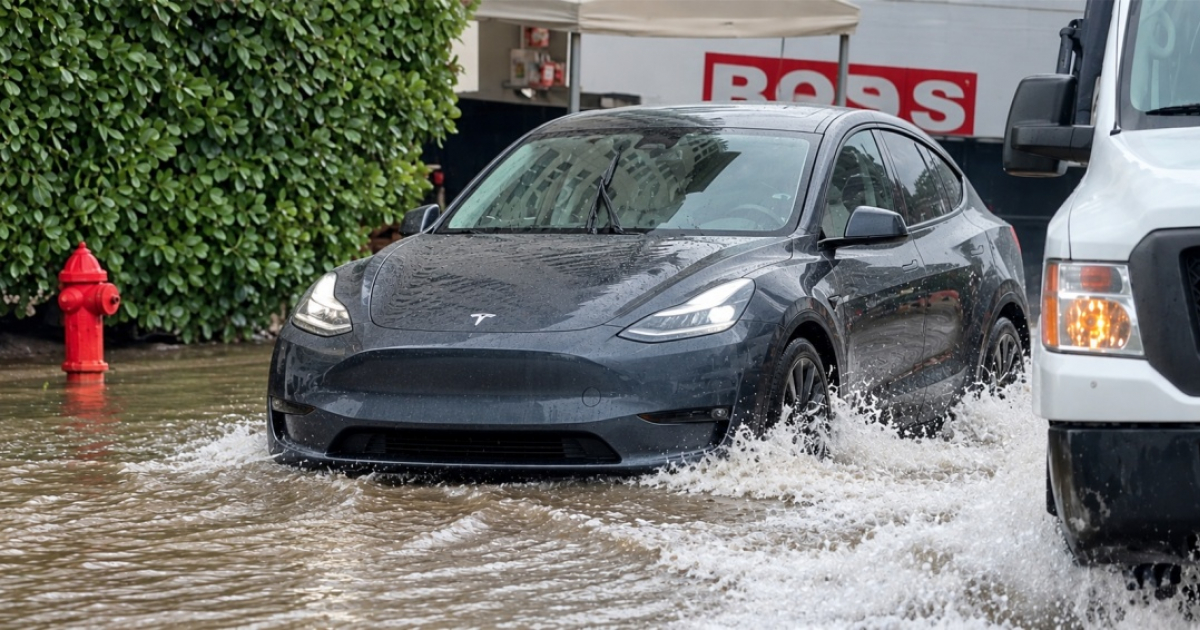
The flooding caused by the king tide in South Florida has brought to light a danger that may persist long after the water recedes: electric vehicles exposed to saltwater can suffer battery damage that could lead to fires days, weeks, or even months later.
The National Fire Protection Association (NFPA) warns that an electric vehicle submerged in salt water should not be considered safe simply because the flooding has ended. The vehicle may appear normal, yet it could have internal damage that is not visible.
According to Telemundo 51, owners of these vehicles should avoid turning them on, driving them, or attempting to charge them after a flood until they have been assessed by trained professionals.
Why can salt water cause fires in electric cars?
The main risk arises when saltwater reaches the high-voltage battery pack. Salt facilitates electrical conduction and can create connections between internal components, leading to short circuits and accelerating corrosion.
Under certain circumstances, these damages can trigger a reaction known as thermal runaway, during which the battery cells heat up uncontrollably. This process can release flammable and toxic gases, cause fires, and in severe cases, explosions.
The U.S. Fire Administration (USFA) also warns that lithium-ion batteries can reignite after a fire has apparently been extinguished, which complicates emergency response efforts.
Danger can appear weeks or months later
One of the most concerning characteristics of damage caused by saltwater is that its consequences do not always manifest immediately.
The NFPA explains that there is no specific timeframe for an affected battery to experience a thermal reaction. The issue may arise hours, days, or weeks after exposure.
The warning was reinforced on October 28 by the authorities of Huntington Beach, California, who warned that batteries damaged by flooding can overheat, release toxic gases, ignite, or explode even months after a storm.
The announcement released by the city of Huntington Beach, also reported by Telemundo 52, emphasizes that a battery can still pose a danger even after it has completely dried out.
What to do if your electric car is flooded?
If an electric vehicle was submerged totally or partially during a flood, the NFPA recommends treating it as a car that has been involved in an accident.
The main security measures are:
- Do not enter the vehicle or attempt to start it. Although it may seem to work, it could have internal electrical damage.
- Do not drive it. A flooded vehicle should be assessed before being used again.
- Do not attempt to charge the battery. Connecting a vehicle affected by water to a charging station may increase the danger.
- Request a tow truck. Inform the operator that it is an electric vehicle exposed to salt water so they can take the necessary precautions.
- Keep the vehicle away from buildings and combustible materials. Safety recommendations suggest a separation of at least 50 feet, approximately 15 meters.
- Do not store it in a garage or in an enclosed space. The vehicle must remain in a safe area, following the instructions of the professionals responsible for its removal.
The United States Fire Administration recommends keeping vehicles and batteries affected by flooding at least 50 feet away from structures and combustible materials, as well as notifying the fire department if there is suspicion that a lithium-ion battery has been exposed to water.
Warning signs: when to call 911
A damaged battery may show visible or audible signs before a fire occurs. Among the indicators identified by the NFPA and the authorities in Huntington Beach are:
- Hissing, cracking, or small bursts.
- Sounds of bubbling or gurgling.
- Unusual chemical odors.
- Excessive heat.
- Smoke or gas emissions.
- Swelling or deformation of the battery.
- Liquid leaks.
If you see these signs, move away from the vehicle and do not attempt to inspect or handle the battery. In case of smoke, sparks, or fire, evacuate the area and call 911 immediately.
If you suspect that the vehicle has suffered flood damage, even if there are no visible signs yet, consult with the fire department and qualified professionals to determine how to proceed.
What happened to electric cars during Hurricane Ian?
The risk of fires associated with saltwater was documented after Hurricane Ian, which impacted Florida in September 2022.
According to figures from a study by the National Highway Traffic Safety Administration (NHTSA), cited by the NFPA and reported by Telemundo 51, between 3,000 and 5,000 electric vehicles were affected in some way by immersion in saltwater during that hurricane.
Of these, approximately 600 were deemed total loss, and 36 fires were reported.
The NFPA notes that less than 1% of the electric vehicles estimated to be affected by the saltwater flooding during Ian ended up catching fire. Although fires were relatively infrequent among the exposed vehicles, their consequences can be severe, and extinguishing them is particularly challenging.
How to protect your vehicle before a flood?
The best way to reduce the risk is to prevent the car from coming into contact with floodwaters.
If authorities anticipate exceptionally high tides and it is still safe to move around, the NFPA recommends relocating electric vehicles to higher ground, out of the reach of water.
It also advises not to cross flooded roads, regardless of whether the car is electric or combustion.
The authorities in Huntington Beach have extended these precautions to other devices that use lithium-ion batteries, such as electric bikes, scooters, and power tools. They recommend storing them in dry, elevated places, not charging them if they have been exposed to water, and avoiding placing damaged batteries in closed spaces.
Damaged lithium-ion batteries should not be disposed of in household trash or conventional recycling bins. Their removal requires following the guidelines of local hazardous waste management services.
Does the insurance cover flood damage?
In Florida, coverage for flood damage depends on the type of insurance purchased. Generally, this damage is covered by the comprehensive policy, known as comprehensive coverage, while a policy limited to liability does not cover damages sustained by the vehicle itself.
Owners can check which insurance policies cover flood damage in Florida and review the terms of their policy before filing a claim.
If your electric car has been exposed to saltwater, notify the insurance company and request instructions for its evaluation and safe transport. Do not attempt to start it to check if it still works.
The warning from the authorities is clear: just because the water has receded does not mean that the danger has disappeared. A flooded electric vehicle must remain out of service until specialized personnel determine how to handle it safely.
Related videos:
Filed under: