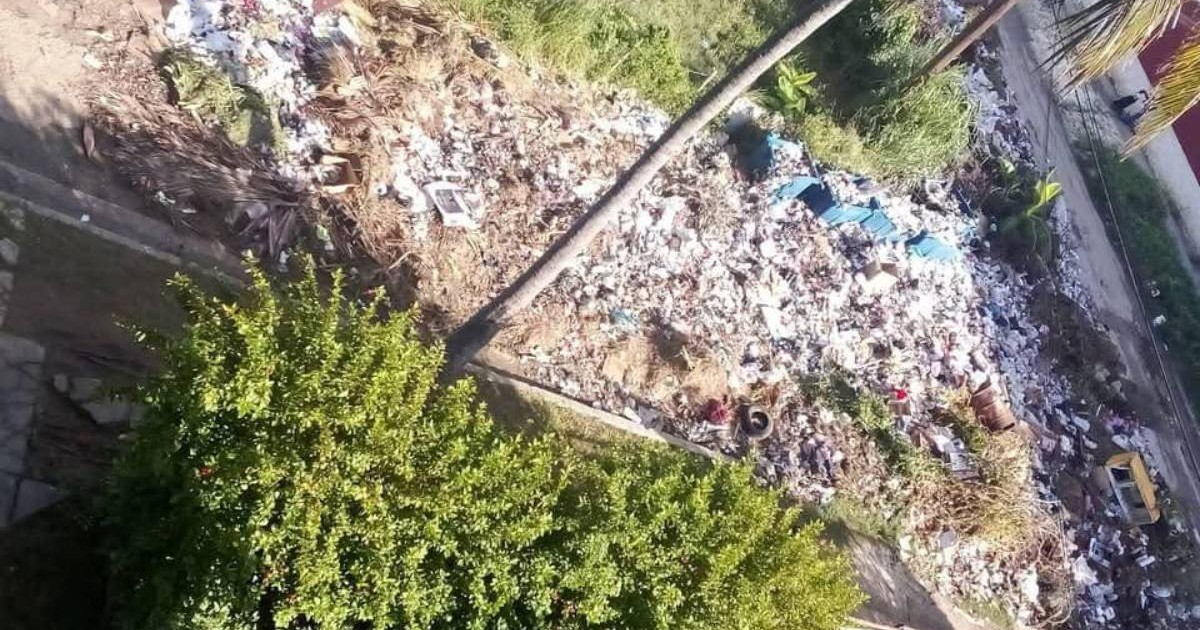
A Cuban woman resorted to irony to denounce the unsanitary conditions in her neighborhood. She introduced herself as "Mama Lucinda," a neighbor who "lives in the dump" and whose "favorite place in the world" is the William Soler Pediatric Hospital, which she visits every week with her sick daughter.
He made his report on Facebook and accompanied it with two photographs taken from a building in the Altahabana neighborhood, in the Boyeros municipality. The images show a drainage channel and a street completely filled with solid waste, debris, tires, and plastics accumulated near Cuba's main pediatric hospital.
"My favorite place in the world is William Soler. Every week I go there and take a little stroll with my daughter, who loves going there to get her shots, whether it's for vomiting, diarrhea, dengue, etc... The best part is that I'm always accompanied by my neighbors, who are also fans of William Soler with its 5-star services," wrote the author.
The irony culminates in a simple message: "I don't know what will become of my neighbors and me when, in 15 years, they collect that trash."
A commentator specified the exact location of the dump: "If I'm not mistaken, it's on L Street and 7th, that's practically behind the William Soler."
Other Cubans joined in with messages of outrage. "Altahabana has become a dumping ground. There is no street where you can turn, where you can walk. Sometimes it makes you want to scream, many times it makes you want to cry," wrote one person.
"It is sad to see how our children are growing up in a country filled with filth that leads to getting sick again and again," said an internet user.
The same dump had been reported in October by another neighbor from the area, who described mounds of waste that almost completely obstructed traffic.
The garbage crisis in Havana, with no solution in sight
The situation in Altahabana is not an exception but a reflection of a healthcare crisis in the country, with an increase in vectors, viral diseases, and a buildup of garbage that floods the streets of all of Havana and other cities.
At the beginning of 2026, only 44 out of the 106 collection trucks in the capital were operating due to a lack of diesel and mechanical breakdowns. The city produces between 24,000 and 30,000 m³ of waste daily, of which up to 23,814 m³ could remain uncollected each day.
The regime announced a plan of 49 measures in February 2026, but active garbage dumps multiplied in Boyeros, Centro Habana, Luyanó, San Miguel del Padrón, and Old Havana, among other municipalities.
The accumulation of waste next to the William Soler University Pediatric Hospital worsens the health risk. The center is facing overcrowded emergency rooms, a shortage of medications, power outages, and insufficient staff. The leader Miguel Díaz-Canel acknowledged during a visit to the hospital at the end of October the existence of many of these issues.
The stagnant water among the debris, conducive to the breeding of the mosquito that transmits dengue, turns the environment into a direct threat to the children in the neighborhood and the patients at the hospital.
Related videos:
Filed under: