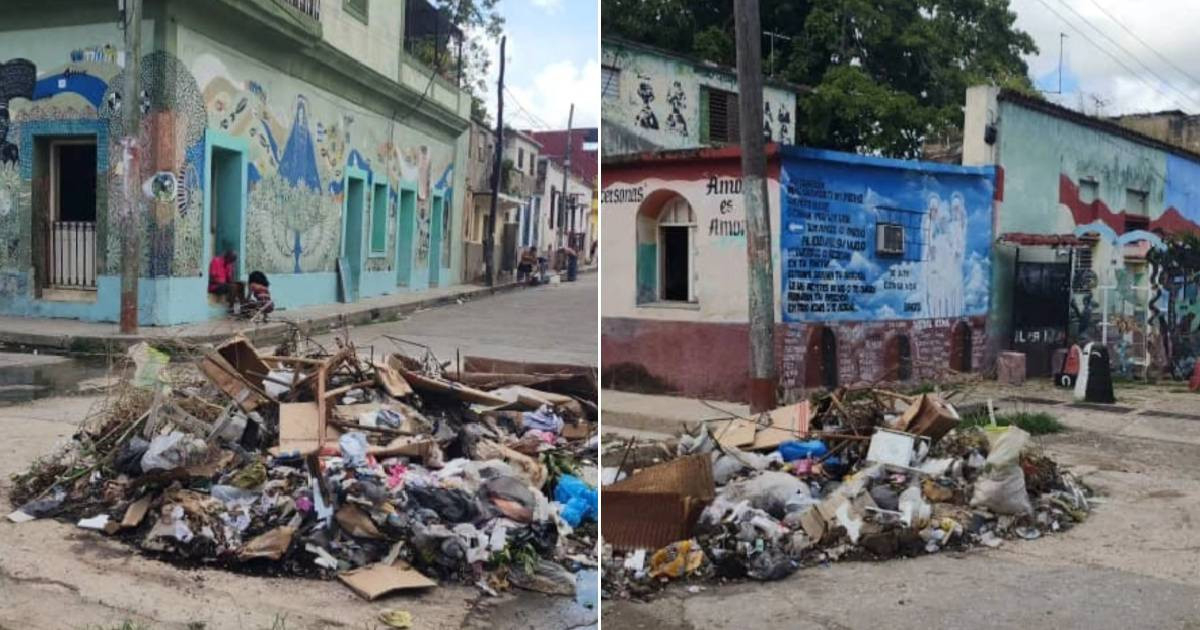
Residents of Pueblo Nuevo, in the city of Matanzas, reported that authorities are renovating the Tirry roadway ahead of a "high-level" ministerial visit, while other streets in the neighborhood remain neglected and littered with trash.
The complaint was published this Saturday on Facebook by AfroAtenas. Callejón de las Tradiciones, a socio-cultural and community project that brings together residents and activists from the area. Its members questioned the disparity between the maintenance, painting, and decoration work carried out on the road chosen for the visit and the conditions endured daily by the rest of the community.
Neighbors described the incident as a "disparity between the cosmetic actions taken by the authorities and the reality of abandonment we face." They also warned that the neighborhood is home to children, elderly adults, and vulnerable individuals in an environment they consider to be of high epidemiological risk.
In light of this situation, they demanded that official visits include tours of the most deteriorated areas and not be limited to the streets prepared to receive officials.
The post was also marked by irony regarding the arrival of the leaders. "It's an ironic way of maintaining existence, but to say: Lazo is going to solve the chaos and unsanitary conditions we are subjected to, well, WELCOME," the neighbors wrote.
The message refers to Esteban Lazo Hernández, president of the National Assembly of People's Power and the Council of State.
In the comments, the project itself emphasized that residents survive due to their daily efforts in the face of deterioration and demanded an end to what it described as a mockery. Another user pointed out that the door-to-door service has not been operational for a long time and attributed the central issue to deficiencies in waste collection.
The episode recalls what happened at the end of October in Bejucal, Mayabeque, where the religious figure Sor Nadieska Almeida denounced street repairs, weed removal, and facade painting prior to a visit from the ruler Miguel Díaz-Canel on October 22. She then questioned how authorities could guarantee electricity, cleanliness, and beautification for a few hours, but not maintain those services permanently.
In Matanzas, the deterioration of sanitation is attributed to structural causes related to a shortage of collection trucks, a fuel deficit, and a reduced workforce, due to low salaries and poor working conditions.
The consequences have become visible in various areas of the city. In October, a dump at the corner of Embarcadero, Blanco, and Mujica stretched more than 100 meters and blocked vehicular traffic. Days later, another resident reported that the accumulated garbage in front of her home prevented her from leaving to go to work.
Since April, authorities have issued alerts regarding outbreaks of hepatitis A in the municipalities of Matanzas, Cárdenas, and Versalles. In June, seven confirmed cases and 49 suspected cases were reported in just one week. Additionally, around 265,000 residents of the province lack a stable supply of drinking water.
The seriousness of the situation was acknowledged in May by the official newspaper Girón, the organ of the Communist Party in the province, when it warned that not only the image of Matanzas was at stake, but also the health and future of its inhabitants.
For his part, the municipal mayor, Michel León Rodríguez, acknowledged before the cameras of the TV Yumurí telecenter that the authorities had "a debt to the city".
Related videos:
Filed under: