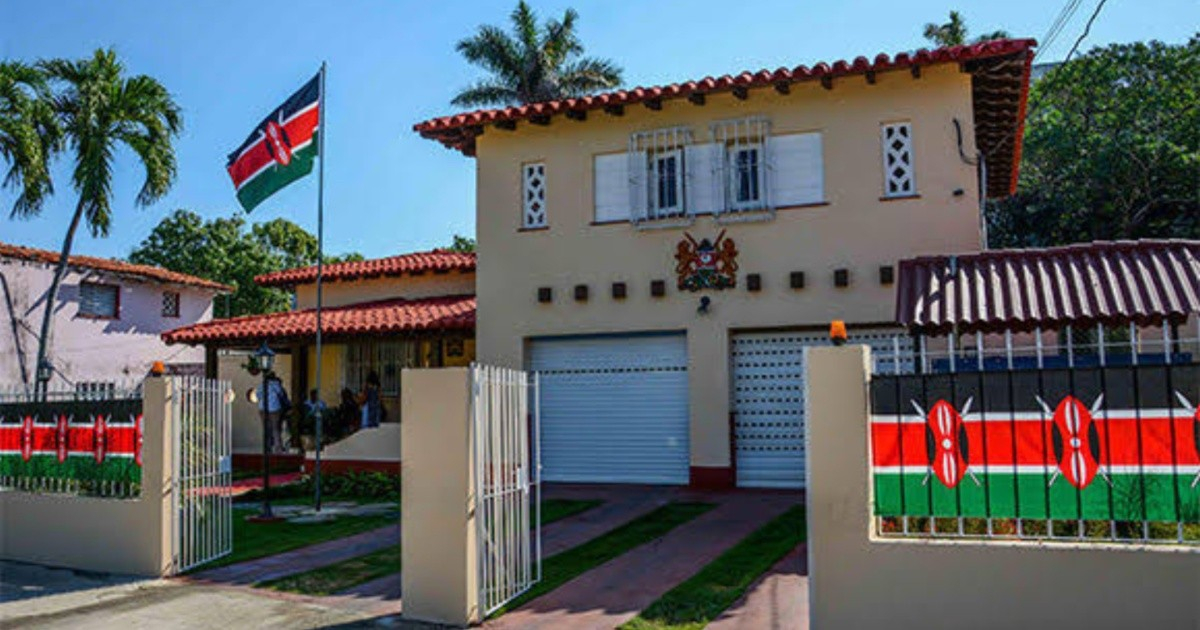
The Kenyan government officially acknowledged this Sunday, for the first time, that U.S. sanctions against Cuba were a determining factor in its decision to close the embassy in Havana and move its diplomatic operations to Kingston, Jamaica, according to the Kenyan newspaper The Star.
The statement came from the Principal Secretary for Foreign Affairs of Kenya, Korir Sing'oei, during bilateral talks with Barbados' Senior Foreign Minister, Christopher Sinckler, held on the sidelines of the Commonwealth Heads of Government Meeting (CHOGM) in St. John's, Antigua and Barbuda.
Sing'oei explained that the decision was made in response to "the need to provide temporary operational relief to the staff of its embassy in Havana, Cuba," directly linking the relocation to the administrative and financial challenges arising from the U.S. embargo.
The Kenyan Foreign Ministry did not specify the particular difficulties faced by its diplomats on the island, although the embargo—in place for over six decades—has complicated international banking transactions, access to goods and services, and the overall operation of accredited missions in Cuba.
This is the first time Nairobi has explicitly linked the move to the impact of Washington's sanctions. Until now, the Kenyan government had presented the change as a strategic bet to deepen relations with Jamaica and gain access to the Caribbean Community (CARICOM) market.
The Kenyan embassy in Havana closed in August 2026, after a decade of operations since its inauguration in 2016 as Kenya's first diplomatic mission in the Caribbean. The new High Commission based in Kingston began operations in July of that year, with Karisa Mwenda —previously the representative in Havana— serving as the first resident high commissioner.
The closure does not signify a break in relations: Cuba maintains its embassy in Nairobi, and Kenya will continue to be accredited to the Cuban government through a non-resident ambassador based in Kingston.
The revelation of Sing'oei is striking given that Kenya publicly maintains a position against the embargo. On October 28, the Kenyan deputy ambassador to the UN, Yabesh Monari, voted in favor of the resolution calling for an end to the sanctions and stated that the embargo "has inflicted suffering on ordinary Cubans, weakened their livelihoods, and exacerbated the country's economic difficulties."
However, that UN resolution against the embargo received only 130 votes in favor, compared to 165 in 2025 and 187 in 2024, marking the worst historical result for Cuba since the resolution has been presented annually since 1992.
In that same context of regional adjustment, Jamaica abstained for the first time in over three decades in the vote on the Cuban embargo, in a shift that reflects the growing distance of several Caribbean and African countries from Havana.
The Trump administration intensified sanctions in 2026 with new rounds affecting over 40 entities and at least 38 individuals linked to Cuban military, energy, and financial sectors. On May 1, it signed Executive Order 14404 as a basis for additional measures, further worsening the operational environment for those maintaining diplomatic or commercial presence on the island.
"for more than six decades, the economic, commercial, and financial embargo against Cuba has been in blatant contradiction with the principles on which the United Nations was founded," Monari stated before the General Assembly, in a position that his own government contradicts in practice by withdrawing its diplomats from Havana due to the same sanctions it condemns.
Related videos:
Filed under: