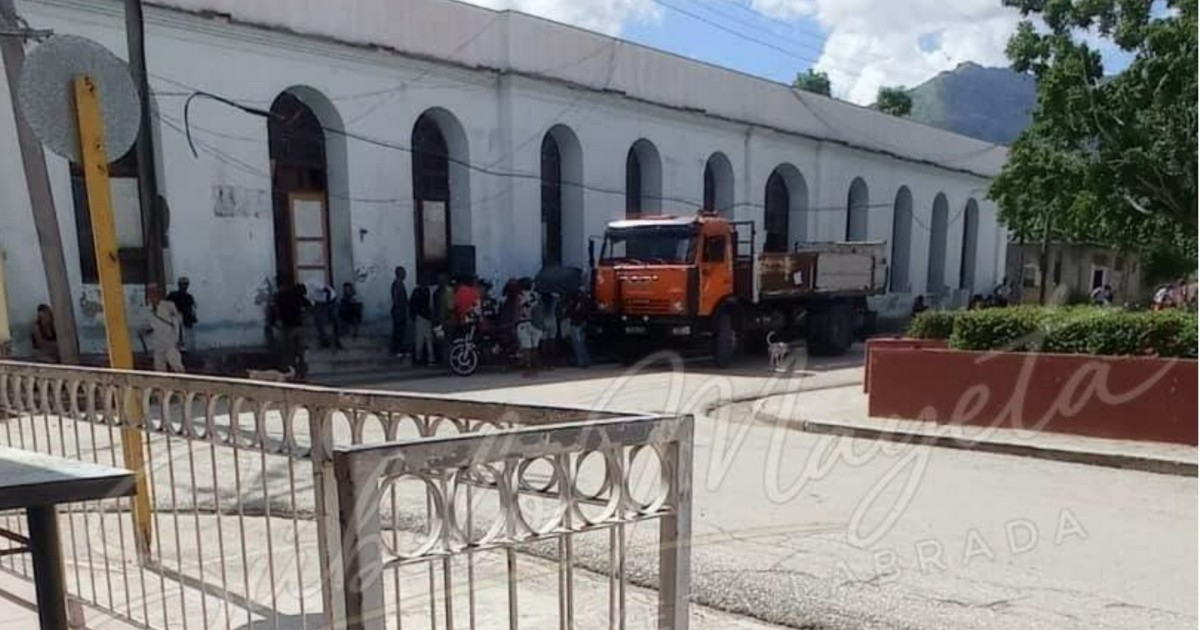
A food truck appeared this Sunday near the park of El Cobre in Santiago de Cuba, a day after dozens of residents took to the streets to demand the release of community activist Yoel Alejandro Pérez Serrano, who was detained by special forces and State Security agents.
A second truck headed towards Guamuta, the neighborhood where Pérez Serrano managed his free assistance project, according to testimonies gathered by independent journalist Yosmany Mayeta Labrada.
The residents did not interpret the arrival of food as a gesture of goodwill. "In El Cobre, food doesn't arrive when there is hunger. It arrives when there are protests," wrote Mayeta Labrada. For the neighbors, the sequence says it all: "First they took him away arrested. Then the protests for his freedom came. Now the food arrives."
Pérez Serrano was leading the humanitarian project "Save Cuba" in Guamuta, which provided at least one meal a day—Monday through Friday—to the elderly, children, the sick, and vulnerable families. It is estimated that the project benefited more than 400 people in the community, with the support of the Patriotic Union of Cuba (UNPACU) and the Assembly of the Cuban Resistance.
In the early hours of Saturday, around six in the morning, the agents burst into his home, sealed off the neighborhood, confiscated food, pots, cauldrons, phones, money, and jewelry, and took him into custody. As of the close of this Sunday, the Cuban authorities had not reported his whereabouts or the formal charges against him.
The arrest triggered immediate protests: dozens of locals took to the streets of El Cobre with signs and pots chanting "Freedom for Yoel!". The arrival of the truck the next day was interpreted as a direct response to that pressure, not as a spontaneous initiative from the regime.
The irony did not escape anyone. "Yoel was distributing hot food for free to mothers, children, and the elderly. No one paid to eat. Today, in the same neighborhood, a plate comes with a price. The one who gave without charging was taken away. Those who charge arrived in a truck," summarized Mayeta Labrada.
Those who bought did so out of necessity, not out of compliance. "Purchasing a little food does not erase the reasons why a people protest," the journalist pointed out.
This episode mirrors a documented pattern in Santiago de Cuba. In March 2024, following protests where people shouted "We are hungry", the provincial secretary of the PCC promised rations of rice and sugar. In May 2025, after nighttime protests, the distribution of delayed donations was expedited. In July 2026, just days before the anniversary of 11J, authorities distributed chicken, rice, and beans. Independent media interpret these deliveries as social containment tactics rather than as a sustained food policy.
Pérez Serrano had a history of public confrontation with the regime. In November 2025, he confronted Díaz-Canel during an official visit to El Cobre, denouncing the abandonment of Guamuta after Hurricane Melissa: "They left us alone," he said. In July 2026, he staged a one-man protest barefoot and in his underwear, holding a white sheet with the words "Freedom," "Democracy," "Justice," and "Dignity."
"A sale relieves a table today. It doesn't guarantee breakfast tomorrow. When the truck leaves, hunger remains," concluded Mayeta Labrada. "El Cobre doesn't need crumbs for a few hours. It needs to eat every day."
Related videos:
Filed under: