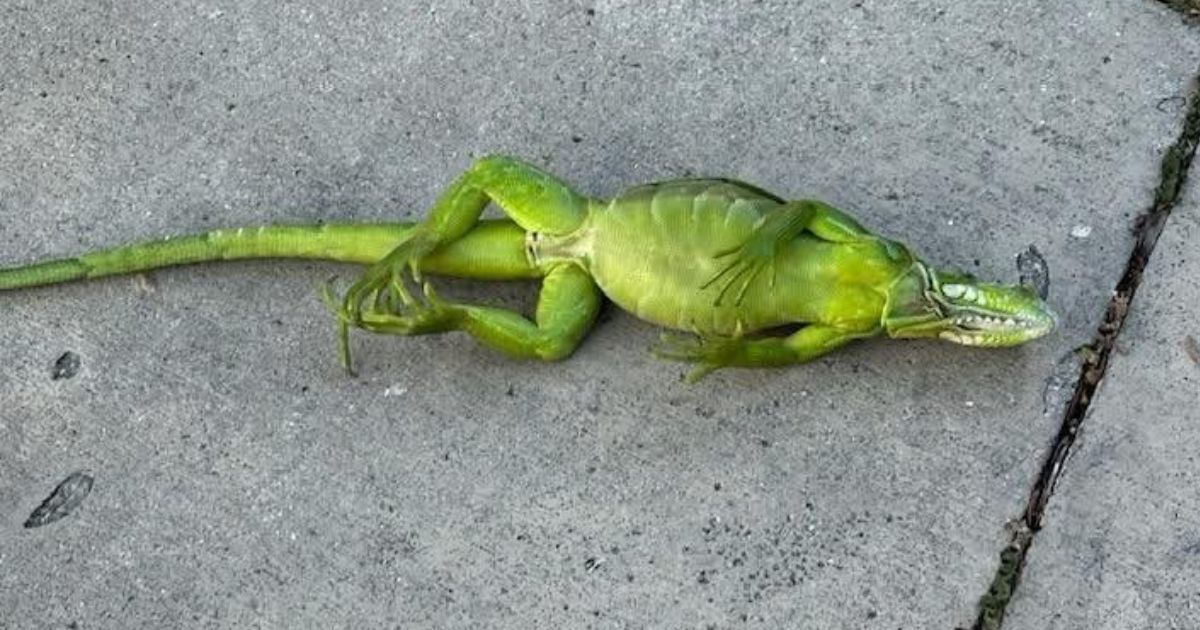
Iguanas could fall from trees again in some areas of Florida over the upcoming weekend, as a new cold front brings a significant drop in temperatures.
Although the main urban areas in the southern part of the state appear to be at lower risk, meteorologist Matt Devitt warned on Tuesday that the phenomenon could recur in other locations.
In a post made on Facebook, Devitt explained that there is a possibility that some iguanas may lose their mobility and fall from trees during the mornings of Saturday and Sunday, when the arrival of colder air is expected.
"When temperatures drop to 45 degrees or lower, iguanas can fall from trees," the specialist warned, referring to degrees Fahrenheit, which is equivalent to about 7 degrees Celsius.
Devitt clarified that these animals do not necessarily die from falling: “They are not dead, only immobilized,” he explained, before specifying that most iguanas in the metropolitan areas of South Florida seem to be safe this time, although others in the state may not be so fortunate.
The warning coincides with forecasts of a significant drop in temperature that will begin to be felt towards the end of the week.
According to reported this Tuesday by the newspaper Palm Beach Post, temperatures could drop to as much as 15 degrees Fahrenheit below the normal values, with a cold air mass moving across the peninsula starting this Thursday.
The meteorologists consulted by that outlet consider a widespread fall of iguanas in southern Florida to be unlikely, where the minimum temperatures could briefly drop to the high range of 50 degrees Fahrenheit, approximately between 13 and 15 degrees Celsius.
Although some specimens may show less activity, the cold is not expected to be intense and prolonged enough to affect large numbers of these reptiles.
The outlook will be different in areas of central and northern Florida. The National Weather Service in Melbourne predicts that minimum temperatures on Saturday and Sunday will drop to the mid to upper 40s Fahrenheit in some inland locations, with heat index values ranging from 40 to 45 degrees from the Orlando area northward.
Green iguanas are cold-blooded reptiles that rely on the ambient temperature to regulate their activity. When the cold intensifies, their metabolism slows down, and they may enter a state of dormancy that temporarily results in a loss of muscular control.
If they are resting on the branches, they may lose their grip and fall to the ground.
This phenomenon, known as cold stun, does not necessarily mean that the animals have died. Many iguanas regain their mobility when temperatures rise, so they can react suddenly if someone tries to touch or pick them up.
Florida has a long history and record of this unique phenomenon. In November 2025, iguanas were reported falling from trees during a cold wave that dropped temperatures to around 38 degrees Fahrenheit (3 degrees Celsius) in certain areas.
On that occasion, Matt Devitt himself documented the fall of an iguana in Port Charlotte, north of Fort Myers, after the low temperatures had immobilized the animal.
The images showed a phenomenon that tends to attract attention when cold weather reaches regions of Florida that typically experience warm temperatures.
Another episode occurred at the beginning of February, when a strong influx of cold air impacted the state. The Florida Fish and Wildlife Conservation Commission (FWC) then alerted about the effects of the low temperatures on iguanas, manatees, and sea turtles.
During that episode, the authorities implemented an extraordinary procedure to remove invasive green iguanas stunned by the cold.
According to a subsequent report by the FWC, 5,195 specimens were removed from the state's ecosystems. That special authorization was temporary and is not in effect as a general measure.
In the event of finding an immobile iguana, the FWC recommends not picking it up or bringing it into homes or vehicles to attempt to warm it. These animals can quickly regain their mobility and respond defensively, using their teeth, claws, and tail.
The phenomenon was also documented in January 2020, when the National Weather Service warned about iguanas falling from trees during another cold wave.
At that time, meteorologists explained that these reptiles can become immobile when the temperature drops to around 40 degrees Fahrenheit (4 degrees Celsius).
Related videos:
Filed under: