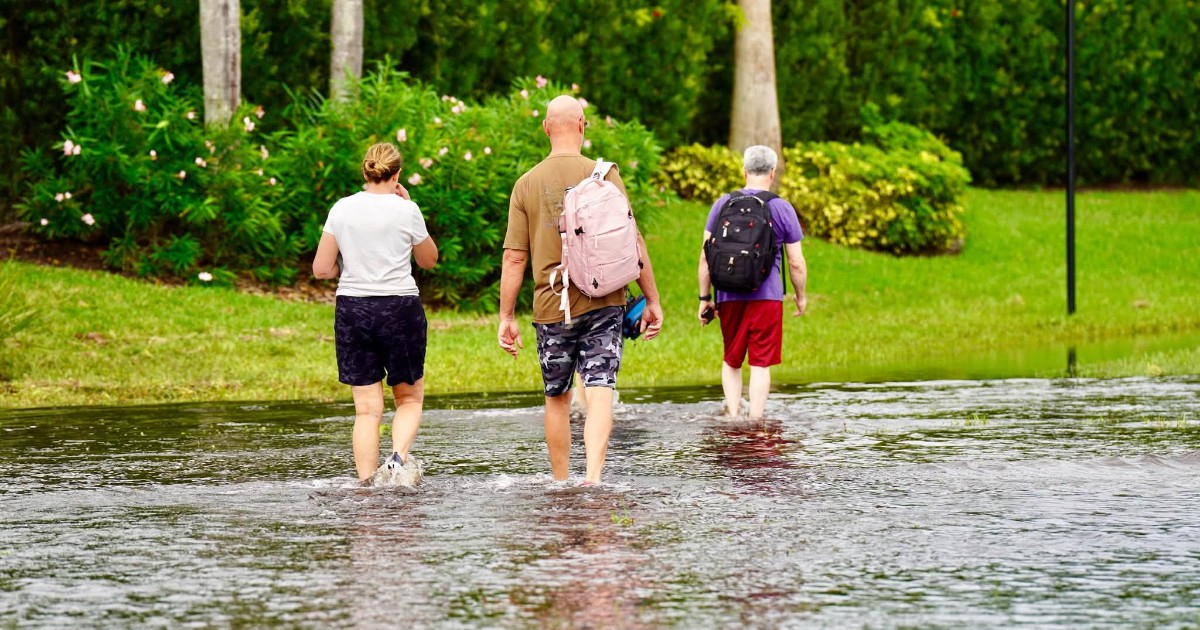
Families in Florida who lost their belongings, suffered damage to their homes, or had to evacuate due to the recent flooding may access new federal assistance.
The state requested a major disaster declaration to obtain additional resources, but the measure still needs approval in Washington and does not mean that those affected will automatically receive funds.
The Florida Division of Emergency Management (FDEM) announced on Monday that, at the request of Governor Ron DeSantis, it submitted a federal request for a major disaster declaration for the communities affected by flooding in the central and southern parts of the state.
The information was confirmed by the network WFLX, which specified that the authorities are looking to strengthen recovery operations following the extraordinary rainfall at the beginning of the month.
The FDEM stated that it will continue to work with federal agencies to secure the assistance needed by the affected residents.
The announcement comes at a time when many families are still facing flooded homes, material losses, and challenges in returning to normalcy.
The declaration of major disaster is a federal measure that can authorize extraordinary resources when the consequences of an emergency exceed the response capacity of state and local authorities.
In the United States, it is the president's responsibility to approve it after evaluating the request submitted by the governor and the recommendations from the Federal Emergency Management Agency (FEMA).
For those affected, the difference is significant. If FEMA's Individual Assistance is authorized, eligible residents of the designated counties may apply for help with temporary housing, rental of alternate housing, essential repairs to their homes, and replacement of certain personal property damaged by the floods.
Assistance may also cover some urgent needs arising from the disaster that are not addressed by insurance or other sources. However, the programs have specific requirements and are not designed to compensate for all economic losses.
Another option is Public Assistance, primarily aimed at state and local governments, as well as certain nonprofit organizations.
These funds can be used, according to the approved categories, for debris removal, financing emergency measures, and repairing damaged roads, bridges, public buildings, and infrastructure.
For now, Florida authorities have not publicly specified which counties are included in the new federal request or what specific types of assistance they have requested. Therefore, it is still not possible to determine which residents will be able to apply for individual economic aid.
The need for assistance is evident in places like Jensen Beach, in Martin County. According to reported WFLX this Tuesday, the floods had impacted 66 homes in that county, of which 25 were classified as destroyed.
Some residents reported that their homes have become uninhabitable and that much of the immediate assistance has come from neighbors, churches, and community donations.
The affected families are hoping to find out if they will be able to access federal resources to cope with their losses and secure housing while their properties are being repaired.
The floods occurred after intense rainfall impacted various areas of Florida between October 31 and the early days of November.
The governor initially declared a state of emergency in seven counties: Brevard, DeSoto, Hardee, Highlands, Indian River, Martin, and St. Lucie, through Executive Order 26-227 on November 2.
Two days later, on November 4, DeSantis expanded the emergency to seven more territories: Glades, Hendry, Lake, Okeechobee, Palm Beach, Seminole, and Volusia, bringing the total number of counties included in the state declaration to 14.
While the application is being decided, residents who have suffered damage should not wait to document their losses. The FDEM has recommended taking photographs of the damage, keeping receipts, preparing inventories of affected belongings, and contacting their insurers. This evidence may be important for both insurance claims and later assessments for assistance.
It is also advisable to keep identity documents, proof of residence, insurance policies, and invoices related to emergency expenses, especially when families have been compelled to leave their homes.
Related videos:
Filed under: